Showing posts with label mystery. Show all posts

Monday, June 6, 2011

The Twisted Thread

Bacon, Charlotte. The Twisted Thread. New York: Voice - Hyperion, 2011. Print.
[Book cover credit: goodreads.com/book/show/9519064-the-twisted-thread]

Booktalk:
When Madeline returns from her moning jog, she can tell something's wrong from across the green. Not only are her students awake at what they consider the unholy hour of 7am, but they're all on the lawn with police surrounding the dorm. Claire Harkness is dead. And that's not all.
"No, no, that's not possible. Sally, did Claire just have a baby?" Madeline said sharply, still holding the girl but lifting her chin so she could stare into the narrow face. "Where's the baby?" Madeline found that she was almost shaking Sally's bony shoulders. ...
     Sally shook her had and could not speak. "I don't know," she finally whispered. "He's gone..."
p.11*

Review:
The Twisted Thread follows English teacher intern Madeline, art teacher Fred, detective Matt, and facilities handyman Jim as they each play their parts trying to unravel how the unthinkable has happened at the prestigious Armitage Academy. They start with Claire's death and the disappearance of her baby and work their way backwards through Claire's actions and motives to figure out what really happened. Following four different narrators was a bit challenging in the beginning, while I was still getting to know all of them. Though the point of view changes, the story never retraces its steps so that we see the same even through different eyes. Usually, I really appreciate that! This time, however, I do have to admit to some flipping back and forth trying to figure out why I was suddenly dumped into the head of someone I'd just met. Fred and Matt both interact with Madeline a lot, so the changing point of view, sometimes in the same scene (but different chapters!), seemed unneccesarily confusing in a few places, especially without the help of backing up the action a little bit so that the reader can get their bearings.

Of all our narrators, Madeline is the star of the show. She struggles with a lot of guilt because she didn't notice anything wrong (or preggers) with Claire, her student and resident in her dorm. She is also struggling to figure out what to do with her life. It is the emotional ringer of riding out the aftermath of Claire's death with the remaining students on campus that finally allows/makes her kind of grow up and make Real Life Decisions. The absence of any teen narrators in this high school boarding school book makes the adult hand-wringing a little more pronounced. It's not something that bothered me at all. It never veered into preachy or overly dramatic; it was all very believable. Still, I think it'll be a turn-off to some teen readers who may construe it as just more "kids these days" criticism. So while there is nothing in this book that would make me hesitate giving it to a high schooler to read, it's definitely not the book for a reader of primarily young adult literature who is looking for a good boarding school mystery.

That said, it is dead high school senior Claire, or at least her presence/memory, that brings depth to the stories in ways that I can't share without spoiling it for you. Just trust me when I say that the mystery goes far beyond how beautiful, intelligent, priviedged, and ultimately more complicated than anyone dared guess Claire Harkness died.


The Twisted Thread will be out and available for purchase June 14th!


Book source: ARC provided by the publisher through the LibraryThing Early Reviewers program.


*Quotes and page numbers are from an uncorrected proof and may not match the published copy.


Links to Amazon.com may be affiliate links for the Amazon Associates program. If you buy something through this link, I may receive a referral fee.

Monday, April 25, 2011

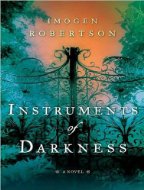
Instruments of Darkness

Robertson, Imogen. Instruments of Darkness: A Novel. New York: Pamela Dorman Books - Viking, 2011. Print.
[Book cover credit: librarything.com/work/8398153]

Booktalk:
This book opens with a body and a murder. In that order.

When Harriet Westerman finds a body on her property in the country, she rudely wakes up Crowther at some ungodly hour of the morning to help her investigate. News has spread that Crowther conducts research on human remains; he's convinced that the way a person lives and dies leaves marks on their body. In addition to the gash across its throat, this body has a ring bearing the crest of Harriet's neighbor in its vest pocket.

Meanwhile in London, Susan hears her father lamenting the loss of a ring that Jonathon, Susan's younger brother, liked to play with. The ring falls from her mind when she and Jonathon are witnesses to their father's murder in his music shop. Before dying, their father tells Susan to find a very important box hidden in the shop and asks Mr. Graves, a young family friend with hardly the means to support himself, to care for the children.

Review:
Instruments of Darkness is full missing heirs, hidden wills, unhinged trophy wives, absent husbands, headstrong women, shamed men, and more bodies to go with more murders. It's a fun and engrossing historical mystery that really has no dull moments. Even scenes away from the "action" had something to entertain: comedy in one story, grief and uncertainty in the other, drama and intrigue in both.

Ms. Robertson makes good use of the Georgian period in which she places her cast, using the Gordon riots heavily in one storyline and making the real John Hunter a connecting point between the two. For the most part, characters speak in that generic historical fiction kind of way that is unique to no period but "the past." This is good since real Georgian English would be a bit hard to follow, but I was a bit disappointed that there were a few phrases that stood out a modern. They weren't enough to pull me out of the story for long, but they stood out enough that I remember them. Additionally, though I loved Harriet, some of her boldness and forwardness seemed a bit too progressive for the time in which she lived. I don't know that I would have noticed, but put beside Susan, Miss Chase, and Harriet's own sister, Harriet is definitely a bit fiery.

Though this is an adult book, there is nothing in Instruments of Darkness to make it inappropriate for teen readers, though it is a bit light on the romance and heavy on the murder/mystery compared to comparable YA titles. Still, it is sure to be enjoyed by historical fiction and mystery readers and adored by those who revel in the combination of the two.


Book source: ARC provided by the publisher through the goodreads first reads program.

Links to Amazon.com may be affiliate links for the Amazon Associates program. If you buy something through this link, I may receive a referral fee.

Thursday, June 24, 2010

Beautiful Malice

James, Rebecca. Beautiful Malice: A Novel. New York: Bantam Books - Random House, 2010. Print.
[Book cover credit: librarything.com/work/9367605]

Booktalk:
After the violent death of her little sister Rachel, popular Katie Boydell reinvents herself as quiet, keeps-to-herself Katherine Patterson. Moving in with her aunt and changing high school for her senior year complete the transformation.

Until Alice.

Alice is one of those girls who acts as her own center of gravity, always in the center of everything and dragging you in. Katherine can't resist her, and Alice pulls Katherine into Life again. It looks like everything could be alright in a post-Rachel world. But then Alice starts to devolve. And she's determined to take Katherine down with her.

Review:
I don't know that it's meant to be read this way, but Beautiful Malice was a great mystery. The entire story is told in flashbacks. Katherine, an adult with a young daughter, is looking back on her senior year of high school when she met and knew Alice. Eventually her teenage self is remembering and telling Alice about the events leading up to Rachel's death. In both scenarios, the reader should, on some level, know how the story ends: Katherine grows up and has a child; Rachel dies. And yet, I never felt impatient waiting for that end to come. In fact, there were plenty of points in the senior year storyline when I was sure that things could not possibly end the way adult Katherine seemed to imply that they would. Moreover, when the endings finally did come they were plenty twisted, making them surprising even if they really do amount to Katherine growing up and having a child and Rachel dying.

The bulk of the story is set during Katherine's senior year of high school, specifically when she is befriended by Alice. Katherine is Katherine, rather than Katie, because she is trying to move on in her life past Rachel's death, but it is still a big part of her. It takes a really long time for Katherine to open up to anyone, including the reader, about what happened to Rachel, and yet I wasn't annoyed by not knowing. From almost the beginning, I knew Katherine was dealing with some serious survivor guilt, but as her recollections of Rachel slowly unfolded, it became clear that her guilt went beyond just the guilt of still being alive. Katherine feels truly responsible for Rachel's death, and because her story of what really happened the night Rachel died is so drawn out, it looks like she just might be. She's dealing with all of this while she slowly gets sucked into Alice's world.

Alice, by the way, is the mayor of crazytown. She's fun-crazy in the beginning, always managing to have alcohol and a party to go to (and an awesome dress to wear to it, and one for you to borrow besides). She lives in an apartment of her own, paid for by her birth mother who feels guilty that Alice was adopted by hicks. She seems so grown-up and exotic to Katherine, who used to be a more suburban version of her. Alice drags Katherine back into the social scene she should have always inhabited, introduces her to new people and experiences, gains her complete trust and (for a while) adoration, and then goes crazy-crazy. When Katherine stops worshiping the ground Alice walks on and gets her own friends, Alice becomes possessive and stalker-y. It's pretty scary, and the lengths she goes to (and why) left me speechless.

I think Beautiful Malice will be devoured by readers looking for more thriller in their mysteries, but be warned that though Alice and Katherine are teenagers for most of the story, they have very few "typical" teen experiences. They're never in school, they hang out in bars, and they date grown men. I'm not saying that this book is inappropriate, because really, there's nothing graphic or too "adult" going on, but it's certainly not set in high school, even if the main characters are technically high schoolers.


Beautiful Malice will be available for purchase next month!


Book source: Review copy from the publisher through the LibraryThing Early Reviewers program.

Tuesday, June 22, 2010

Stolen - for Tween Tuesday

Tween Tuesday was started over at Green Bean Teen Queen as away to highlight awesome books for the 9-12 yr olds or Tweens. Any book highlighted on Tween Tuesday also counts for the In the Middle Reading Challenge! This week's book is:


Velde, Vivian Vande. Stolen. Marshall Cavendish, 2008. Print.
[Book cover credit: librarything.com/work/5839124]

Awards:
South Carolina Junior Book Award Nominee (2010-2011)

Booktalk:
The simplest way to begin is to start at the ending: The girl's name was Isabelle.

This is the simplest way because in the beginning she had no name -- she was a girl with no name running through a forest she didn't know, for a reason she couldn't remember. She didn't know if she was running away from something or to something or for the simple joy of running
p.10
When Isabelle is chased into a tree by a pack of dogs, she realizes she probably is running from something; she just has no idea what that something is. She's brought into the village and told that she's probably running from the old witch in the woods. A baby was just stolen by the witch, so maybe, just maybe, the witch released the girl she stole six years ago. Her name was Isabelle.
 
Review:
Let me start off by saying that this book is never as spooky as the cover would suggest. There may be an old witch, and there is certainly rampant speculation about said witch and what she might do out there all alone in the forest, but this book isn't about her. It's about Isabelle. Also, there is someone a lot more scary than a witch, but that person is scary in a much different way than what the cover advertises. This person inspires a slow build of scary rather than a jump out and grab you scary. I say this because I certainly wouldn't have picked this book up when I was in late elementary/early middle school (I was kind of a wimp), but I probably would have really loved the story inside.
 
The girl who might be Isabelle gets thrown into a lot of drama, right from the get-go. She's bitten by a hunting dog that is looking for a witch. When she begins to recover from that, she has to tell the family that took her in that she remembers nothing about her own life. Just when she starts to come to terms with that, the folks who might be her family come to claim her. The newly stolen baby was their daughter as well. Their joy at having Isabelle back is tempered by worry about the baby. There is so much pain in this family; Isabelle wants to be their missing daughter, if only to allow them to avoid the pain of losing a daughter all over again. Then Isabelle meets Honey, possibly her older sister, and she can tell that whether Isabelle is the "real" Isabelle or not, Honey wants her family to have nothing to do with her.

Isabelle has some memory; she knows how to spin wool and she knows she was never a princess, for example. She can still navigate the world she's found herself in, even if she has no idea what her place is in it. Maybe because, at least in her head, she has no history with the people around her, she sees things about them that the rest of the village may not. She feels sorry for the mother and father (hers?) who have love two daughters to the witch, but she can see, where others do not, that this desperation to have Isabelle back isn't just the grasping hope of grieving parents. She can see that the rich aunt after whom Isabelle was named is lonely and desperate to have her namesake back. She sees that Honey isn't just suspicious of her, never believing her to be the true Isabelle, but that she doesn't believe that the "real" Isabelle is capable of coming back at all. And she sees that Avis, the woman who initially took her in, doesn't trust the lot of them. These insights don't always seem to help Isabelle figure things out as quickly as she should, but they are more interesting than simple, wide-eyed wonder at that is new around her.

There's a lot of intrigue in this little village that Isabelle must decipher if she's going to figure out who she really is. When it does finally come back to her, it all comes back in a rush (I mean for her. The writing isn't rushed). The ending is unbelievably clever. I had to rush back and reread the prologue to make sure it all fits together, because it is certainly not what I was expecting. It's awesome; I highly recommend it.


Book source: Philly Free Library

Tuesday, April 27, 2010

When You Reach Me - for Tween Tuesday

Tween Tuesday was started over at Green Bean Teen Queen as away to highlight awesome books for the 9-12 yr olds or Tweens. Any book highlighted on Tween Tuesday also counts for the In the Middle Reading Challenge! This week's book is:

Stead, Rebecca. When You Reach Me. New York: Wendy Lamb Books - Random House Children's Books, 2009. 
[Book cover credit: librarything.com/work/6802401]

Awards:
Amazon's Best Books of the Month (July, 2009)
Amazon's Best Books of the Year (2009)
Andre Norton Award Finalist (2009)
School Library Journal Best Book of the Year (2009)
ALA Best Books for Young Adults (2010)
ALA Notable Children's Book (2010)
and the grandaddy of middle grade awards:
Newbery Medal (2010)

Booktalk:
It's 1979 in New York City. Miranda (named after the rights) is a sixth grade latch-key kid whose favorite book is A Wrinkle in Time, whose best friend, Sal - also sixth grade and also latch-key, lives in the apartment downstairs, and whose mom is practicing to be on The $20,000 Pyramid, with the help of her (awesome) boyfriend Richard and Miranda herself.

And then Sal gets punched by a neighborhood kid and the letters start:
M,
This is hard. Harder than I expected, even with your help. But I have been practicing, and my preparations go well. I am coming to save your friend's life, and my own.
p.60
And then everything changes.


Review:
This is a great light mystery (with a bit of sci-fi thrown in) that I think will appeal to a wide variety of readers, including those who would never think of picking up a sci-fi book or a mystery. For most of the book, the story is just a regular story, with a bit of intrigue. No aliens, no men with dark mustaches, just a story about Miranda and how she has to get on when her best friend stops speaking to her for no reason. The relationships that Miranda, who has only ever really been friends with Sal, ends up forming with her classmates are what keep the book light-hearted in spite of the weird notes she keeps receiving. They are what keep everything normal.


At the same time, these relationships also highlight what is different. At school they are all just kids and they, for the most part, make friends easily. Outside of school, though they are still friends, they are very different. Miranda, whose hair is just brown and who gets stuck with hot pink construction paper for self-portraits, is the daughter of a single mom (as is Sal) who sometimes struggles to make ends meet, but they do alright. Annemarie lives in a building with a doorman and has an elevator that opens right to her apartment; her dad is always making her special snacks and her mom is always as work. Marcus receives free dental care at school because his family cannot afford it otherwise (46). Alice Evans is always really close to peeing her pants (she’s not in the “group,” and this is why). Julia travels the world with her parents and describes herself as “cafĂ© au lait” colored with eyes the color of “sixty-percent-cacao-chocolate” (34). We don’t get to learn much about Colin’s home situation because, well, he’s a boy and doesn’t invite Miranda over for a sleepover, nor is it blatantly evident from what happens at school. He’s just a goofy guy who gets along with everyone. Other than talking a lot about rushing rivers in front of Alice, the kids don’t care about any of this, except that Julia is a snob, having picked up her fancy names for light brown and brown (Miranda’s assessment of the situation) while learning about chocolate in Switzerland. Some of the adults, on the other hand, care a lot about this stuff. There is one big confrontation, caused by an adult, which starts out about Julia’s race and ends up being about Miranda’s lack of money. The way that the group handles it, without any intervention or input from the grown-ups, is possibly unrealistic, but it keeps things from getting too preachy. No one ever has to say, “Judging people based on their perceived race or financial status is wrong,” and yet the point is made very clearly.

And, of course, there are the letters and the mystery. I don’t want to say too much or give anything away. A large part of the fun while reading a mystery is trying to figure out whodunit, and When You Reach Me is no exception. There were definitely points when I thought I had something figured out and I was so frustrated with Miranda because she Just. Didn’t. Get. It., but when the end finally rolled around, there was so much more to it than I could have guessed.


Book source: Philly Free Library