Showing posts with label local library challenge. Show all posts

Wednesday, July 27, 2011

Almost Perfect

Katcher, Brian. Almost Perfect. New York: Delacorte Press - Random House Children's Books, 2009. Print.
[Book cover credit: librarything.com/work/8205913]

Awards:
ALA Best Books for Young Adults (2010)
ALA Quick Picks for Young Adult Readers (2010)ALA Rainbow List (Fiction, 2010)
ALA Stonewall Book Award (Children's and Young Adult Literature, 2010)

Booktalk:
     She turned to me. "Hi," she said. "I'm Sage Hendricks."
     Sage had a deep but sexy, feminine voice, the kind you hear on ads for 900 numbers. I waited for her to say something else.
     "Dude," whispered Tim, jabbing me with a chocolaty finger. "Your line."
p.18
As soon as she walked through the classroom door, Logan became enamored with Sage. But love is seldom without complications, and Sage's hard-to-get act is hiding a doozy of one.

Review:
Almost Perfect, how do I love thee? Let me count the ways.
I love thine characters in their complexity and their completeness,
From their talk of motorboating to their genuine concern for each other
They make me think of actual teenagers rather than teen-aged "types."
I love Tammi's fierce love for her sister, masquerading as aloofness:
Most quiet need to protect and hope at the same time.
I love Logan's mother, who has done her best in trying circumstances.
I love Logan's cool and supportive older sister (who tries to help him get laid).
Logan, I love thee. Insecurities and bravery and insecurities again
In situations never expected, and with grace unmatched by peers.
I love every characters' flaws; none is the pinnacle of righteousness or political correctness.
Sage, the object of Logan's affection and mine, shines as brightly as her braces.
She lives in the belief that the world can be better and love worth the risk;
And, if God choose, she is right.*


Seriously guys, this is an amazing book, and Brian Katcher is an amazing author.** That might explain why I've been waiting for my turn to read it from the library since it was announced as the winner of the Stonewall in January. It was more than worth the wait. Everyone has talked about the Big Issue that Almost Perfect addresses, but I have yet to see someone talk about how the issues (more than one, even) are in perfect balance with the flirting and the humor and the sexiness and the teenage-guy-ness of the book as a whole.

I loved it. You probably will too.


Book source: Philly Free Library (but I'm gonna go buy my own asap)


*  To Elizabeth Barrett Browning, I extend my greatest thanks for the inspiration. And my apologies.


** And also a practical genius! The standard has been set, folks, any author's note containing lists of websites that offer support to queer or genderqueer or drug addicted or suicidal or [insert thing you don't want your parents to know about here] kids should also contain detailed instructions for how to clear your cache history.

Links to Amazon.com may be affiliate links for the Amazon Associates program. If you buy something through this link, I may receive a referral fee.

Wednesday, July 13, 2011

Threads and Flames

Friesner, Esther. Threads and Flames. New York: Viking, 2010. Print.
[Book cover credit: librarything.com/work/9688825]

Booktalk:
Before Raisa even takes her first steps in NYC, she has managed to acquire a younger "sister," and she's managed to lose the older sister with whom she was supposed to live. Through the kindness of strangers, serendipity, and not a little bit of trial and error, she manages to get a great job that allows her to both support Brina, her younger sister, and look for Henda, her older sister. She's lucky; the Triangle Shirtwaist Factory is one of the best places a girl can work in 1911.

Review:
I think the best thing about Threads and Flames is that Friesner provides oodles of information and context without ever making me feel that I'm reading a book about the plight of immigrants or factory girls and how the injustices they faced lead to the tragedy of the Triangle fire.* I was simply reading an engaging story about Raisa's new life in America, complete with a little bit of mystery, a little bit of (the cutest without being the least bit saccharine) romance, and a whole lot of my-gumption-is-both-my-greatest-flaw-and-my-greatest-strength. And yet I finished the book knowing a lot about how the ill-treatment of immigrants in general and factory girls in particular created the perfect storm of awfulness that caused so many deaths in the fire.

While the book is undoubtedly about the Triangle fire, Raisa doesn't even start working at the Triangle Shirtwaist Factory until at least halfway through the book, maybe more. Usually, this delay of the "point" of the story would drive me batty, but in this instance, I didn't mind the wait. Raisa is such a fun character; she's so headstrong and determined to do what is right for her sisters, both Henda and Brina. It never occurs to her that she shouldn't take responsibility for Brina, even though she can barely take care of herself. I was rooting for her before she even got to Ellis Island. Raisa's little romance with Gavrel is also handled beautifully. When you're reading about Raisa who is on her own and working more than full time to make enough money to cover room and board for two people, it's easy to forget how young she is. Her relationship with Gavrel, however, with all of Raisa's do I or don't I feelings, constantly reminded me that she's just in her early teens. Their romance had all the little flutters of any middle grade romance, but with the added seriousness of two people, no matter how young, who work full time and both immediately start working even more when they "get serious." That's why they're both in the factory on the Saturday when it catches fire.

The fire itself is gruesome. The rush for the elevators after finding all the doors locked, the description of girls jumping from the windows rather than dying the flames, the display of unclaimed bodies that Raisa must search for Gavrel afterwards. The broken families who either found bodies to claim or were left with nothing. It's all so harsh. We see it all through Raisa who is still so determined to do what's right, who finds another job right away, and who becomes the strength and stability that Brina and Gavrel's family need in the fire's aftermath. Watching her continue on was possibly just as, if not more, heartbreaking as the fire itself. Slightly spoilery (highlight away): When the ending was happier than I would have expected, it did not feel like a cop-out on Friesner's part. I was just happy Raisa got a little bit of what she deserved. 

There was recently a request on the yalsa-bk list-serv for fiction books that teach the reader something. I wish I had finished reading this book in time to suggest it! Threads and Flames is so informative, but it's still great fiction too. I highly recommend it!


Book source: Philly Free Library


* This book reminded me very much of Annette Laing's books in that way. I kept wanting to re-read A Different Day to see how Raisa's factory experience differed (or in a lot of ways didn't) from Hannah's experience 50 years earlier and across the pond.

Links to Amazon.com may be affiliate links for the Amazon Associates program. If you buy something through this link, I may receive a referral fee.

Tuesday, July 5, 2011

Chime


Billingsley, Franny. Chime. New York: Dial Books - Penguin Books (USA) Inc., 2011. Print.
[Book cover credit: librarything.com/work/10284513]

Booktalk:
I've confessed to everything and I'd like to be hanged.

Now, if you please.
p.1
Briony's life consists of two main pursuits. She's spent her whole life trying to hide the fact that she's a witch. Better to keep her neck out of the noose. And since her stepmother died -- correction, since Briony killed her stepmother -- she's been taking care of her twin sister Rose. But lately Briony's been a bit conflicted. When Rose gets the swamp cough, a disease that is slowly killing off the town's children, Briony has a choice: she can let Rose die or she can deliver a message on behalf of the creatures of the swamp in return for Rose's health, revealing her witchy self in the process.

It's not as though she really has a choice.

Review:
Chime is an interesting twist on the current paranormal fare. It's set in an unspecified past when England is in a kind of transitional phase. The Old Ones are still around, but they're being pushed back into disappearing wild places, such as the swamp that is being drained behind Briony's home. Her little town with its busy pub across from the gallows and Briony, the beautiful daughter of the town preacher who's being pursued by a handsome but dumb local guy, were comfortably recognizable. The addition of Eldric, the handsome AND charming son of a family friend, made me think I knew what I was in for. In a good way.

But I was wrong. I had no idea what a treat I was in for when I met Briony. She's smart and sarcastic and employs just the right kind of self-depreciating-but-everyone-else-is-annoying-too humor. For example:
Cecil teased me to reveal my worldly knowledge, and I found amusing ways to sidestep his questions, and on we went with this for quite a while until it occurred to me that this is what is called flirting.
It's a tedious exercise.
p.177
Underneath her slick veneer, Briony has some real self-hate. She is both a witch and a preacher's kid, after all. Her self-loathing competes pretty heavily with her self-preservation instinct as Briony tries to figure out how to appease the Old Ones in her swamp to save Rose (who not only has done nothing wrong but whose problems Briony also places on her own shoulders) and save her own neck at the same time.

As if a great and fun yet complex main character/narrator weren't enough, there's Eldric who really is very charming and sweet and a worthy book crush. His interactions with Briony, especially their "fraternity," were really cute and fun, though their relationship was not without some very serious complications. Issues with Briony and Rose's father added real emotional depth to the story in ways that an emotionally and physically absent father is usually not able. And, of course, there's Rose. I prefer that you read about and fall in love with her for yourself. In short, Chime is just one good thing after another; I highly recommend it!


Book source: Philly Free Library


Links to Amazon.com may be affiliate links for the Amazon Associates program. If you buy something through this link, I may receive a referral fee.
Wednesday, May 25, 2011

Ballad: A Gathering of Faerie

Stiefvater, Maggie. Ballad: A Gathering of Faerie. Woodbury, Minn.: Flux - Llewellyn Publications, 2009. Print. A Gathering of Faerie 2.
[Book cover credit: librarything.com/work/8109101]

This review contains no spoilers for Lament, and the book really doesn't either. And yet, this isn't quite a stand-alone book. There are a few things, especially in the stressful climax of the action, that will be a bit confusing if you don't at least have a vague idea of the first book.

Booktalk:
When people said "musician," they never seemed to mean "bagpiper." If I heard the phrase "folk musician" one more time, I was going to hit someone.
p.5
James and Dee, both fully recovered from their summer shenanigans (at least physically), have been recruited by a prestigious music school, miles away from the faeries they're hoping to leave behind. It should be a wonderfully enjoyable, life-changing experience, right? Except it's not. They're both still reeling from the love-proclamation-that-never-was, and neither of them plays the "right" kind of music for their prestigious school. And the faeries have followed them.

You'd think two people as experienced in the practical consequences of faerie lore as James and Dee would have known they'd be surrounded by faeries at a school named Thornking Ash.

Review:
I love James. In fact, I capital "L" Love him. He's funny and snarky and smart and oh-so-flawed. He's also hopelessly stuck in the friend-zone, and the story he tells from way over there is both hilarious and tragic. That's right. This book is all about James. Even the parts of the story that are told from other points of view are all about James. It's great. He deserves it.

Ballad contains some serious faerie shizz. There's a wack-job wielding an iron crowbar, mysterious singing accompanied by a guy with horns growing out of his head (possibly king of something ;) ), teachers who wear iron jewelry, and the return of Eleanor, Lament's faerie queen, but what this book is really about is how James finally figures out that girls like him. At the opening of this book, his heart is continuing to break over Dee. Still, he finally allows himself to revel in the attention of another woman (and though it gets steamy in a few places, it's totally an intellectual romance). He also finally gets to have some guy friends, even if his closest buds consist of Paul, his oboe playing roommate, and Sullivan, his English teacher/dorm parent. Even at Thornking Ash and without Dee (who contributes with text messages never sent between chapters), James figures out how to be happy.

And this is a Stiefvater book. As you can see, this woman knows how to put words on a page. Her characters are all fully-fleshed people, many of whom I would die to eat Chinese take-out with on a Saturday night. They're funny and smart and a little nerdy. This would be a great book for John Green fans who want to ease into fantasy, or vice-versa.

So far, there's no word of another book in this series, but I still want to throw this out there: Stiefvater, if you're listening, the world could use more James.


Book source: Philly Free Library
Book 1: Lament: The Faerie Queen's Deception

Links to Amazon.com may be affiliate links for the Amazon Associates program. If you buy something through this link, I may receive a referral fee.

Monday, May 16, 2011

The Boy from Ilysies

North, Pearl. The Boy from Ilysies. New York: Tor Teen, 2010. Print. Libyrinth 2.
[Book cover credit: librarything.com/work/10545774]

Both Libyrinth and The Boy from Ilysies could be read as stand-alone books, in my opinion. There is nothing mind-blowing in this second book that will ruin the first for you, but if you're planning on reading Libyrinth (and I suggest that you do), you should probably skip this review.

Booktalk:
Culturally, the Libyrinth is a utopia. Libyrarians and Singers, Ilysians and Ayorites all get along and work together. But they're still starving, and there are still growing pains. Po, the only Ilysian male, is feeling the latter acutely. He misses the green, fertile land of his youth, but more than that he misses living in a society where he knows what is expected of him.

Review:
I guess when I read Libyrinth I missed something key about Ilysies. I knew it was a matriarchal society, but I failed to notice that men are greatly outnumbered and treated as second class citizens. Things like that happen, I guess, when you're worrying about the torture of one protag and the budding romance between the other two. It is this second class status that has Po all mixed up in The Boy from Ilysies. Not only is he having problems thinking of Princess, I mean, Libyrarian Selene as just one of the girls and no more than anyone else, but he's also having trouble seeing himself as no less than. He's used to serving women like Selene, not working alongside them, and he's used to being emotionally taken care of, in return, by a matriarchal figure. All of this equality has left him feeling very alone and unsupported.

Much of the book is spent on this dilemma. It's interesting and important and turns gender stereotypes on their heads, but it wasn't what I was looking for in a sequel to the action-packed, literature-rich, POC and LGBTQ-featuring Libyrinth. I wanted more action than intrigue, more of Clauda's brashness and less of Po's confusion, more of the books' wisdom and less erections as feelings, more of the look-how-I've-grown Selene and less of the back-to-the-beginning Selene, more Nod(s), more Haly, and for the love, more Clauda AND Selene. When Po finally left on a quest, along with former Censor Siblea, Selene*, and a few others, I was so happy. I just wish that moment had come before I was halfway through the book.

But that second half of the book was totally worth it for me. The above group sets out for the former Singer headquarters to look for a tool from the legends of every major cultures' folklore that will hopefully make the land around the libyrinth fertile enough to support the community living there. Of course, when they get there, things do not go as planned, but in the course of the search and the fighting, we find out more about the foundations of the Singers' society. Their (former) reasoning behind the fear and demonization of the written word isn't exactly spelled out, but it makes a lot more sense now. Their still present culture of abuse and neglect of women also butts up against Po's sensibilities in a way that makes him take action rather than wallow in confusion and self-pity. The trip is also filled with danger, suspense, a cute but damaged girl for Po, and a cliff-hanger of an ending. I'm re-sucked in to this trilogy (or series?) an eagerly awaiting the as yet untitled Book 3. 


Book source: Philly Free Library


*without Clauda! Have they really never gotten together? Were they together and have since broken up? Are they together but trying to keep things hush-hush? WHO KNOWS? We get to hear (a tiny bit) about Haly and her boyfriend from the first book. Why no follow-up on Clauda and Selene's relationship, North?


Links to Amazon.com may be affiliate links for the Amazon Associates program. If you buy something through this link, I may receive a referral fee.
Wednesday, April 20, 2011

Guardian of the Dead

Healey, Karen. Guardian of the Dead. New York: Little, Brown and Company, 2010. Print.
[Book cover credit: librarything.com/work/8574661]

Awards:
ALA Best Fiction for Young Adults (2011)
William C. Morris YA Debut Finalist (2011)

Booktalk:
Ellie can't seem to get control of her life lately. She's let her best friend Kevin "convince" her to drink on school nights and even to let him sleep in her room. She's made a fool of herself in front of the guy of her dreams, Mark (did she somehow mistake her secret fantasy that he actually wanted to interact with her for real life?). She's even starting to get along with Iris, Kevin's other best friend. And, as if that wasn't bad enough, she has a nagging feeling that the Eyelasher killings that have been terrorizing the North Island have something to do with her. This feeling goes way beyond the connection that everyone who's lived on the North Island feels to the murders, and that feeling might have something to do with Mark. Unless that's just her fantasy life invading reality again.

Review:
There is a lot to love about Guardian of the Dead. Here's the shortlist:
  • a smart, kind of nerdy heroine
  • the freedom/restrictions of boarding school
  • use and explanation of Maori myth (by a white author who has the balls to point out in the text the colonial nature, possible inaccuracies, and just plain wrongness of Maori myth written down by white people)
  • high school use of a university library, because serious shizz calls for serious research
  • patupaiarehe (fairy-type creatures), one of whom is Titiana in Iris's production of A Midsummer Night's Dream -- because I'm not the only one who likes art to imitate life
  • casual treatment of varying sexualities*
  • a hottie who is half-Maori, half-...well, something else
and I could go on. But do you want to know what I loved the absolute most about this book? The ending. I won't go into detail (or talk about the "action" ending) because I don't want to ruin it for you (cause oh-my-gosh is it cool), but I can still tell you why I love this ending.

Things go crazy, Ellie falls in lurv which may become love in the future, and Ellie and love-interest have to save the world. It's life-changing, obviously, but Ellie doesn't let it derail her life completely. She doesn't possibly blow off her art school application or get married right out of high school or ditch her best friend in the face of tru lurv and harsh circumstances or even, and this is the big one, drop out of school in order to save the world which apparently cuts off the possibility of being a brilliant academic and instead becomes a mostly silent side-character.**

Instead, Ellie keeps going, gets excited about going to college and majoring in Classics, and tells love-interest that she'll visit him when she's on break. She simply takes all that she's learned from these life-changing events with her, because that's what smart girls do.

So, if you want to read an urban fantasy (a little light on the urban grit) or paranormal romance (a little light on the romance) that's headed by a smart girl, this is your book. It's also your book if you want to read the Maori Percy Jackson equivalent, a good boarding school romp, a murder mystery, a different kind of fairy book...


Book source: Philly Free Library


*How often do you see YA books with a teen character who is asexual? Not often. I'm not going to lie and say it's not a big deal at any point, but it is not THE big deal. And it is not a problem ever, except to the people crushing on the character. :)

**Was this anyone else's take-away message from Hermione's whole 1 or 2 lines in that horrible epilogue?!? I know Ginnie's important and everything, especially cause she's the mother of Harry's children, but why does she get all the speaking parts? Since when does Hermione let everyone around her do all the talking?

Links to Amazon.com may be affiliate links for the Amazon Associates program. If you buy something through this link, I may receive a referral fee.
Wednesday, April 13, 2011

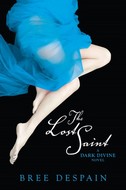
The Lost Saint

Depain, Bree. The Lost Saint. New York: Egmont USA, 2011. Print. A Dark Divine Novel 2.
[Book cover credit: librarything.com/work/9903924]

Not only will this not make much sense if you haven't read The Dark Divine, but it will spoil the crap out of the last chapter for you. You've been warned!

Booktalk:
     "Oh. My. Gosh." April shouted so loud I slammed on the breaks, thinking we were about to hit a dog or something. But April bounced in her seat with the craziest smile on her face, like she'd just thought of the best idea since nail polish. "...I have to ask: if you're gonna be a superhero, can I be your sidekick?"
p.111
Now that Grace is the one with superhuman abilities, Daniel is trying (mostly in vain) to get her to keep her powers and emotions in check so that the wolf doesn't take control. But calm and controlled is not what Grace wants. She wants to be out fighting the evils of the world, rescuing damsels in distress, thwarting demons and saving Jude. And if she has to embrace the power the wolf gives her in order to do that, she will. The fact that the hot new guy in town is willing to train her in ways that Daniel is not has nothing to do with it. Right?

Review:
I'm going to start out by saying that, while I loved the first book, I was not DYING to read The Lost Saint. I was interested, looking forward to it, and knew I would love it, but the first book did not leave me with that unquenchable need (as a result of a too-late-in-the-story twist or cliff-hanger) to pick up the next book in the series. I knew that nothing horrible would happen to Grace, Daniel, or even Jude before I met them again.

Well, I'm clawing my eyes out now waiting for the still untitled third book in the series. I tore through the last chapter and was half a paragraph into the acknowledgements before it hit me: I have to wait until December to find out what happens next. Oh, the agony!

Where The Dark Divine had mystery and the unknown (and one of my favorite romances in the paranormal genre) to move it forward, this has an overall feeling of doom and dread to push the story along (and a rift in my favorite romance). Despain does not fall into the paranormal trap of making either Grace (the girl) or Daniel (the love interest of the paranormal) helpless or unable to read the hints right in front of them, but there were still plenty of moments where I just knew that Grace was Going the Wrong Way, and just like while watching a horror movie, I could do nothing but yell at her through the pages and watch her go. Her little tiffs with Daniel that turned into petty I'm-not-speaking-to-you problems that turned into secrets kept were believable and painful. They also made her vulnerable, and that vulnerability made her trust people she shouldn't have. And that, of course, gets everyone in trouble.

The upside to all of this is the return of April. And, well, she's just awesome. From her superhero aspirations to her wink-wink-nudge-nudge secret keeping to her inability to not see the upside of everything Grace is going through, she made this book for me. This is what I absolutely love about Despain's writing and why I will keep reading anything she puts out. There is so much about these books and others like them that is serious and stressful (in a good way), but she so far she has managed to put in something to balance it, and it is not a serious and dramatic love story where no one smiles but instead gazes. In the first book, it was the happy flashbacks to Grace and Daniel's childhood together and the fluttery first love between them. In this book, it is April's excitability and the rekindling of Grace's friendship with her. These additions help to pace the story and help to create well-rounded characters (did I mention that April is designing Grace a superhero outfit as part of her art school application?). The world does not fall away in the face of the Despain's werewolves; they exist in it.

And I can't wait to see what they do next!!!


Book source: Philly Free Library


Links to Amazon.com may be affiliate links for the Amazon Associates program. If you buy something through this link, I may receive a referral fee.

Tuesday, March 29, 2011

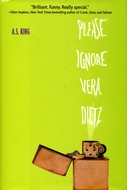
Please Ignore Vera Dietz

King, A.S. Please Ignore Vera Dietz. New York: Alfred A. Knopf, 2010. Print.
[Book cover credit: librarything.com/work/9822588]

Awards:
ALA Best Fiction for Young Adults (2011)
Edgar Award Nominee, Young Adult (2011)
Printz Honor (2011)

Booktalk:
Kid bullying you at school? Ignore him. Girl passing rumors? Ignore her. Eighth-grade teacher pinch your friend's ass? Ignore it. Sexist geometry teacher says girls shouldn't go to college because they will only ever pop out babies and get fat? Ignore him. Hear that a girl in your class is being abused by her stepfather and had to go to the clinic? Hear she's bringing her mother's pills to school and selling them to pay for it? Ignore. Ignore. Ignore. Mind your own business. Don't make waves. Fly under the radar.
p.43-4
And while you're busy taking that advice and ignoring everything else that's going wrong, Please Ignore Vera Dietz too.

Review:
Ever since her best friend Charlie died, Vera's had a hard time dealing with life. Wait, back up. Ever since Charlie ditched Vera for the detentionheads (and THEN died), Vera's had a hard time dealing with life. And her dad, the biggest proponent of the "just ignore it" philosophy, is slow to notice, or at least slow to show Vera that he's noticing. And somehow Vera is stuck living life as a full-time high school student/full-time pizza delivery technician.

Even describing the book is a little confusing and wrapped up in itself. But King pulls it off in a way that only she can, by allowing the pagoda on the hill (yes, a building), Vera's dad, and Vera's dead best friend to all weigh in, along with Vera herself, on Vera's life. Through their joint narration, we get a glimpse of the real Vera (and the real Charlie and the real Vera's Dad). They're all flawed. There are no knights (or supernatural beings of your choice) in shining armor here. They're all just trying to make it through. Even Charlie, who is doing so from beyond the grave.

Though this is part mystery (we know Charlie's dead, but we don't know how or why), part "issue" book (Vera drinks a lot, much to the concern of her recovering alcoholic dad), part dangerous relationship (1-Vera's crush is in his twenties. 2-the flashbacks contain a guy who wants to take grade school Vera and Charlie's pictures. 3-Vera is herself the product of a young high school romance gone wrong), it is mostly a darkly funny book about grief. Everyone, except maybe the pagoda, is grieving someone. It's the way that they each deal with their grief, Vera and Charlie over the loss of each other and their friendship, Vera and her dad over the abandonment by Vera's mom, that makes this such a compelling book. There is plenty of the weird, the funny, the snarkiness, and the romance to keep the book fun, but it is the way that Vera et. al. deal with the more serious aspects that made me care about them.

It sounds all over the place, and I wish I could write a more coherent/convincing review. You'll just have to trust me that Please Ignore Vera Dietz is one that you really should pick up. Either that or check out the multitude of positive reviews already out there. We can't all be wrong.


Book source: Philly Free Library (Though I've finally convinced my director that as an academic library that (1) religiously collects Newberry and Caldecott winners/honors and (2) is serving a school with a Master of Education program that has a high school English track, we should also collect Printz winners/honors, so we have a copy at work too!)

Links to Amazon.com may be affiliate links for the Amazon Associates program. If you buy something through this link, I may receive a referral fee.

Friday, March 18, 2011

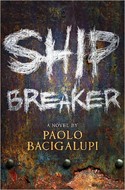
Ship Breaker

Bacigalupi, Paolo. Ship Breaker: A Novel. New York: Little, Brown and Company, 2010. Print.
[Book cover credit: librarything.com/work/9160869]

Awards:
Andre Norton Award Finalist (2010)
National Book Award Finalist, Young People's Literature (2010)
ALA Best Fiction for Young Adults (2011)
Printz Award (2011)

Booktalk:
While scavenging in an old ocean tanker, Nailer falls into a vat of oil, still black gold in his world years upon years ahead of ours. In order to survive, he has to watch all of that oil wash into the ocean. Still, he's lucky to be alive. He thinks his luck is going to give him a second chance when he and Pima find a clipper washed up on shore after a city wrecker of a storm. It's full of silver, gold, and other valuables in addition to regular old copper and steel scavenge. It's their own lucky strike. Until the dead swank in one of the clipper's cabins blinks.

Review:
The world in which Nailer lives and works is brutal. He and his friend Pima are on light crew which means they pick light scavenge from old ships, primarily pulling copper wire from small utility ducts. This is opposed to heavy crew, where Pima's mother works pulling steel and other valuable metals from the same ships. These are the only good options in life. The only others are to become professional fighters who moonlight as security (like Nailer's dad), sell of body parts and/or fluids, or become some version of a prostitute. Basically, even though Nailer is doing dangerous and backbreaking work that almost gets him killed, he was lucky even before he survived his dip in the oil. He's also 15. Nailer's background and, really, his entire society make his decision to help Nita (the swank) more amazing. And it's that decision, so contrary to the way he's been taught to survive, that create an adventure story in the middle of a dystopian world.

I think one of the most amazing things about Ship Breaker, for me at least, is they way Bacigalupi accomplishes his world-building. This is a seriously complex world full of swanks, ship breakers, beach rats, half-men, and all the cultural implications these groups carry with them. Bacigalupi manages to explain all of this without ever sitting the reader down and explaining all of it, yet I was amazingly un-lost throughout the story. The world he builds is still our world too. Nailer lives on the Gulf Coast and takes a train that carries him over the drowned city of New Orleans. We can recognize leftovers from our day and age. It's clear that some kind of environmental fall-out has occured (in addition to a severe lack of oil and a submerged New Orleans, traders can sail right over the Arctic Circle), but the details of how we got from here to there are never explained, leaving the reader to put 2 and 2 together. No heavy-handed environmental message required (or present).

Ship Breaker is, at times, a very bleak book portraying a society in which each person is practically required to step over someone else to survive. Getting ahead is a pipe dream. But, like many other dystopian novels, its points of light that make the story. This is the kind of book that can stress you out (in a good way) while reading, and it will be a hit with your dystopia fans. My library is also adding it to our Environmental Justice bibliography for next year's incoming freshmen.


There is talk of a sequel, The Drowned Cities, but it's not showing up yet on the publisher's website, only on GoodReads.


Book source: Philly Free Library


Links to Amazon.com may be affiliate links for the Amazon Associates program. If you buy something through this link, I may receive a referral fee.

Tuesday, March 8, 2011

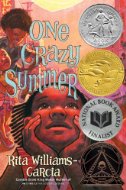
One Crazy Summer - for Tween Tuesday

Tween Tuesday was started over at Green Bean Teen Queen as away to highlight awesome books for the 9-12 yr olds or Tweens. This week's book is:


Williams-Garcia, Rita. One Crazy Summer. New York: Amistad - HarperCollins Publishers, 2010. Print.
[Book cover credit: librarything.com/work/9160752]

Awards:
National Book Award Finalist, Young People's Literature (2010)
Coretta Scott King Award, Author (2011)
Newberry Honor (2011)
Scott O'Dell Award for Historical Fiction (2011)

Booktalk:
     Mother is a statement of fact.
...
     Mommy gets up to give you a glass of water in the middle of the night. Mom invites your friends inside when it's raining. Mama burns your ears with the hot comb to make your hair look pretty for class picture day. Ma is sore and worn out from wringing your wet clothes and hanging them to dry; Ma need peace and quiet at the end of the day.
     We don't have one of those. We have a statement of fact.
p.14

It is not without a little trepidation that Delphine boards a plane with her little sisters to visit their mother in Oakland, California. When they get there, they're presented with a single room to share and told to walk themselves to get their own Chinese take-out for dinner. The end of their 28 day stay could not come soon enough.

Review:
This is a book that I want to tell you all about in quotes, because even in soundbites, it's so so good.

     My sisters and I had stayed up practically all night California dreaming about what seemed like the other side of the world. We saw ourselves riding wild waves on surfboards, picking oranges and apples off fruit trees, filling out autograph books with signatures from movie stars we'd see in soda shops. Even better, we saw ourselves going to Disneyland.
p.3
But they don't go to Disneyland just like they don't find a Mom or a Mommy in Oakland. They go to Black Panther Summer Camp. Delphine, Vonetta and Fern learn about the movement, about the Panthers themselves (who they've only seen in news stories), and about each other. Delphine, the only of the three who remembers her to begin with, also gets to learn about the mother that abandoned them.

But, as Liz B. points out, this isn't necessarily a book about the Black Panthers or the 60s or even finding a mother. This is mostly a sister book. There's Fern, the baby, who has carried around a (white) baby doll for as long as anyone can remember and is always ready to throw out a "surely" in support of her sisters. Vonetta constantly seeks attention like the middle child she is, and she's desperate to make friends with the most fashionable girls at camp, even at the expense of her sisters. Then there's Delphine. She promised her Pa she would take care of her older sisters, like she always has, and it's her job to keep them out of trouble (and keep them from killing each other). She's saved up money to pay the fines on the books she checked out from the library to read to her sisters each night before bed. She plans activities for the three of them to do in order to make the most of their trip to California (I looked forward to their field trip to San Francisco almost as much as Delphine did). She tries to stand in between her sisters and her mother; she remembers how crazy her mother can get. She's the leader.
     She gave another "Hmp" and a headshake. "We're trying to break yokes. You're trying to make one for yourself. If you knew what I know, seen what I've seen, you wouldn't be so quick to pull the plow."
     I sort of knew what she meant, but someone had to look out for Vonetta and Fern while we were here.
     I stacked the plates in the sink and ran the hot water.
     "It wouldn't kill you to be selfish, Delphine," she said, and moved me out of the way to wash her hands. Then she went back to praying over her puzzle pieces.
p.110
It's Delphine, Vonetta and Fern, their relationship and interactions, that drive the story. They help each other get through what looks like a horrible situation until it becomes kind of fun. Together they're the Gaither sisters. They finish each others sentences, each knows just how to get under the other two's skin, and though they take sides two against one all the time, they all always stand up for each other in the end.

Though the story is, clearly, centered around Delphine and her sisters, the "supporting cast" is fleshed out and important. There are tons of people at the People's Center while the girls are at camp, but their teacher Sister Mukumbu, who Delphine recognizes as a "real teacher" right away, lends the tiny bit of normalcy that Delphine needs to settle into the camp and Oakland. There's also a boy, Hirohito. Though it's no where near a major storyline, I loved the awkward crushing that went on all around him. And, of course, there is the girls' mother. As the story progresses, she becomes more of a real person than the dismissive, nervous woman who picked them up (late) from the airport. We also find out just how much Delphine remembers about her and how much she misses having a mother (even if she won't admit it). The relationship between Delphine and Cecile (their mother) is built on more understanding than either of them want to admit, and watching it unfold was one of the most moving parts of this story.

Overall, One Crazy Summer was a wonderful book and totally deserving of it's numerous awards! It has it all: history, humor, emotion, drama, and annoying but lovable little sisters!


Book source: Philly Free Library


Links to Amazon.com may be affiliate links for the Amazon Associates program. If you buy something through this link, I may receive a referral fee.

Tuesday, March 1, 2011

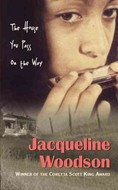
The House You Pass on the Way

Woodson, Jacqueline. The House You Pass on the Way. New York: Speak - Penguin Group (USA) Inc., 1997. Print.
[Book cover credit: librarything.com/work/248239]

Awards:
ALA Popular Paperbacks for Young Adults, GLBTQ (2006)
Lambda Literary Award, Children's and Young Adult (1997)

Booktalk:
Staggerlee has never had many friends. Her classmates think she's stuck-up, her ex-best friend ditched her when she found out about Staggerlee's famous grandparents, even her older brother, Charlie Horse, has left home and Staggerlee to go to college. Now, at least for the summer, she has Trout. Will she, too, leave Staggerlee behind? Staggerlee, who always stays in The House You Pass on the Way to somewhere else.

Review:
I'm always amazed by how quickly I get sucked in to Jacqueline Woodson's books. The House You Pass on the Way is barley over 100 pages, and yet it is full of growth, a well-rounded cast of characters, and so  much emotion. It even covers enough time to be both a little bluesy and a little hopeful at the same time. It's the perfect book for a rainy afternoon.

Staggerlee is kind of a loner, and, for the most part, she likes it that way. It gives her space to think and to play her music. In a town that is mostly Black, her mother is white. The statue in the center of town is of her grandparents, and it marks Staggerlee and the rest of her family as "special," something her classmates see as "better than." Also, we find out early on, Staggerlee was in love (in a sixth grade kind of way) with her ex-best friend Hazel. She has no words to describe the feeling she had for Hazel, but she knows she should keep them a secret. She feels different and out of place in her small town.
She looked so different from everyone. Her clothes, the thick-soled hiking boots, her hair. And she felt different too--off-step somehow, on the outside. What did it sound like, Staggerlee wondered, having someone call your name across a crowded school yard? How did it feel to turn to the sound of your name, to see some smiling face or waving hand and know it was for you and you alone?
p.43
And this is where Staggerlee's cousin Trout comes in. They understand each other in more ways than they could have predicted at the beginning of their summer together. They spend that crazy, transformative summer between middle school and high school together, and they each gain from the other the strength to figure out who they really may be.

Though the circumstances may not be universal, Staggerlee's feeling of being on the outside is something just about everyone has experienced at one time or another, and her friendship with Trout, the way it helps Staggerlee to define herself and the vulnerability that creates, is beautifully rendered in the text. Even though The House You Pass on the Way can be read as an overall sad book, the melancholy is never overwhelming. And the writing, oh the writing, is so lyrical, emotional, and just plain gorgeous.


I can't remember who suggested this book on the yalsa-bk listserv. I also can't remember if it what suggested to someone looking for books about African American teens in non-urban settings or someone looking for LGBTQ titles. The House You Pass on the Way would fit nicely on either list (yay!).


Book source: Philly Free Library


Links to Amazon.com may be affiliate links for the Amazon Associates program. If you buy something through this link, I may receive a referral fee.

Friday, February 18, 2011

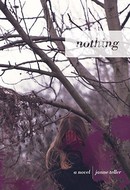
Nothing

Teller, Janne. Nothing. Trans. Martin Aitken. New York: Atheneum Books for Young Readers, 2010. Print.
[Book cover credit: librarything.com/work/1567168]

Awards:
ALA Best Fiction for Young Adults (2011)
Batchelder Honor (2011)
Printz Honor (2011)

Booktalk:
Pierre Anthon has decided that nothing matters. He's also decided to sit in a plum tree and harrass his former classmates until they come to the same conclusion. They have to make him stop. They have to show him that there is something that still holds meaning. In order to do so, they each must sacrifice something that holds a great deal of meaning to them.

Review:
Disturbing does not even begin to cover it.

Nothing is a tiny book. It's shorter than most and more narrow. The story takes up slightly more than 200 pages, and those pages contain a lot of white space. Still, it is probably the most disturbing book I've ever read. And almost not even in a good way. Don't get me wrong, Nothing is a wonderfully written book. Not a single word is superfluous and yet the story feels expansive. We see the whole thing from Agnes' point of view, and yet the feelings of others and the crowd mentality of the group are clear. It's got a kind of terrible, terrifying beauty to it. As one LibraryThing reviewer said, "There is no age appropriate for this book."

As Agnes and her classmates try to collect things to counter Pierre Anthon's nothingness, things take a definite turn towards the sinister. If they're going to prove meaning, these things must really mean something to the person who has to give them up. And each time someone has to give something up, they get to choose what the next person has to lose:
When Dennis had first handed over the last four of his Dungeons & Dragons books, it was as if the meaning started to take off. Dennis knew how found Sebastian was of his fishing rod. And Sebastian knew that Richard had a thing about his black soccer ball. And Richard noticed how Laura always wore the same African parrot earrings.
p.35
This accumulation of things starts out as mean and a bit vindictive, but it very quickly spirals out of control until it is not just things that are being accumulated. Friendships break up, kids get in trouble, alliances are formed, and people get both emotionally and physically hurt.

Watching what these kids require of their friends and classmates, what they deam worthy sacrifices to the "heap of meaning," was like driving past a multiple car pile-up on the freeway. It's gruesome and terrible, but you can't help but look. I finished this book in a single day, holding my hand over my gaping mouth for the last 50 pages or so (and more than a few times before that as well). I was repulsed and hooked at the same time. This is an engrossing and haunting read.


Book source: Philly Free Library

Links to Amazon.com may be affiliate links for the Amazon Associates program. If you buy something through this link, I may receive a referral fee.

Tuesday, February 15, 2011

Hold Me Closer, Necromancer

McBride, Lish. Hold Me Closer, Necromancer. New York: Henry Holt and Company, 2010. Print.
[Book cover credit: librarything.com/work/9880508]

Awards:
ALA Best Fiction for Young Adults (2011)
William C. Morris YA Debut Finalist (2011)
Booktalk:
     "You even smell a little like him," he said, his voice going throaty.
     Disturbing. Was it good to smell like someone else? I reached out cautiously and put my hands over his, leveraging for a bit of breathing room. "Like who?" I choked out. Buff Guy had a fierce grip [on my neck].
     "Like the grave," he said, not really answering my question. "Like cold death."
     "Thanks," I said. Creepy, creepy, creepy. I didn't add that he smelled like meat. Not that I could. Apparently, choking helped me keep my mouth shut and mind my manners. I wished he'd put me back down. Or that Ramon and Frank would rush him from behind. Then he'd have the opportunity to strangle all of us. I needed to get bigger friends.
     "And blood," he said. "You smell like blood."
p.22-3
Sam has pissed off the wrong guy. A guy who unnerves Sam for reasons he can't explain. A guy who radiates evil and power in equal measures. A guy who employs a very large, slightly unhinged henchman. But Sam is not going to go down without a fight, and he'll be damned if he lets this guy take his family and friends out with him. Unfortunately, it's starting to look like Sam might be damned already.

Review:
Hold Me Closer, Necromancer is a hilarious book, but it's still horror. When I was thinking about this review, I knew I wanted to include a quote that showed both at once. I found this one by opening the book to a random spot near the beginning. That's how much the humor and terror go hand in hand throughout the novel. The hilarity keeps the book from getting too too scary, but the story still never loses it's dark and serious edge. It's awesome.

For me, though, the funny stuff won. I laughed out loud (on a quiet commuter train, no less) while reading this book. Sam's a smart and introspective college drop-out, Brooke's a manipulative smartypants (and I mean that in the most flattering way possible) in a cheerleader's body, Ramon's still in college and living on Sam's couch, and Frank's the new kid that they're all trying to break and/or befriend. What they have in common is their cynicism, irreverence, and fast food employer. They are masters of biting and witty one-liners, exactly my kind of humor. Ramon, Frank and Brooke do their best to make sure that Sam stays firmly grounded in his regular life even though he's being pursued by creatures he's not sure he even believes exist.

And that's where the horror part kicks in. The evil guy, Douglas Montgomery, is a ridiculously powerful necromancer, and he thinks Sam is a necromancer too. The guy in the quote above? Sam isn't quite sure WHAT he is, but he's left huge cuts down Sam's back that could only have come from a knife. Only no one saw a knife. Within the first 50 pages, someone we already care about is dead. Without getting too spoilerly, let me just say that necromancers are not the only magical/paranormal beings to grace these pages. There are werewolves, fae, witches, vampires and more. Oh, and Douglas's house comes complete with a magical cage and basement torture chamber.

This is one that I think is more suited to older teens. Sam is out of high school and has already nixed college, and  his "normal" life problems reflect that. That's not to say that the average high schooler won't love this book. It is darkly humorous, scary, and Sam and co. exhibit the kind of sarcasm and cynicism to which many in high school aspire (myself included, at that age). And Sam is stuck in the stage of life where he is trying to find himself, something that is highly relatable for many teens and twenty-somethings. He's just got the added pressure of "to raise the dead or not to raise the dead" making everything more interesting. I loved it.


I mentioned the internal musical loop this title can inspire, but luckily the chapter titles mix it up a bit. Leah's got a series of posts going to help you place the song lyrics.


Book source: Philly Free Library

Links to Amazon.com may be affiliate links for the Amazon Associates program. If you buy something through this link, I may receive a referral fee.

Friday, January 28, 2011

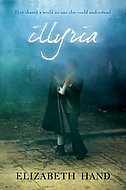
Illyria

Hand, Elizabeth. Illyria. New York: Viking, 2010. Print.
[Book cover credit: librarything.com/work/2569090]

Awards:
Shirley Jackson Award Finalist (Novella, 2007)
World Fantasy Award (Novella, 2008)

Booktalk:
No one had ever heard of DNA back then, not in my family anyway, and our grasp of genetics was practically nonexistent. But, because our fathers were identical twins, their children had all been told -- warned -- that we were closer than the other cousins.
"More like stepchildren," said Aunt Dita.
"Half-brothers and -sisters," my mother corrected her.
"Kissing cousins," said Aunt Roz. That would be the cue for everyone to cast a cold eye upon Rogan and me.
p. 8-9

Review:
Illyria feels like it's set in some make-believe world where eccentric aunts never age, miniature theatres come to life, every house has a ghost light, and where Maddy's childhood crush on her cousin Rogan can turn into a not-so-secret love affair. But it's not. Maddy and Rogan's story takes place in a cul-de-sac in a town outside New York City populated by the descendants of a once well-known actress. But that doesn't keep any of the above from being true. Hand just makes it all seem surreal.

In this not quite a fantasy world, the ick factor of Maddy and Rogan's relationship is missing. There is disapproval from the family and their classmates make fun of them, but their romance is just another (doomed) romance. And it is doomed, right from the beginning, and not just because they're cousins. There is something off about Rogan, something that sets him apart from everyone else, and it's what attracts Maddy to him. It haunts the entire story in the beautiful way that it haunts Maddy. It stays with you.

I know I'm not doing this book justice, but that's hard to do with my overwhelming book crush! Seriously, everything about this book is lyrical, magical, gorgeous. But just in case you're interested, here are a few more reviews from:

Liz @ A Chair, A Fireplace & A Tea Cozy
Jenny @ Forever Young Adult
Tasha @ Kids Lit (Menasha Public Library)


Book source: Philly Free Library

Links to Amazon.com may be affiliate links for the Amazon Associates program. If you buy something through this link, I may receive a referral fee.

Tuesday, December 7, 2010

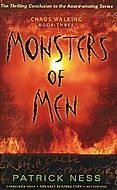
Monsters of Men

Ness, Patrick. Monsters of Men. Somerville, Mass.: Candlewick Press, 2010. Print. Chaos Walking 3.
[Book cover credit: librarything.com/work/9116020]


As I've said before, Ness doesn't do nice little catch-up spots in the openings of his book, and all his books end on HUGE CLIFFHANGERS (even, to some extent, this one). So, while I have tried to avoid them at all costs, this review has some spoilers for the previous two books. Don't read this if you haven't already read The Knife of Never Letting Go and The Ask and the Answer. But really, if you haven't started reading this trilogy, you should. The entire thing is heart-wrenchingly wonderful (though pretty freaking violent).


Booktalk:
"And what other kind of man would you want leading you into battle?" he [the Mayor] says, reading my Noise. "What kind of man is suitable for war?"
A monster, I think, remembering what Ben told me once. War makes monsters of men.
"Wrong," says the Mayor. "It's war that makes us men in the first place. Until there's war, we are only children."
p.11

Monsters of men, I think. And women.
p.287

Review:
Reading this book is like getting punched in the stomach. In a good way. And if I learned anything from Monsters of Men, it is that there is, in fact, a good way. It's basically when you're keeping someone else from getting decked, or when you're getting pummelled to protect the one you love.

Monsters of Men was the most satisfying end to a series or trilogy that I've read in a long time. A really long time. Like the previous books, the plot runs at a breakneck pace that left me breathless, and it covers a lot of ground. Coming into the book I couldn't have even imagined things that happened in the middle, let alone how it would end. There are a lot of loose ends that are tied up over the course of the book, but ending is not finite. I don't think Ness will be writing another book in this world or with these characters anytime soon (ever), but the ending is open to possibility and to the imagination of the reader. This book is full of passion, action, and general umph.

I know I'm being really vague, but I think the best way to read these books is to go in blind.

And, word to the wise, it can reduce just about anyone to a sobbing mess. There were a few moments in the beginning that had me looking out the train window and blinking a lot during my commute, but the real stuff is saved for the end. I wouldn't advise that anyone read beyond page 400 or so outside of the comfort of their own home. We're talking hug the book, can't see through the tears crying for the last 100 pages. But oh-so-good!


Book 1: The Knife of Never Letting Go
Book 2: The Ask and the Answer
Book source: Philly Free Library

Friday, December 3, 2010

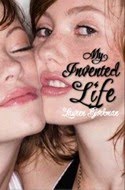
My Invented Life

Bjorkman, Lauren. My Invented Life. New York: Henry Holt and Company, 2009. Print.
[Book cover credit: librarything.com/work/8212420]

Booktalk:
Roz and Eva have always been best friends as well as sisters. Secrets, giggles, pillow fights, the works. Sure, Roz has always lived in Eva's shadow, but it's an impressive shadow so she doesn't mind too much. That was before Eva removed Roz from her life. Now, PD (Post Deletion), Eva is doing a pretty good job of pretending Roz doesn't exist, and Roz thinks she knows why. Eva MUST be a lesbian and she MUST be terrified of coming out. Even though Eva is being horrible to Roz, she wants to do something nice for her, to help her. So Roz pretends to be a lesbian and comes out at school, both to show Eva how it's done and to snag a bit of that spotlight for herself.

Review:
I checked out My Invented Life after reading Libyrinth and being overjoyed at reading about a queer character with friendS. It seems like such a simple thing, to give a queer character more than one friend and/or a friend who is NOT another queer character of the opposite sex so that none of the real life problems of one-sided-lovey feelings between friends get in the way of the story arc. My Invented Life was suggested (by the awesome MissAttitude) as another book featuring queer teens with (gasp) friends of both sexes and multiple sexualities. On that basis alone, this book is already a win!

My Invented Life is a modern retelling of Shakespeare's "As You Like It," but instead of mistaken genders, we have mistaken sexualities. In case you don't get that similarity right away, the characters are also auditioning and rehearsing for a school showing of the play. Much of the book takes place in the big barn behind the school where the theatre geeks hang out and practice. The characterizations of the drama club crowd are pitch-perfect. The major players range from Eva, popular cheerleader who always gets the lead, to Eyeliner Andie, the showy goth chick with the super-skinny, shy boy toy. Amazingly, up until Roz decides to pretend to be queer, there doesn't appear to be any other non-hetero folks in the group.

Right before auditions, this tight-knit group (which also includes Roz and her arch-nemesis Carmen) is joined by the drama teacher's nephew, Jonathon. He's new (read: automatically crush-worthy for most of the group), has done something that has gotten him kicked out of his parents house (mysterious bad boy with a serious chip on his shoulder), and African-American (a fact which seems to surprise only Roz). Roz lays claim to him on the basis that he's her next door neighbor, she's the drama teacher's favorite, and she could use a friend. Coming out does not go as she hoped. She gets attention, RoZ iZ a leZ on the bathroom wall, but not the outpouring of love and support she was hoping for:
"None of my friends hugged me, not even once." We theater geeks touch a lot -- hug, polka around the room, and smoosh cheeks together for pictures. ..."They probably though I would fondle their breasts."
p.63
So Roz starts a campaign to educate her classmates about the Kinsey Scale and to make them accept her as a lesbian. For Eva's sake, of course. Even though Eva still won't admit that she's queer (no matter how much Roz tactlessly badgers her about it), Roz keeps up the facade. She and Eva begin to bond again over The L Report (Roz's nightly updates on her "experiment" with lesbianism), Roz gains some new friends (including Jonathon and Eyeliner Andie) and a new understanding of what all those people online mean when they say "sexuality is fluid," and secrets come out of the woodwork and from all directions.

This is a cute story with an engaging and memorable cast of characters and a predictably happy ending (if you're familiar with "As You Like It"). It's also a great book about being the only "one" in a crowd, whether by "one" you mean POC, queer, poor kid, goth, whatever.


Book source: Philly Free Library

Tuesday, November 16, 2010

The Lost Hero - for Tween Tuesday

Tween Tuesday was started over at Green Bean Teen Queen as away to highlight awesome books for the 9-12 yr olds or Tweens. Any book highlighted on Tween Tuesday also counts for the In the Middle Reading Challenge! This week's book is:

Riordan, Rick. The Lost Hero. New York: Disney - Hyperion Books for Children, 2010. Print. The Heroes of Olympus 1.
[Book cover credit: librarything.com/work/9822197]

Booktalk:
Camp Half-Blood is packed, even in the winter. With the addition of new cabins for all the minor gods' children and everyone being claimed by the time they're 13, there are a ton more Heroes roaming around. But things still aren't going swimmingly. Zeus has closed Olympus and is not allowing the gods to talk to their mortal children. Artemis, even, is cut off from her huntresses. And Percy's missing. No matter where Rachel's predictions send Annabeth looking, she can't find him.

But this story isn't about all that, not really. It's about Piper, Leo and Jason. Three half-bloods with special gifts: Piper can convince anyone to do just about anything, Leo is amazingly good with his hands and can make an engine out of just about anything, and Jason, well, at the moment Jason can't remember anything. They've been hidden away at a school for delinquents, all unclaimed even though they're well beyond 13, but chosen by the gods since birth for what they must do now.

Review:
The Lost Hero totally fulfilled all my wishes and desires for it. It's still Camp Half-Blood (even if Chiron is especially cranky and unhelpful in this go-round), but it's not just more of the same. We're not so far into the future that Percy and Annabeth are former legends, nor are we so close to the end of the last Percy book that we have to sit around and watch them make out all the time. They're not even main characters in this story, just cameo characters. The addition of the children of all the minor gods makes everything a bit more hectic and crowded and crazy, but the explanations of the various gods and their traits are still there. Not only do we get Piper, Leo and Jason as new characters, but there are a bunch of new potentially important folks back at camp as well. And (this is a bit spoilery, so highlight to read) San Francisco was never really evil! But that last one is probably only important to me.

I couldn't have asked for more, and I doubt other fans of the Percy Jackson books could either.

The Lost Hero is told from the perspectives of Piper, Leo and Jason. While they all kind of sound alike (see my criticism of the alternative viewpoints in Riordan's The Red Pyramid), I never got them mixed up during the story. This may be more because of what is going on in each of their heads rather than distinction of voice. Even though they're all on the same quest and living through the same adventures/dangers, they're not remotely going through the same things. Each of their lives really has been leading up to this quest and they're just now starting to figure out how. Piper is going through all kinds of internal torment because she has been basically told that she'll double-cross the other two (not to mention that all her memories of Jason, who she thought was her boyfriend, are probably a product of some super-potent Mist). Leo is seeing his former babysitter Tia Callida (who encouraged playing with both fire and knives) and is figuring out connections between her, the weird circumstances surrounding his mother's death, and the prophecy he, Piper and Jason are meant to be fulfilling. And poor Jason. He's just trying to grasp hold of his memories: the ones that allow him to be a top-notch fighter, the ones that bring the gods' Roman rather than Greek names to his lips, and the ones that rumble in the back of his mind with every mention of the Titan War.

It's a bit more complicated, a bit more multi-layered, and a bit longer than the Percy books. But then, the characters (and the original Percy fans) are also a bit older. New readers will fare just fine without having read the Percy books (so far), but I have a feeling that won't be the case for much longer. And Percy fans will love the continuation of the Camp Half-Blood story.


Also of note: Leo is Latino and Piper is of Cherokee descent. Leo (very) occasionally uses Spanish words, especially in his memories. Piper reflects on her grandfather's life on the reservation as opposed to the life she's lived in California (her dad's a famous actor). She also bristles at the term "Half-Blood" upon reaching camp (though there is no examination or explanation of why that term bothers her in the text). Riordan doesn't make a big deal about the ethnicities of any of the characters (at least not the mortal half of their ethnicity...), but he still manages to make it matter.


Book source: Philly Free Library where I started out 27th in line for this title a week before its release. :)

Thursday, October 28, 2010

Tombstone Tea

Dahme, Joanne. Tombstone Tea. Philadelphia: Running Press Teens - Running Press Book Publishers, 2009. Print.
[Book cover credit: librarything.com/work/8431217]

Booktalk:
Jenny loves her daughter, Amy, and would do and has done anything and everything for her. This will never change. Even after they are separated by Amy's death. Even years after Jenny has died herself, hoping for a reunion beyond the grave. When Jessie walks into Laurel Hill Cemetery and bumps into the metal angel over Amy's tombstone, Jenny knows she can use Jessie's life force to bring Amy's spirit back to her. After all, a mother's love is eternal.

Review:
Tombstone Tea alternates (in huge chunks) between shortly after Amy's death and Jessie's modern day experiences in the cemetery. We don't quite learn what really happened between Jenny and her daughter at the same time that we watch Jenny try to use Jessie for her otherworldly purposes, but the two stories still run alongside each other with Paul as a connection and guide for each. His role as a spiritualist in the early 1900's is an interesting one that I wish had been looked at more closely. But even without any explanation of the spiritualist movement, it's clear from the start that Paul's connection to the dead is both important and powerful. Not until almost the end of the book do we see how much it altered his life.

For me, the characters, not the two storylines, were the strength of Tombstone Tea. Paul and the other ghosts Jessie meets in Laurel Hill Cemetery are well-done and manage to convey the weirdness of finding oneself a ghost as well as the history of their former, living selves without detracting from the story. It's very Graveyard Book, especially since all of them, save Jenny, are almost completely non-threatening. And Jenny? She is deliciously creepy, obsessive and dangerous, both in life and after it. She is not, however, enough to ratchet this book's scary points up to the "horror" level. Though there are scary moments, the whole thing is much more paranormal, creepy, spiritualist, if you will, than downright scary. It is still a great Halloween read, especially if you're fascinated by the Victorians' fascination with death and the beautiful cemeteries they created.


There was one thing this book was missing that I noticed right from the start: an author's note about the real Laurel Hill Cemetery. If I didn't live in so nearby in Philly and have a sister who really likes visiting cemeteries and a girlfriend who really likes taking pictures of weird things (Jessie's dad calls Laurel Hill a "magnificent outdoor sculpture garden" (16) and he is so right), I wouldn't know that this book is set in a real place. This is a real shame for a lot of different reasons, first of which is the fact that the main historical ghosts in the story were also real people that are actually buried in Laurel Hill (except Paul, of course, for whom there is no record in real life or the book). The spooky reason being that Laurel Hill hosts a lot of events throughout the year including one called Dining with the Dead, which is happening tonight. Eerily close to a Tombstone Tea, don't you think?


Book source: Philly Free Library

Tuesday, August 17, 2010

Birthmarked

O'Brien, Caragh M. Birthmarked. New York: Roaring Brook Press, 2010. Print.
[Book cover credit: librarything.com/work/9117047]

Booktalk:
Gaia has just finished her first delivery as a midwife rather than a midwife's assistant. The birth goes well, but Gaia must take the baby. The first three babies delivered by each midwife must be surrendered to the Enclave. Every month. And no matter how badly she feels for the mother who loses her baby, Gaia knows she must do her duty. Besides, everyone knows that advanced children, once surrendered babies, who grow up in the affluence of the Enclave are much better off. They never go hungry or thirsty like children in Wharfton often do. With these thoughts swirling in her head, Gaia heads home, only to find no one there. Her parents have been taken by the Enclave. Unlike the baby Gaia has just advanced, her parents need to be rescued.


Review:
Set on the shores of Unlake Michigan, this dystopian world has me hooked. Following some kind of environmental fallout that resulted in not nearly enough water to go around, the difference between the haves and the have-nots grows much more pronounced. What used to be the northern United States becomes something resembling a feudal city-state. The have-nots in Wharfton, where Gaia lives, depend on the "good people" of the Enclave for water to survive. And a bleak survival it is. Gaia and her parents do alright; there are only three of them and both her parents work, her mother as a midwife and her father as a tailor. Gaia's new status as a full midwife should have brought her family the Wharfton version of luxury: plenty of water and extra passes to the local entertainment center, Tvaltar. The Enclave also could not exist without those in Wharfton. Though there are bakers, tailors, and other services available right inside the wall, the people of Wharfton provide much of the labor and services the Enclave requires.

And the babies. The people of Wharfton also provide Enclave families with babies.

At first I thought this was going to be a situation like that in The Handmaid's Tale where most women become sterile and those who still can are pressed into service as babymakers. That is not the case here, though why the Enclave needs Wharfton babies remains a mystery for most of the book. Many people on both sides of the wall believe, like Gaia herself, that the children sent to the Enclave are simply lucky, even while their parents are left heart-broken; they have a chance at a much easier life. The Protectorat, the ruling class of the Enclave, have a much more complicated need for children born in Wharfton. Luckily (not really) Gaia is caught pretty early on on her attempt to rescue her parents and so gets to meet the key people behind the "advancement" program.

After Gaia is captured in the Enclave, where she has no right to be, she learns so much more about the history of her society and world than she could have imagined. She learns just how the Enclave uses those in Wharfton and the vital part she and her mother play in that relationship as midwives. She learns that her parents, who she trusted implicitly and thought she knew inside and out, hid very important things about themselves and their family from her. She learns what they hid about her own past. And during all of this acquisition of knowledge, she makes some unlikely allies inside the wall and, of course, falls in love with an especially broody, high-ranking member of the military who seems to hate her and yet find her interesting.

It's a lot for one girl to go through. And it's all a set-up. It was an emotional thrill ride the whole way through with an ending just barely satisfying enough to not make me want to tear my hair out.

I can't wait for Book 2.


Book source: Philly Free Library