but instead I get really busy.
So June's turning out to be a ridiculously busy month for me. I thought I could keep up and you all would be none the wiser. But let's be honest, I'm not that on top of things.
First there was the girlfriend's brother's wedding, which was lovely if not a little overly warm. There was also a party bus involved and I got to show off my mad dress bustling skills (on I-95 no less).
Then the girlfriend's other brother graduated from high school, which was also fun.
Then there was Linds' ordination, which was beautiful. It's also probably the only time in my life that I'll ever get to sign a legal document stating that someone has upstanding moral character.
Then we bought iPads at work (I know, life is hard sometimes), and as the emerging technologies librarian I've been running around like a crazy person to make them usable on our network, with office documents, etc.
Now I'm writing to you all from the back row of a conference session in Lancaster (wave to the Amish!) on my almost totally functional iPad! It doesn't let me use the compose function in blogger, though, so I can't do anything too fancy.
I'm giving myself until next week to recover, and then I'll be back with a review of Dead Rules, which is pretty great.
Happy June, folks. Who said summer was supposed to be relaxing?
Links to Amazon.com may be affiliate links for the Amazon Associates program. If you buy something through this link, I may receive a referral fee.
Tuesday, June 14, 2011

Monday, June 6, 2011
The Twisted Thread
 Bacon, Charlotte. The Twisted Thread. New York: Voice - Hyperion, 2011. Print.
[Book cover credit: goodreads.com/book/show/9519064-the-twisted-thread]
Booktalk:
When Madeline returns from her moning jog, she can tell something's wrong from across the green. Not only are her students awake at what they consider the unholy hour of 7am, but they're all on the lawn with police surrounding the dorm. Claire Harkness is dead. And that's not all.
"No, no, that's not possible. Sally, did Claire just have a baby?" Madeline said sharply, still holding the girl but lifting her chin so she could stare into the narrow face. "Where's the baby?" Madeline found that she was almost shaking Sally's bony shoulders. ...
Sally shook her had and could not speak. "I don't know," she finally whispered. "He's gone..."
p.11*
Review:
The Twisted Thread follows English teacher intern Madeline, art teacher Fred, detective Matt, and facilities handyman Jim as they each play their parts trying to unravel how the unthinkable has happened at the prestigious Armitage Academy. They start with Claire's death and the disappearance of her baby and work their way backwards through Claire's actions and motives to figure out what really happened. Following four different narrators was a bit challenging in the beginning, while I was still getting to know all of them. Though the point of view changes, the story never retraces its steps so that we see the same even through different eyes. Usually, I really appreciate that! This time, however, I do have to admit to some flipping back and forth trying to figure out why I was suddenly dumped into the head of someone I'd just met. Fred and Matt both interact with Madeline a lot, so the changing point of view, sometimes in the same scene (but different chapters!), seemed unneccesarily confusing in a few places, especially without the help of backing up the action a little bit so that the reader can get their bearings.
Of all our narrators, Madeline is the star of the show. She struggles with a lot of guilt because she didn't notice anything wrong (or preggers) with Claire, her student and resident in her dorm. She is also struggling to figure out what to do with her life. It is the emotional ringer of riding out the aftermath of Claire's death with the remaining students on campus that finally allows/makes her kind of grow up and make Real Life Decisions. The absence of any teen narrators in this high school boarding school book makes the adult hand-wringing a little more pronounced. It's not something that bothered me at all. It never veered into preachy or overly dramatic; it was all very believable. Still, I think it'll be a turn-off to some teen readers who may construe it as just more "kids these days" criticism. So while there is nothing in this book that would make me hesitate giving it to a high schooler to read, it's definitely not the book for a reader of primarily young adult literature who is looking for a good boarding school mystery.
That said, it is dead high school senior Claire, or at least her presence/memory, that brings depth to the stories in ways that I can't share without spoiling it for you. Just trust me when I say that the mystery goes far beyond how beautiful, intelligent, priviedged, and ultimately more complicated than anyone dared guess Claire Harkness died.
The Twisted Thread will be out and available for purchase June 14th!
Book source: ARC provided by the publisher through the LibraryThing Early Reviewers program.
*Quotes and page numbers are from an uncorrected proof and may not match the published copy.
Links to Amazon.com may be affiliate links for the Amazon Associates program. If you buy something through this link, I may receive a referral fee.
Friday, June 3, 2011
48 Hour Book Challenge!
It's here! I can't believe that I didn't remember this morning. That really doesn't bode well for my weekend.
Speaking of which, I pretty much know that I won't be able to cram in 12 hours of reading this weekend, especially since my morning commute happens too early to count (depressing in so many ways). Also, I have a (wonderful!) houseguest all weekend and a family wedding to go to tomorrow. But I'll be reading with you all in spirit!
If you haven't signed up yet, you should!
Links to Amazon.com may be affiliate links for the Amazon Associates program. If you buy something through this link, I may receive a referral fee.
Wednesday, June 1, 2011
The Midnight Palace
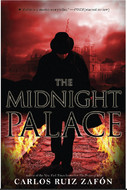 Zafón, Carlos Ruiz. The Midnight Palace. Trans. Lucia Graves. New York: Little, Brown and Company, 2011. Print.
[Book cover credit: librarything.com/work/3595363]
Booktalk:
On a dark night in 1916, a man ran through the streets of Calcutta in fear for his life. And in fear for the lives of the infant twins he carried. Sixteen years later, Ben meets Sheere, an intense girl exactly his age, and starts seeing ghost trains in the night. Together with a group of Ben's friends, they seek out the source of Ben's visions and their own history, which leads them back to a dark night in 1916...
Review:
If you are a fan of Carlos Ruiz Zafón's adult novels (which I am, go read Shadow of the Wind right now!), this may not be the book for you. It lacks some of the magic of his adult work. However, if you are the kind of reader who likes to see the evolution of a writer's work as he hones his skill (guilty again), this is most definitely the book for you. Written before his adult works but translated into English later, The Midnight Palace shows the beginning of CRZ's talent for layering stories, juggling a large cast of characters (though none are very well rounded in this one), and placing the unbelievable in the middle of a believable place and time. Unfortunately, his ability to turn a place into a character in its own right is not on display here, which is a shame because Calcutta would have been a good one. Here, it is incidental rather than integral to the story. If you're not already a fan or CRZ, really, go read Shadow of the Wind. Also, the rest of this review is for you.
The Midnight Palace is not the kind of book I usually read. It's an action/horror/paranormal-type hybrid that leans toward the scary/creepy end of things, and it is not at all character-driven. No one really grows or changes because of what happens. It has both a prologue (not my fave) and a where-are-they-now epilogue (one of my pet peeves). And yet, I really enjoyed reading it. While I was reading, I was scared and jumpy right along with the rest of Ben's gang. I was concerned for everyone's safety because they were so concerned for each other. I was nodding along with Sheere when she longed to be part of a group like theirs. It looked like fun (until it looked like a house of horrors), and I wish CRZ had let me, the reader, a bit more into the group. I never felt like I got to know any of the characters, Ben and Sheere included. Frankly, almost as soon as I finished reading, they were gone from my mind. What they went through and what they did, though, that stayed with me.
Looking back, there were holes and a few things that could have used an explanation, but I didn't notice at the time. I was too caught up in the bowels of a burnt-out train station with the rest of the gang. There was plenty going on to keep my attention. In addition to the ghost train there is a pool of blood that never dries, a grandma who operates strictly on a need-to-know basis and fails to realize that Ben and Sheere Need to Know it all, court records in vast archives, an architect's dream house, and a guy whose hand burst into flame on a disturbingly regular basis. The action is quick, the consequences are severe, and the reasons behind it all are shrouded in mystery.
In short this is a quick, fun read. It's certainly not light and fluffy summer reading, but it's the dark and stormy night equivalent.
The Midnight Palace is out and available for purchase now!
Book source: ARC provided by the publisher.
Series note: Goodreads has this book listed as the second in a series with Prince of the Mist as the first. However, nothing in the book indicated that this is not a stand-alone novel.
Links to Amazon.com may be affiliate links for the Amazon Associates program. If you buy something through this link, I may receive a referral fee.
Wednesday, May 25, 2011
Ballad: A Gathering of Faerie
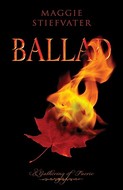 Stiefvater, Maggie. Ballad: A Gathering of Faerie. Woodbury, Minn.: Flux - Llewellyn Publications, 2009. Print. A Gathering of Faerie 2.
[Book cover credit: librarything.com/work/8109101]
This review contains no spoilers for Lament, and the book really doesn't either. And yet, this isn't quite a stand-alone book. There are a few things, especially in the stressful climax of the action, that will be a bit confusing if you don't at least have a vague idea of the first book.
Booktalk:
When people said "musician," they never seemed to mean "bagpiper." If I heard the phrase "folk musician" one more time, I was going to hit someone.James and Dee, both fully recovered from their summer shenanigans (at least physically), have been recruited by a prestigious music school, miles away from the faeries they're hoping to leave behind. It should be a wonderfully enjoyable, life-changing experience, right? Except it's not. They're both still reeling from the love-proclamation-that-never-was, and neither of them plays the "right" kind of music for their prestigious school. And the faeries have followed them.
p.5
You'd think two people as experienced in the practical consequences of faerie lore as James and Dee would have known they'd be surrounded by faeries at a school named Thornking Ash.
Review:
I love James. In fact, I capital "L" Love him. He's funny and snarky and smart and oh-so-flawed. He's also hopelessly stuck in the friend-zone, and the story he tells from way over there is both hilarious and tragic. That's right. This book is all about James. Even the parts of the story that are told from other points of view are all about James. It's great. He deserves it.
Ballad contains some serious faerie shizz. There's a wack-job wielding an iron crowbar, mysterious singing accompanied by a guy with horns growing out of his head (possibly king of something ;) ), teachers who wear iron jewelry, and the return of Eleanor, Lament's faerie queen, but what this book is really about is how James finally figures out that girls like him. At the opening of this book, his heart is continuing to break over Dee. Still, he finally allows himself to revel in the attention of another woman (and though it gets steamy in a few places, it's totally an intellectual romance). He also finally gets to have some guy friends, even if his closest buds consist of Paul, his oboe playing roommate, and Sullivan, his English teacher/dorm parent. Even at Thornking Ash and without Dee (who contributes with text messages never sent between chapters), James figures out how to be happy.
And this is a Stiefvater book. As you can see, this woman knows how to put words on a page. Her characters are all fully-fleshed people, many of whom I would die to eat Chinese take-out with on a Saturday night. They're funny and smart and a little nerdy. This would be a great book for John Green fans who want to ease into fantasy, or vice-versa.
So far, there's no word of another book in this series, but I still want to throw this out there: Stiefvater, if you're listening, the world could use more James.
Book source: Philly Free Library
Book 1: Lament: The Faerie Queen's Deception
Links to Amazon.com may be affiliate links for the Amazon Associates program. If you buy something through this link, I may receive a referral fee.
Thursday, May 19, 2011
Spinning Out
 Stahler, David. Spinning Out. San Francisco: Chronicle Books, 2011. Print.
[Book cover credit: librarything.com/work/10831527]
Booktalk:
Gilliam High's annual musical is kind of a big deal. The kind that's looked forward to by the whole town. That's why Frenchy thinks Stewart has got to be joking when he suggests they audition. The audition will be marginally fun, wholly embarrassing, and the biggest jewel in their pranking crown. Or so Frenchy thinks. It turns out, flubbing the audition for laughs is not part of Stewart's plan. That's how Frenchy and Stewart snag the leads in "Man of La Mancha," as Sancho and Don Quixote respectively. For Frenchy, it's all a little surreal. When Stewart starts immersing himself in the role just a little too much, things really start to get weird.
Review:
Frenchy's had a hell of a year, and now he just wants to coast through his senior year. But Stewart wants to get involved and, as his best friend, Frenchy backs him up. Their relationship, mirrored in the master-servant/leader-follower relationship of Sancho and the Don, is the driving force of this book. And it's a serious and challenging relationship. Still, Spinning Out is mostly hilarious. It's not laugh-out-loud funny; it's more subtle than that. If this book were literary fiction instead of YA, it would be called "intelligent humor." The banter between Frenchy and Stewart is always snarky, and when you throw Ralph, their pot dealer/Frenchy's mom's boyfriend, into the mix, it's gets a little out of control. In a good way. That's why, when Stewart starts to act a bit...off, Frenchy doesn't think too much of it.
Stewart falls further and further into the role of Don Quixote; it's great for the play, but hard on Frenchy. It's also hard on his budding relationship with stage manager Kaela (who is awesome-sauce). So he steps away, just a little bit. Finally able to claim a little bit of his own limelight in the role of Sancho, Frenchy separates himself just the tiniest bit from Stewart. They're still best friends (and just like Norah, Frenchy is a Great Friend), they're just no longer practically surgically attached.
During all of this changing and growing and relationship stuff, there is still a show to put on! Long rehearsals, music practices,
Spinning Out will be available for purchase May 25th!
Supers, Super Spoiler only for people who want to know the "issue," or what's really going on, or the ending: (highlight to read)
Stewart has undiagnosed schizophrenia. During his descent into the disease, he clings to Don Quixote, convinced that the Don is the real him. The fact that Stewart is obsessed with/plagued by the wind turbines on the edge of town helps push him over the edge. Now, I'm not an expert in mental illness, but I thought the schizophrenia was handled very well. Though the school bullies call Stewart crazy, Frenchy never does. The whole thing is handled with respect. It's also really scary, and Stahler doesn't shy away from that fear, Stewart's or Frenchy's. I also thought that the reactions of the adults in Stewart's life were, sadly, probably pretty realistic. Stahler doesn't shy away from the consequences of those reactions either. Still, at no point did this feel like an "issue book." It was not preachy and there was no info dump. All the necessary information was worked seamlessly into the story. This is a great book for readers interested in mental illness in general and schizophrenia in particular.
Book source: ARC provided by the publisher through the LibraryThing Early Reviewers program.
Links to Amazon.com may be affiliate links for the Amazon Associates program. If you buy something through this link, I may receive a referral fee.
Monday, May 16, 2011
The Boy from Ilysies
 North, Pearl. The Boy from Ilysies. New York: Tor Teen, 2010. Print. Libyrinth 2.
[Book cover credit: librarything.com/work/10545774]
Both Libyrinth and The Boy from Ilysies could be read as stand-alone books, in my opinion. There is nothing mind-blowing in this second book that will ruin the first for you, but if you're planning on reading Libyrinth (and I suggest that you do), you should probably skip this review.
Booktalk:
Culturally, the Libyrinth is a utopia. Libyrarians and Singers, Ilysians and Ayorites all get along and work together. But they're still starving, and there are still growing pains. Po, the only Ilysian male, is feeling the latter acutely. He misses the green, fertile land of his youth, but more than that he misses living in a society where he knows what is expected of him.
Review:
I guess when I read Libyrinth I missed something key about Ilysies. I knew it was a matriarchal society, but I failed to notice that men are greatly outnumbered and treated as second class citizens. Things like that happen, I guess, when you're worrying about the torture of one protag and the budding romance between the other two. It is this second class status that has Po all mixed up in The Boy from Ilysies. Not only is he having problems thinking of Princess, I mean, Libyrarian Selene as just one of the girls and no more than anyone else, but he's also having trouble seeing himself as no less than. He's used to serving women like Selene, not working alongside them, and he's used to being emotionally taken care of, in return, by a matriarchal figure. All of this equality has left him feeling very alone and unsupported.
Much of the book is spent on this dilemma. It's interesting and important and turns gender stereotypes on their heads, but it wasn't what I was looking for in a sequel to the action-packed, literature-rich, POC and LGBTQ-featuring Libyrinth. I wanted more action than intrigue, more of Clauda's brashness and less of Po's confusion, more of the books' wisdom and less erections as feelings, more of the look-how-I've-grown Selene and less of the back-to-the-beginning Selene, more Nod(s), more Haly, and for the love, more Clauda AND Selene. When Po finally left on a quest, along with former Censor Siblea, Selene*, and a few others, I was so happy. I just wish that moment had come before I was halfway through the book.
But that second half of the book was totally worth it for me. The above group sets out for the former Singer headquarters to look for a tool from the legends of every major cultures' folklore that will hopefully make the land around the libyrinth fertile enough to support the community living there. Of course, when they get there, things do not go as planned, but in the course of the search and the fighting, we find out more about the foundations of the Singers' society. Their (former) reasoning behind the fear and demonization of the written word isn't exactly spelled out, but it makes a lot more sense now. Their still present culture of abuse and neglect of women also butts up against Po's sensibilities in a way that makes him take action rather than wallow in confusion and self-pity. The trip is also filled with danger, suspense, a cute but damaged girl for Po, and a cliff-hanger of an ending. I'm re-sucked in to this trilogy (or series?) an eagerly awaiting the as yet untitled Book 3.
Book source: Philly Free Library
*without Clauda! Have they really never gotten together? Were they together and have since broken up? Are they together but trying to keep things hush-hush? WHO KNOWS? We get to hear (a tiny bit) about Haly and her boyfriend from the first book. Why no follow-up on Clauda and Selene's relationship, North?
Links to Amazon.com may be affiliate links for the Amazon Associates program. If you buy something through this link, I may receive a referral fee.
Tuesday, May 10, 2011
Under the Green Hill - for Tween Tuesday
Tween Tuesday was started over at Green Bean Teen Queen as away to highlight awesome books for the 9-12 yr olds or Tweens. This week's book is:
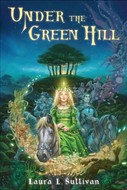 Sullivan, Laura. Under the Green Hill. New York: Henry Holt and Company, 2010. Print.
[Book cover credit: librarything.com/work/10043234]
Booktalk:
Review:
As you may have guessed from this blog's title and header, I'm a bit partial to kids in unfamiliar old houses who stumble upon magical worlds. Extra points if that old house is in the English countryside. Extra, extra points if the kids get caught up in an epic war requiring brave heroics. There was never any doubt in my mind that I would love Under the Green Hill.
I want to be so very grown-up and objective and say that what I found so attractive in this book was its own sense of place in and reverence to the tradition of books about kids in unfamiliar old houses, so on and so forth. Or that I loved the allusions to other fairy/faerie stories that I caught but will probably fly over the heads of young readers. Or that I was excited about a middle grade book featuring a position of power passed down through the maternal line, with almost inconsequential (but loved!) husbands marrying into the family to help produce the all important female heir and spare. Or even that I was enchanted by Sullivan's use of language. For example:
So Finn, Dickie, and even youngest brother James are a bit underdeveloped. That's okay; they each serve their purpose in the story, hindering or helping the rest of the Morgans along. There's also a little ambiguity in the beginning about when this story is set. It feels like it should be set in the past, between World Wars perhaps, what with the incurable fever ravaging America's children and names like Finn, Rowan and Dickie, but Finn despairs about the DVDs and video games he brought with him to England but can't use since the Rookery has no electricity. It's also possible that I projected a former time on a book whose time period should be last week. Regardless, time period ceased to matter once all the children reached the Rookery and the real story started.
In case you missed it the first two times I said it, I loved this book and I think you all should read it! More professionally, I think other fantasy adventure readers are sure to enjoy it, and it will be an immediate hit with readers looking for something to read once they've run out of Narnia books.
Under the Green Hill is available now, and its sequel Guardian of the Green Hill will be available this fall!
Book source: Review copy provided by the publisher.
Links to Amazon.com may be affiliate links for the Amazon Associates program. If you buy something through this link, I may receive a referral fee.
 Sullivan, Laura. Under the Green Hill. New York: Henry Holt and Company, 2010. Print.
[Book cover credit: librarything.com/work/10043234]
Booktalk:
"It's like in The Lion, the Witch and the Whachamacallit," Silly said, opening the door.When a dangerous fever breaks out in the States, the Morgan children: Rowan, Meg, Silly, and James, are sent to England to stay with relatives for the summer. And haughty Finn and allergy-stricken Dickie are going with them. As they head to the Rookery, their great-aunt and -uncle's house, the Morgan children expect to spend a long summer in the company of tiresome elderly people. Finn's more concerned about the lack of electricity and Dickie's worried about all the pollen in those famous English gardens. Needless to say, none of them are excited. But when they get to the Rookery, they find a house of busy people getting ready for a midnight festival and themselves packed off to bed, forbidden to leave the grounds. Nothing is more exiting than that which is forbidden, so the Morgans, Finn, and Dickie sneak out to join the festivities, and what they find will change the course of the summer and possibly their lives.
"Wardrobe," Meg said.
"Yup, that's it. Look, it's full of furs, too, just like the one in the book. I wonder if there's a passageway to a secret world."
"We have enough to do here with the fairies without finding another world full of trouble," Meg said testily.
p.123
Review:
As you may have guessed from this blog's title and header, I'm a bit partial to kids in unfamiliar old houses who stumble upon magical worlds. Extra points if that old house is in the English countryside. Extra, extra points if the kids get caught up in an epic war requiring brave heroics. There was never any doubt in my mind that I would love Under the Green Hill.
I want to be so very grown-up and objective and say that what I found so attractive in this book was its own sense of place in and reverence to the tradition of books about kids in unfamiliar old houses, so on and so forth. Or that I loved the allusions to other fairy/faerie stories that I caught but will probably fly over the heads of young readers. Or that I was excited about a middle grade book featuring a position of power passed down through the maternal line, with almost inconsequential (but loved!) husbands marrying into the family to help produce the all important female heir and spare. Or even that I was enchanted by Sullivan's use of language. For example:
Dickie could tell it was extraordinary just from the smell. An odor of knowledge permeated the air, ghosts of arcane secrets wafted about by the breeze the children made when they opened the door. Here were books more rare than any first editions. ... The air seemed stale, as though no one had visited that room in decades. But, oddly, though there was dust on all visible surfaces, the library didn't make Dickie sneeze. Books have their own peculiar kind of dustiness, which didn't catch in his nose the same way cat's hair or thistle pollen might.I could say all of that, and it would all be true (especially that last one). But what really made me fall in love with Under the Green Hill was the story, pure and simple. I'm a sucker for a good fantasy adventure, and this one is full of that goodness: a beautiful setting that is recognizable but still full of fantastical elements, betrayal, swamp monsters, life and death stakes, war-training, a wise benefactress who one can only hope will make everything okay, an enemy that isn't so evil that anyone really wants to kill him, a sensible sister who tries to be the voice of reason, and a brother hell-bent on grand acts of heroism. Plus an added bonus (that I'm also a sucker for): a selkie!
p.119
So Finn, Dickie, and even youngest brother James are a bit underdeveloped. That's okay; they each serve their purpose in the story, hindering or helping the rest of the Morgans along. There's also a little ambiguity in the beginning about when this story is set. It feels like it should be set in the past, between World Wars perhaps, what with the incurable fever ravaging America's children and names like Finn, Rowan and Dickie, but Finn despairs about the DVDs and video games he brought with him to England but can't use since the Rookery has no electricity. It's also possible that I projected a former time on a book whose time period should be last week. Regardless, time period ceased to matter once all the children reached the Rookery and the real story started.
In case you missed it the first two times I said it, I loved this book and I think you all should read it! More professionally, I think other fantasy adventure readers are sure to enjoy it, and it will be an immediate hit with readers looking for something to read once they've run out of Narnia books.
Under the Green Hill is available now, and its sequel Guardian of the Green Hill will be available this fall!
Book source: Review copy provided by the publisher.
Links to Amazon.com may be affiliate links for the Amazon Associates program. If you buy something through this link, I may receive a referral fee.
Wednesday, May 4, 2011
Open Wounds
 Lunievicz, Joseph. Open Wounds. Lodi, NJ: Westside Books, 2011. Print.
[Book cover credit: lunievicz.com/open-wounds/]
Booktalk:
"The bells of hell go ting-a-ling-a-lingCid has always been the kid nobody wants. His mother died when he was born, leaving him with a father who could never forgive him for his fatal birth and a grandmother who could never forgive him for his Jewish mother. When he inevitably gets left at an orphanage, he thinks he'll be there forever. A man like Lefty, a cousin he never knew existed, is the last person he'd expect to claim him.
For you but not for me"
...
I met my cousin on the street. Sister Bernadette closed the front door behind me, her parting words echoing in my ears. "Mr. Leftingsham is your guardian by law of the state and by law of the Lord, Cedric. You are ours no longer. May the Lord be with you."
p.88-9*
Review:
Cid's already lived a rough life by the time Lefty takes him from the orphanage. He's spent most of his childhood as his father and grandmother's punching bag, watched most of his neighbors be evicted from their homes, watched his grandmother kill herself to avoid the same, been taken in to a loving home and then left behind. And that's all before he really even hits teenage-hood (and before we hit the 100 page mark). But that's not to say that it's all bad. Cid has two great best friends, Siggy and Tomik, and he goes to the movies, "church," with his grandmother every Saturday. And out of that comes Cid's dream of becoming a fencer.
The bright and the horrible are wonderfully balanced in these opening pages. You never quite forget one while you're reading about the other. And they set things up perfectly for Lefty's grand entrance. The Great War left him horribly disfigured, crippled, and cranky, but life with him gives Cid opportunities he never would have had otherwise. Together they form a little family (aawww - but not that obvious. Lefty and Cid are both way too tough for all that), but more importantly, Lefty sets Cid up with daily fencing lessons with the crazy, drunk Russian on the roof. Once Nikolai gets involved, Open Wounds quickly becomes a sports book. There's training and fighting and sore muscles and exhausted bodies. But there's also stage-fighting with a Shakespeare company, a cute girl, a reunion with Siggy and Tomik, and the reappearance of their childhood bullies. Again, the beautiful balance. There wasn't so much plot that the fencing stopped being important, but at the same time, I never felt lost in a book centered around the practice of a sport I've only seen in movies.
Now, I don't read a lot of fencing books (though I'm considerably more interested in them now), but I do read a lot of ballet books. I always try to comment on the accuracy of the dancing or the attitudes towards it. I can't do that here, but Richie can (sorry, his site doesn't do direct links). If he says Open Wounds is good, you can bet that it is and that the swordplay therein is up to par (and he does). This will be a hit with readers who are looking for sports books, but historical fiction and hard-knock-life fans will love it as well.
Open Wounds comes out May 25!
Book source: ARC provided by the publisher.
*Quotes and page numbers are from an uncorrected proof and may not match the published copy.
Links to Amazon.com may be affiliate links for the Amazon Associates program. If you buy something through this link, I may receive a referral fee.
Monday, April 25, 2011
Instruments of Darkness
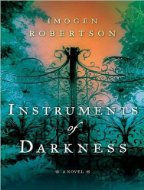 Robertson, Imogen. Instruments of Darkness: A Novel. New York: Pamela Dorman Books - Viking, 2011. Print.
Booktalk:
This book opens with a body and a murder. In that order.
When Harriet Westerman finds a body on her property in the country, she rudely wakes up Crowther at some ungodly hour of the morning to help her investigate. News has spread that Crowther conducts research on human remains; he's convinced that the way a person lives and dies leaves marks on their body. In addition to the gash across its throat, this body has a ring bearing the crest of Harriet's neighbor in its vest pocket.
Meanwhile in London, Susan hears her father lamenting the loss of a ring that Jonathon, Susan's younger brother, liked to play with. The ring falls from her mind when she and Jonathon are witnesses to their father's murder in his music shop. Before dying, their father tells Susan to find a very important box hidden in the shop and asks Mr. Graves, a young family friend with hardly the means to support himself, to care for the children.
When Harriet Westerman finds a body on her property in the country, she rudely wakes up Crowther at some ungodly hour of the morning to help her investigate. News has spread that Crowther conducts research on human remains; he's convinced that the way a person lives and dies leaves marks on their body. In addition to the gash across its throat, this body has a ring bearing the crest of Harriet's neighbor in its vest pocket.
Meanwhile in London, Susan hears her father lamenting the loss of a ring that Jonathon, Susan's younger brother, liked to play with. The ring falls from her mind when she and Jonathon are witnesses to their father's murder in his music shop. Before dying, their father tells Susan to find a very important box hidden in the shop and asks Mr. Graves, a young family friend with hardly the means to support himself, to care for the children.
Instruments of Darkness is full missing heirs, hidden wills, unhinged trophy wives, absent husbands, headstrong women, shamed men, and more bodies to go with more murders. It's a fun and engrossing historical mystery that really has no dull moments. Even scenes away from the "action" had something to entertain: comedy in one story, grief and uncertainty in the other, drama and intrigue in both.
Ms. Robertson makes good use of the Georgian period in which she places her cast, using the Gordon riots heavily in one storyline and making the real John Hunter a connecting point between the two. For the most part, characters speak in that generic historical fiction kind of way that is unique to no period but "the past." This is good since real Georgian English would be a bit hard to follow, but I was a bit disappointed that there were a few phrases that stood out a modern. They weren't enough to pull me out of the story for long, but they stood out enough that I remember them. Additionally, though I loved Harriet, some of her boldness and forwardness seemed a bit too progressive for the time in which she lived. I don't know that I would have noticed, but put beside Susan, Miss Chase, and Harriet's own sister, Harriet is definitely a bit fiery.
Though this is an adult book, there is nothing in Instruments of Darkness to make it inappropriate for teen readers, though it is a bit light on the romance and heavy on the murder/mystery compared to comparable YA titles. Still, it is sure to be enjoyed by historical fiction and mystery readers and adored by those who revel in the combination of the two.
Book source: ARC provided by the publisher through the goodreads first reads program.
Links to Amazon.com may be affiliate links for the Amazon Associates program. If you buy something through this link, I may receive a referral fee.
Subscribe to:
Posts (Atom)