Showing posts with label abuse. Show all posts

Wednesday, May 4, 2011

Open Wounds

Lunievicz, Joseph. Open Wounds. Lodi, NJ: Westside Books, 2011. Print.
[Book cover credit: lunievicz.com/open-wounds/]

Booktalk:
"The bells of hell go ting-a-ling-a-ling
For you but not for me"

...
I met my cousin on the street. Sister Bernadette closed the front door behind me, her parting words echoing in my ears. "Mr. Leftingsham is your guardian by law of the state and by law of the Lord, Cedric. You are ours no longer. May the Lord be with you."
p.88-9*
Cid has always been the kid nobody wants. His mother died when he was born, leaving him with a father who could never forgive him for his fatal birth and a grandmother who could never forgive him for his Jewish mother. When he inevitably gets left at an orphanage, he thinks he'll be there forever. A man like Lefty, a cousin he never knew existed, is the last person he'd expect to claim him.

Review:
Cid's already lived a rough life by the time Lefty takes him from the orphanage. He's spent most of his childhood as his father and grandmother's punching bag, watched most of his neighbors be evicted from their homes, watched his grandmother kill herself to avoid the same, been taken in to a loving home and then left behind. And that's all before he really even hits teenage-hood (and before we hit the 100 page mark). But that's not to say that it's all bad. Cid has two great best friends, Siggy and Tomik, and he goes to the movies, "church," with his grandmother every Saturday. And out of that comes Cid's dream of becoming a fencer.

The bright and the horrible are wonderfully balanced in these opening pages. You never quite forget one while you're reading about the other. And they set things up perfectly for Lefty's grand entrance. The Great War left him horribly disfigured, crippled, and cranky, but life with him gives Cid opportunities he never would have had otherwise. Together they form a little family (aawww - but not that obvious. Lefty and Cid are both way too tough for all that), but more importantly, Lefty sets Cid up with daily fencing lessons with the crazy, drunk  Russian on the roof. Once Nikolai gets involved, Open Wounds quickly becomes a sports book. There's training and fighting and sore muscles and exhausted bodies. But there's also stage-fighting with a Shakespeare company, a cute girl, a reunion with Siggy and Tomik, and the reappearance of their childhood bullies. Again, the beautiful balance. There wasn't so much plot that the fencing stopped being important, but at the same time, I never felt lost in a book centered around the practice of a sport I've only seen in movies.

Now, I don't read a lot of fencing books (though I'm considerably more interested in them now), but I do read a lot of ballet books. I always try to comment on the accuracy of the dancing or the attitudes towards it. I can't do that here, but Richie can (sorry, his site doesn't do direct links). If he says Open Wounds is good, you can bet that it is and that the swordplay therein is up to par (and he does). This will be a hit with readers who are looking for sports books, but historical fiction and hard-knock-life fans will love it as well.


Open Wounds comes out May 25!


Book source: ARC provided by the publisher.


*Quotes and page numbers are from an uncorrected proof and may not match the published copy.

Links to Amazon.com may be affiliate links for the Amazon Associates program. If you buy something through this link, I may receive a referral fee.

Monday, April 25, 2011

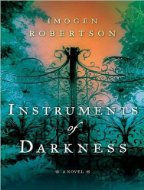
Instruments of Darkness

Robertson, Imogen. Instruments of Darkness: A Novel. New York: Pamela Dorman Books - Viking, 2011. Print.
[Book cover credit: librarything.com/work/8398153]

Booktalk:
This book opens with a body and a murder. In that order.

When Harriet Westerman finds a body on her property in the country, she rudely wakes up Crowther at some ungodly hour of the morning to help her investigate. News has spread that Crowther conducts research on human remains; he's convinced that the way a person lives and dies leaves marks on their body. In addition to the gash across its throat, this body has a ring bearing the crest of Harriet's neighbor in its vest pocket.

Meanwhile in London, Susan hears her father lamenting the loss of a ring that Jonathon, Susan's younger brother, liked to play with. The ring falls from her mind when she and Jonathon are witnesses to their father's murder in his music shop. Before dying, their father tells Susan to find a very important box hidden in the shop and asks Mr. Graves, a young family friend with hardly the means to support himself, to care for the children.

Review:
Instruments of Darkness is full missing heirs, hidden wills, unhinged trophy wives, absent husbands, headstrong women, shamed men, and more bodies to go with more murders. It's a fun and engrossing historical mystery that really has no dull moments. Even scenes away from the "action" had something to entertain: comedy in one story, grief and uncertainty in the other, drama and intrigue in both.

Ms. Robertson makes good use of the Georgian period in which she places her cast, using the Gordon riots heavily in one storyline and making the real John Hunter a connecting point between the two. For the most part, characters speak in that generic historical fiction kind of way that is unique to no period but "the past." This is good since real Georgian English would be a bit hard to follow, but I was a bit disappointed that there were a few phrases that stood out a modern. They weren't enough to pull me out of the story for long, but they stood out enough that I remember them. Additionally, though I loved Harriet, some of her boldness and forwardness seemed a bit too progressive for the time in which she lived. I don't know that I would have noticed, but put beside Susan, Miss Chase, and Harriet's own sister, Harriet is definitely a bit fiery.

Though this is an adult book, there is nothing in Instruments of Darkness to make it inappropriate for teen readers, though it is a bit light on the romance and heavy on the murder/mystery compared to comparable YA titles. Still, it is sure to be enjoyed by historical fiction and mystery readers and adored by those who revel in the combination of the two.


Book source: ARC provided by the publisher through the goodreads first reads program.

Links to Amazon.com may be affiliate links for the Amazon Associates program. If you buy something through this link, I may receive a referral fee.
Tuesday, February 22, 2011

Between Shades of Gray

Sepetys, Ruta. Between Shades of Gray. New York: Philomel Books - Penguin Group (USA) Inc., 2011. Print.
[Book cover credit: librarything.com/work/10127764]

Booktalk:
In this, her debut novel, Sepetys tackles the heart-wrenching topic of Stalin's secret deportation of millions from the Balkan states during and after WWII. We see the atrocious conditions that mostly women and children must endure in their "work camps" through the eyes of Lina Vilkas, who knows, as do we, that the conditions must be worse for her father and the rest of the men in Stalin's prisons.

Review:
Clearly, this book is not a pick-me-up, but the spirit of endurance that Lina, her family, and her friends exhibit is inspiring. Between Shades of Gray tracks the slow progress of Lina, her brother Jonas, and their mother Elena from their home in Lithuania to a work camp in Trofimovsk in the Arctic Circle. They suffer many indignities (to put it mildly) at the hands of their Soviet captors (so many and so much that I stopped marking them in my copy). The beginning of the book, especially, is very similar to the beginnings of many other stories about this time in Europe. The lists, the beatings, the cattle cars.

I could go on and on about how the Vilkas and their group suffer. I could draw many parallels between their experience and those of Holocaust survivors. I could talk about how, at times, the weight of what they go through is crushing, but I don't want to. I want to talk about the points of light in this book that made the rest of it bearable (and when I say bearable, I mean in terms of the subject matter. The whole book is beautifully and compellingly written). Lina's memories of her father and of her cousin Joanna certainly help her through her trials, as does her art which she continues, and uses to her advantage in many ways, throughout the book. A sweet, little romance doesn't hurt either. But what really makes the work camps tolerable is what the deportees do for each other. Take this example from near the end of the book, when everyone is on the brink of starvation (and please excuse my page-spanning quote):
     "Do you think we should eat him [an owl]?" asked Janina.
     At first I was shocked. Then I imagined the plump body, roasting in our barrel, like a chicken. I poked at it again. I grabbed its wing and pulled. It was heavy, but slid across the snow.
     "No! You can't drag him. The NKVD will see. They'll take him away from us," said Janina. "Hide him in your coat."
...
     Other deportees looked at me.
     "Our mamas are sick. They need food. Will you help us?" explained Janina.
     People I didn't know formed a circle around me, sheltering me from view. They escorted me safely back to our jurta, undetected. They didn't ask for anything. They were happy to help someone, to succeed at something, even if they weren't to benefit.
pgs. 313-5*

Between Shades of Gray is an important book about a not-often-talked about event in history. For this reason, it will appeal to historical fiction lovers, and WWII aficionados. It's also an emotional read, with dashes of suspense and romance mixed into Lina's experience of oppression and, ultimately, loss. I highly recommend this powerful debut and look forward to whatever Sepetys has in store for us next!

Between Shades of Gray comes out on March 22nd!


Book source: ARC provided by the publisher through the LibraryThing Early Reviewers program.

*Quotes and page numbers are from an uncorrected proof and may not match the published copy.

Links to Amazon.com may be affiliate links for the Amazon Associates program. If you buy something through this link, I may receive a referral fee.
Friday, October 15, 2010

Hope in Patience

Fehlbaum, Beth. Hope in Patience. Lodi, NJ: WestSide Books, 2010. Print.
[Book cover credit: librarything.com/work/10522298/]

Awards:
Nominated for YALSA Quick Pick's for Reluctant Readers, 2010


Booktalk:
Finally out of her step-father's house where she suffered through years of sexual abuse at his hands, Ashley is adjusting to life in Patience, Texas. In Patience she has a father, a real father, who wants to protect her, a step-mother who doesn't see her as "the competition," a little brother who will play his video games so loudly that he entire house shakes, and a therapist who refuses to let her wallow in her past. Basically, she has a chance at a normal life. But with the coming trial against her step-father, her own flashbacks, and a seriously misguided rumor mill threatening to drag her down, Ashley may never be able to focus on the "normal" problems she should be worrying about at her age: her last place status on the cross-country team, a group project with one of the most uncooperative group members ever, and whether or not a certain boy can look past everything else going on in Ashley's life and just like her.

Review:
This is a harsh story, and my heart broke for Ashley over and over again while I was reading it. It is not a book that will be immediately accessible to a wide audience. It is a book that shows how one young woman is able to overcome years of sexual and emotional abuse with the help of some solid family and friends, and as such, it it has the power to provide exactly what the title suggests, hope, if it gets into the right hands.

Ashley's abuse at the hands of her step-father is definitely a focal point of Hope in Patience, even though it is all in the past at the opening of the book (though it does still manage to be graphic in places). Her mother's emotional abuse, however, manages to still reach Ashley in Patience and still tear Ashley to bits. It is that, more than facing her step-father at trial that puts up roadblocks on Ashley's road to normalcy. It is also what makes it so hard for Ashley to trust that her father and step-mother really love her, want her around, and have her best interest at heart.

Ashley's father, David, wasn't around when she was a kid. He had been an alcoholic, prompting her mother to leave him and take Ashley with her. Rather than wallow in the realization that he could have saved Ashley from years of abuse had he just looked her up and been a part of her life, he steps up and welcomes Ashley to his house and home with open arms. He becomes the best supportive dad a girl could ask for, and though Ashley's trust issues (and his prior absence) make her unable to call him "Dad," it is clear that he quickly becomes one of the foundation pieces in her growing support system in in her new life.

Bev, David's wife, is also instrumental to Ashley's increasingly happy life in Patience. She steps right into the role of the mother Ashley never had, without pause and without question. Bev becomes Ashley's confidant and friend (and English teacher), and when the time comes when Ashley needs someone to tell her to just get over it already, Bev's the one to do it.* For clarification, No one ever implies that Ashley should just get over years of abuse. Ever. She has an amazingly patient and supportive family and therapist who all understand that these things take (a lot of) time. But! Whenever anything bad happens, anything at all, Ashley has a tendency to close in on herself and shut out the world. This is what Bev tells her to get over, in a completely not-angry, non-judgemental way.

But the real star is, of course, Ashley. She's scared, kind, bold, shy, and overly aware of herself in the way that folks in therapy often are. And she's funny. And not broken. Fehlbaum, in Ashley, has managed to show that a person can go through hell and back, be totally and in some ways irrevocably scarred, and still not lose what make them them. Ashley displays fierce loyalties to her friends, K.C. and Z.Z. especially, even when she's struggling to hold herself together. And they do the same for her when she needs it the most. And there's Joshua. He's cute, he's also on the track team, and he like Ashley, which in a lot of ways terrifies her. Learning to trust him with all of her issues is the Big Thing in this book. It's the Big Problem and also the Big Indication of Growth. It's also really sweet.

Hope in Patience is ultimately about how Ashley grows out of the shell that years of abuse put her in. It is the powerful story of how she stops being Ashley-who-was-abused and becomes just Ashley.


Hope in Patience will be out in hardback on October 27th!


Book source: ARC provided by the publisher.

*Bev also assigns controversial (Chris Crutcher) books in her classes, allows kids to hang out in her classroom before and after school, accepts "edgy" freaks and religious zealots alike, and is basically all kinds of awesome. And she's backed up by the sassy, southern principal's secretary, making her exponentially more powerful in her school setting. Bev is basically who I want to be when I grow up, except I want to be in a library rather than a classroom. :)

Friday, September 3, 2010

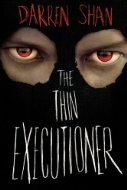
The Thin Executioner

Shan, Darren. The Thin Executioner. New York: Little, Brown and Company - Hatchette Book Group, 2010. Print.
[Book cover credit: librarything.com/work/9460780]

Booktalk:
Among the Um Aineh, being the son of the executioner is almost as good as being the son of the king. In a world of warriors where strength and honor are valued above all, even the youngest son of the executioner, Jebel Rum, can't get the respect he thinks he deserves with a tiny frame. He sets off on a quest to save his honor, a quest that will require him to travel the length of Makhras with a slave by his side, a slave he must sacrifice to Sabbah Eid. In return he'll be granted invincibility that will allow him to beat any man in competition or combat and gain the confidence and respect of his father and his people.

Review:
All of the publishers' blurbs and pre-pub info says that this book was inspired by The Adventures of Huckleberry Finn, but I didn't get that from the story. Sure, It's a story about a young teen traveling with an adult slave who agrees to the trip in an effort to free his family. They get waylaid and sidetracked by a pair of con-artists who seem like friends but really want to sell them to the highest bidders. They travel along a river (but never on it!) and meet many new people with ideas like and unlike their own, and through their trials, the teen and the slave become friends. Okay, so maybe it's a LOT like Huck Finn, but the feel of the story is completely different. Huck Finn is light-hearted, easy-going fun on the surface with issues of race, slavery, violence, theft, general immorality boiling underneath.* In The Thin Executioner, the bad stuff is all right out in the open.

The society in which Jebel has been raised is exceedingly violent. The executioner is an exalted member of society in the way that movie stars are exalted in ours. They are not only men who mete out "justice," but also the providers of entertainment. Anyone convicted of any crime is executed; the Um Aineh have no jails and don't really hold much regard for human life. And their slaves aren't even considered human. Slaves live in their own section of the city where the living conditions are very degraded, can be beaten without recourse, and can be sentenced to death at the wish of their owner for any reason or none at all. Tel Hesani volunteers to accompany Jebel on his quest, knowing he will be executed at the end of it, to free his wife and children from this existence.

Once Jebel and Tel Hesani are on the road, Jebel depends on Tel Hesani's knowledge of the world and other people in it to survive, but still treats him with disdain. Because Jebel is eager to spend time with people like himself, meaning not slaves like Tel Hesani, they end up in quite a few compromising situations. The trials and tribulations of traveling through Makhras add up quickly, much more quickly than the change of heart I was expecting from Jebel. Tel Hesani saves him time and time again, and yet he's still valued as slightly more than a piece of shit by Jebel. About halfway through the book, I had to set it aside. Jebel's attitude is a lot to take. It isn't until Jebel and Tel Hesani are separated and Jebel gets to experience the life of a slave for himself that his ideas about slavery, human life, and Tel Hesani begin to change. When they're finally reunited, they continue on the quest, but Jebel (finally) seriously doubts whether he'll be able to kill Tel Hesani in the name of a god he's not sure is real in exchange for supernatural powers that may or may not exist.

The Thin Executioner is a long book, and I think that a lot of the obstacles Jebel and Tel Hesani meet on their way to Sabbah Eid could have been cut out without risking important plot points or character development. Still, it can be a gripping story. I had a hard time being in Jebel's head for so much of the book when he was such a self-centered jerk, but the payout is worth it in the end. If like me, you're suffering from post-Mockingjay pre-Monsters of Men malaise, The Thin Executioner just might soothe your gratuitous-violence-with-a-message seeking soul for a little while.


If LibraryThing is to be believed, Shan dedicated this book to the country of Jordan "which inspired much of this book's setting and plot, and whose landmarks provided the names of all the characters (with three exceptions) and places" (my ARC doesn't have the dedications page). Jebel also describes his crush as "slim and curvy, with long legs, even longer hair, dazzling brown eyes and teeth so white they might have been carved from shards of the moon. Her skin was a beautiful dark brown color" (2).** He also repeatedly describes the off-putting paleness of Tel Hesani's people. Based on these three things and a vague memory of a description of Jebel himself, I'm thinking Jebel and the rest of the Um Aineh are middle eastern, making this a fantasy book featuring POC! A rare and wonderful thing!


Book source: ARC provided by publisher via yalsa-bk.

 * Admittedly, I don't think I've ever read Huck Finn all the way through (but I've seen the movie with Elijah Wood about a million times), so my assessment of the tone of the original may be a bit off. 

 ** All quotes and page numbers are taken from an Advanced Reading Copy and do not necessarily match the published copy.

Saturday, July 31, 2010

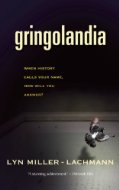
Gringolandia

Miller-Lachmann, Lyn. Gringolandia. Willimantic, Conn.: Curbstone Press, 2009. Print.
[Book cover credit: librarything.com/work/8139206]

Awards:
ALA Best Books for Young Adults (2010)
Americas Award Honorable Mention

Booktalk:
Daniel's life is pretty good, but not perfect. His mom is a grad student so there's not a lot of money, his sister is getting to the age where she's real angsty and annoying, and every year his mother heads a letter writing campaign to free his father from a prison in Pinochet's Chile. Still, Dan's pretty happy. He plays in a band, has a great girlfriend, and speaks with a sexy accent leftover from his Chilean childhood. Then Daniel's mother gets word that her husband will be released and allowed to join his family in America. That should make everything finally perfect. But when Daniel's father is released, he is a physically broken and psychologically scarred shell of the father Dan remembers.

Review:
Gringolandia opens with an Author's Note explaining the very real circumstances and events in Chile that lead up to what is experienced by the fictional characters in the book. A short bibliography for further reading is also provided. Usually this kind of thing goes at the end of the story when readers are more likely to be interested in picking up 4-5 books on the topic. I thought it was a weird choice to put the note and bibliography at the beginning...until I started reading.

Miller-Lachmann expects a lot of her readers, in a good way. Her author's note allows her not to take precious page space away from the story later. For example, we see Dan's father derisively call the States "Gringolandia" and refuse to learn English. We see the disdain he has for the USA and for his wife's choice to bring the family there. Miller-Lachmann doesn't tell us that his dislike (to put it kindly) for America is because the United States government helped Pinochet gain power in Chile. She trusts us to put two and two together, which she is only able to do because she explained Pinochet's rise to power in her opening note.

Because, let's be honest, not many Americans know that much about Chile and certainly don't know that much about what it was like to live through the turbulent times Dan and his family live through, hence the need for the author's note. I don't read a lot of historical fiction about specific events (which I guess this is, even though it makes me feel really old to call the decade in which I was born history), but much of the historical fiction published in the States of this type is about very well-known events. Even if the average American reader doesn't know the ins and outs of the actual event, they know the basics. Think about how much historical fiction is set during WWII or the French Revolution, or is about Anastasia Romanova. Gringolandia fills a huge gap. I can't think of any other historical fiction for teen readers about South America, let alone about Chile. In fact, a search in WorldCat for "historical fiction" and "South America" only returns 78 books, including duplicates for large print titles. "Historical fiction" and "Chile" returns 84, and those numbers don't even begin to touch on the intended audience of the titles.

Even if there were tons of titles about political prisoners under Pinochet, I think that Gringolandia would still stand out. Without repeating events, this story is told from three distinctive points of view: Dan's, his father's, and his girlfriend's. Dan's father, Marcelo, talks about what it was like in prison (and believe me, even the polite version presented here can get graphic), but the strong point in his narrative is his passion for a free Chile. He doesn't regret the actions he took that led to his arrest; he desperately wants to continue that work, regardless of the consequences, now that he's been released. He's also going through some serious PTSD that is tearing his family apart. His perspective is contrasted with Dan's. Dan doesn't really know what his father did (you can't be questioned about what you don't know), and he doesn't understand how his father could put himself and his family at such great risk for a cause. He certainly can't understand why his father doesn't want to just move on and make the best of things. Like his father, Dan has trust issues and a serious flinch in the face of policemen, but without the conviction that helps his father work through these issues. Courtney, Dan's girlfriend, is all fired up about what happened to Marcelo and what is happening in Chile in general, but she is also woefully naive. Semi-spoiler: There is a great scene when they all return to Chile. Courtney decides to join a women's protest and things go as wrong as humanly possible. From Dan's POV: "Courtney. I think she can't believe these [soldiers] will do anything to her--like her pale skin and blond hair are a Plexiglas bubble around her, keeping all the bad things away" (241). It's kind of the perfect way to describe her attitude throughout the entire book. End spoiler. Courtney breaks through to Marcelo when no one else can by believing whole-heartedly in what he believes in, guided by a simple sense of right and wrong and of fairness.

There is so much going on in this book along side of so much actually happening. I'm not going to lie, it's intense and not always easy to read. But it is so worth it! Not only will the reader learn about events not often discussed in American history classes, but they'll also get to know some ridiculously complex characters and watch them make impossible choices for themselves and the greater good.


I read Gringolandia as one of my PK books, but the fact that Courtney's dad's a pastor didn't even come up in my review. It's important to her character and back story, but not all that important to what is going on with her, Dan and Marcelo. The big PK moment is when Dan, her boyfriend and the person she is the most close to, says something at lunch implying that Courtney couldn't possibly know what he's going through at home. Her family and home-life are too perfect. This is followed by a one-line chapter from Courtney's perspective: "Dan doesn't know everything about me" (64). It could have been said by almost all the PKs I've read about in the last month.


Book source: Philly Free Library
Thanks to MissAttitude at Reading In Color for the recommendation!

Saturday, June 5, 2010

House of Stairs - Mini-Review

I have a bad habit of checking books out from the library, reading them, copying down quotes I think I might want to use in my review, and then returning them to the library. Given the volume of books I read, those quotes don't help me that much if I wait too long to sit down and write the review. The books that I'm "mini-reviewing" left an impression on me and I feel that I can recommend (most of) them without hesitation, I just can't remember enough little details to write full reviews.


Sleator, William. House of Stairs. New York: Firebird - Penguin Group, 1974; 2004. Print.
[Book cover credit: librarything.com/work/25469]
 
Awards:
ALA Best Books for Young Adults (1974)
 
Booktalk:
When five teenaged orphans each wake up alone to find themselves trapped in a chamber of staircases that would rival an M.C. Escher print (or a David Bowie/Jim Henson hallucination), none of them are all that surprised. Being an orphan isn't easy, and they're used to be put through the ringer by the state. Peter, Lola, Blossom, Abigail, and Oliver find each other on the staircases and figure that they are being put through some kind of test. When it quickly becomes clear that to fail the test means to starve, they start to turn on each other in order to "win."
 
Mini-Review:
I checked this out because more than a couple people on the yalsa-bk listserv said that The Maze Runner, which I purchased months ago but haven't gotten to yet, is a redone version of The House of Stairs. I can't find the emails now, but I think I remember them saying it wasn't even that great of a do-over.
 
Gee, I hope they're wrong.
 
The House of Stairs did have a lot of weirdness and suspense, especially once the kids all figure out what the machine really wants them to do in order to get food (hint: it's not good), and I did care about the couple of characters that I was supposed to care about. I think where this book fell short for me was the complete lack of backstory and explanation. Those of you who've been reading along here know that I'm not all that into long expository passages; I'd really rather just get to the story. That's all The House of Stairs was! Just story! Still, it didn't work for me. I do need some explanation, and the answers that Sleator offered up at the end were just too little too late to make me like this book. I had too many lingering questions, and not in the good way.
 
That said, there is a reason this book has been continually printed since it's publication (although, the reason for the bad 80's cover on the 2004 edition still eludes me). It's short and suspenseful and it sucks you in. And it would be good for discussion. A lot of my lingering questions would work well in a group, such as "Why AREN'T these kids shocked to be used as lab rats? Is it because they're orphans, because they're kids, or because this might be some kind of post-apocolyptic world (There is a big discussion about the last time anyone had real meat and about the government living in a compound)?" One (more) caveat, though, for group sharing: there is some serious fat-phobia going on here. One of the orphans is overweight, possibly because she hasn't been an orphan that long and possibly because she wants everything for herself. The fact that this isn't clarified bothered me, as did the fact that she was much more obsessed with getting food than anyone else. These kids are actually starving; the fat girl shouldn't be the only one obsessing. But hey, you can talk about that in a group too.
 
 
Book source: Philly Free Library

Friday, May 7, 2010

Tender Morsels

Lanagan, Margo. Tender Morsels. New York, Alfred A. Knopf, 2008. Print.
[Book cover credit: librarything.com/work/5439594]

Awards:
Amazon.com Best Books (Science Fiction & Fantasy, 2008)
BCCB Blue Ribbon Book (2008)
A Horn Book Fanfare Best Book (2008)
Locus Recommended Reading (Young Adult, 2008)
Publisher's Weekly Best Book (Children's Fiction, 2008)
School Library Journal Best Book of the Year (2008)
ALA Best Books for Young Adults (2009)
Printz Honor (2009)
World Fantasy Award (Novel, 2009)
And many more...

Booktalk:
Liga's life is a brutal one. She lost her mother long ago and is now confined to life with her father. He won't let her go into town, where jeers of "the poacher's daughter" follow her. Instead he confines Liga to their home, where she is made to take up her late mother's role as wife, fulfilling wifely duties in the upkeep of their household and her father's marriage bed. When this life becomes too much to bear, Liga decides to end it. When she tries to throw herself and her daughter by her father over a cliff, she is rescued and taken to her personal heaven. Everyone is kind, and life is safe. Lisa raises her, now two, daughters in this place, but her heaven was not made for them. It begins to crack, letting elements of the real world in, until, finally, it becomes clear that they all must get out.

Review:
Brutal does not even begin to cover it. Liga's life with her father is a nightmare. It is clear that she is repeatedly raped by her father. It is not graphically described in the text, but is in the forefront of Liga's thoughts often and so often "discussed." The miscarriages he forces her to have through the use of teas and herbs, on the other hand, are described in graphic detail. The fact that Liga has no idea what is happening to her when she miscarries is, I think, part of why they are described in such detail. Even though she thinks about it often, her mind shies away from the acts her father performs on her. Her shame and self-preservation together keep the detail out of these account. As she slowly comes to realize that the rapes, teas, miscarriages, her monthly blood, and babies are all related, each of these acts in her past are revisited. And things don't even get better after Liga's father dies! Left alone in their cottage with only her infant daughter for company, Liga is gang-raped (again, not graphically described, but not exactly glossed over either) by a group of town boys. This is what finally makes her want to end her own, and her baby's, life.

That's the opening of the book. It's hard to read.

The first time I checked this book out of the library, I couldn't read the whole thing. Long before the gang-rape and attempted suicide, I returned the book. I didn't decide to check it out again until the Common Sense debacle with Barnes and Noble came out (see the comments for where Tender Morsels is mentioned). Still, I didn't get around to actually checking it out until a few weeks ago. I was determined to get through the horrible parts so that I could see Liga in her heaven, and after reading all of that, I needed to see Liga in her heaven. So many other readers had said that the wretched beginning is worth it once you get to the rest of the story , not to mention that I figured the whole book couldn't be ruined by the opening, given its many awards.

It is worth it.

The rest of the story is a fairytale. It is actually based on Snow White and Rose Red. Once Liga's daughters are old enough to have personalities, Tender Morsels becomes their story. It is about Branza and Urdda learning who they are as people and learning how to make their own way in what is, literally, their mother's world. Their story is beautiful, and I think the ugliness that preceeds it helps to make it so. Urdda grows up to be the awesomely headstrong and smart young woman that I always look for in book. I want a whole other book full of her, especially once she leaves her mother's heaven. Branza's nice too, but I clearly have my favorite.

But here is my dilemma: By the end, I really liked this book and I would love to recommend it, but to whom? I don't agree with the Common Sense rating at Barnes and Noble, that Tender Morsels is not appropriate for anyone under 18, but I do think that I may hesitate to recommend it to young adults that I do not know extremely well. What do you think? For those of you who have read this, to whom do you recommend it? Those of you who haven't, knowing all of the horrible things that happen, do you think you ever will?


Book source: Philly Free Library

Monday, March 15, 2010

Scars

Rainfield, Cheryl. Scars. Lodi, NJ: WestSide Books, 2010. Print.
[Book cover credit: librarything.com/work/9445693/book/57675127]

Booktalk:
Kendra is full of secrets. She let one big one out six months ago, when she started to remember and told her parents about the sexual abuse she suffered as a child. Now she's struggling to keep the rest of her secrets in: she wishes her therapist, her art teacher, almost anyone else, was her real mother; she's been cutting herself to deal with the pain that remembering the abuse has brought on; she has a crush on the toughest girl at school, who also sleeps with boys like it's her job; and the biggest secret of all, one she can't even tell herself, somewhere deep down in her memory, she knows who raped her and she knows that he'll kill her if she tells.

Review:
This book is wonderful and powerful. It is a book I read in a day and then took two days to digest. I highly recommend it. That said, this is a book about prolonged sexual abuse and self-injury, in addition to being a book about a girl whose mother is not happy about her daughter's new girlfriend. It is not for everyone, but it will undoubtedly be really important for more than a few someones.

Throughout the course of the book, the bulk of which spans what feels like only a week, Kendra relives her abuse, through flashbacks that hit her out of (almost) nowhere and with her therapist, as she tries to remember the identity of her abuser. She also cuts herself, repeatedly, to cope with the pain and the panic that these memories bring on. Rainfield portrays all of this realistically and sensitively. She lets us inside Kendra's head to see her pain, shame, insecurities, fear and more. More importantly, she shows how much Kendra appreciates and depends on those who support her, even if Kendra doesn't always show it herself. It is Kendra's chosen family, her therapist, her art teacher, her mentor, and her girlfriend, that make it possible for her to face her abuse and ultimately her abuser.

There were some moments in the book when the dialog seemed less than authentic. Using Carolyn, Kendra's therapist, Rainfield can realistically work phrases like "you're not the one who deserves to be hurt, Kendra. He is," into a conversation about Kendra's self-injury. Instead when Meghan, Kendra's girlfriend of a day, says it, it can be a bit jarring (139)*. However, it is the right things to say and important for readers to, well, read. While the few exchanges like this between Kendra and Meghan pulled me momentarily out of the story, they are easily outweighed by the cute wow-you're-pretty moments that these two more often share. Their budding relationship adds the happiness that Kendra so desperately needs and the normalcy that the average reader will need in order to relate to all the Kendra is going through.

Cheryl Rainfield has also included an annotated bibliography of web resources, help lines and crisis support, books, articles, and videos for victims of sexual and ritual abuse, those who self-harm, teens thinking about suicide, and teens in the process of coming out or dealing with homophobia. She also highlights resources specifically for friends, family, and other vital supporters of people dealing with these issues.


To read more about Scars, including a statement from the author and blurbs from some very well-known authors, check out the Cheryl Rainfield's website. Scars will be out and available to purchase March 24th.


Book source: Review copy from publisher.

*All quotes were taken from an uncorrected proof. Exact wording and page numbers may not match the final copy.

Wednesday, December 2, 2009

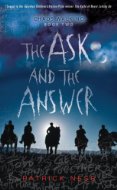
The Ask and the Answer

Warning: This review doesn't have any spoilers for The Ask and The Answer, but it basically gives away the surprise ending of The Knife of Never Letting Go.

If you've never read either of the books in the Chaos Walking Trilogy, here's something that should whet your whistle, so to speak, and if you're in the same boat as me and think you might explode before the last book in the trilogy is published, hopefully this will hold you over for a while: "New World." This short story was published between The Knife of Never Letting Go and The Ask and the Answer, but it's really Viola's backstory, so everyone can read it.


Ness, Patrick. The Ask and the Answer. Somerville, Mass.: Candlewick Press, 2009. Print. Chaos Walking 2.
[Book cover credit: librarything.com/work/8164780]

Booktalk:
Who needs a booktalk? As if "Welcome to New Prentisstown" from the last page of The Knife of Never Letting Go wasn't enough.

And that's exactly where The Ask and the Answer picks up. No recap, no explanations, nothing. Todd wakes up after carrying Viola right to Mayor Prentiss' feet and she's not there. He spends the rest of the book trying to find her.

Meanwhile, the Mayor, now President, is making sure that New Prentisstown in no way resembles the Haven it once was, and he tells Todd that if he helps, he'll get Viola back.

And Viola? The Mayor has plopped her down into a House of Healing full of women whose thoughts, unheard like those of all women on New World, still scream of how they'll regain control of their city.

Review:
Oh.My.Gosh. I finished this book a week ago, and I still feel like I haven't had enough time to really process it in order to write a review. There is just so much going on with Todd, with Viola, with Wilf(!), with the people of what used-to-be Haven, with Davy Prentiss (who you'll actually CARE about by the end), just so much going on.

It was practically impossible to put down.

Character development did not waste away in the face of SO MUCH plot either. Viola and Todd both have to really grow up in order to survive in New Prentisstown. Both of them are faced with decisions that they don't want to make, where neither option seems like the right one. You will forget, long before the really bad stuff happens, that this is a book about 13yr olds.

Todd especially, who has been told that his compliance will buy Viola's safety, does a lot of things he wouldn't normally do. The point that people do unthinkable things in the name of war is really driven home. However, Ness does not leave the reader under the impression that what one does while at war does not stay with you. Though Todd takes part in some pretty gruesome acts for a really noble reason, there are CONSEQUENCES. Otherwise known as Book 3, Monsters of Men.

Long story short, I had mixed feelings about The Knife of Never Letting Go, I became obsessed while reading The Ask and The Answer, and I might die waiting for Monsters of Men to finally be released in the US. In September 2010.


Oh, and for those of you who may be worried about reading The Ask and The Answer after crying uncontrollably while reading The Knife of Never Letting Go (I know I can't be the only one that did this...), don't be! While some important characters do die (they are at WAR people) none of their deaths turned me into a sobbing mess. Your mileage may vary.


Book One: The Knife of Never Letting Go
Book Source: I bought it because my library STILL doesn't have a copy and I just couldn't wait anymore.

Sunday, September 6, 2009

The Chosen One

Williams, Carol Lynch. The Chosen One. New York: St. Martin's Griffin, 2009.
[Book cover credit: librarything.com/work/7518119]

Booktalk:
Kyra is just a normal girl. She loves her family, especially her sister Laura who is also her best friend and Mariah, the baby. She loves to play the piano, and she is very good at it. She's a booknerd and eagerly awaits weekly visits from the county bookmobile. And she's in love with a boy. It's a secret, but what isn't when you're 13.

She doesn't love her uncle. Not at all. But she may be forced to marry him anyway.

Review:
This book was suspenseful, sad, surprising and, eventually, uplifting. Kyra has no problem with the polygamist compound she's grown up in, though she must sneak books in from the bookmobile as all books besides the Bible have been banned and burned. Her Mothers, all three of them, get along, and her father is loving and attentive in a healthy way, not the way normally publicized about Daddies in polygamist groups. This is all before her world shifts to what we've all seen on 20/20 specials. Before the Prophet orders her to marry her uncle, orders her to be the seventh wife of her father's older brother.

Given the slow, quiet, but sustained media attention to this topic, I was a bit worried about what I would find in this book. I've never read any of Williams' other books and know nothing of her reputation as an author. If I had, I might not have been so worried that I would find sensationalized child abuse in The Chosen One. That is not remotely what the reader encounters in this book. This book's strength is Kyra's voice, the voice that tells this story. Her concerns are those of an average 13 yr old, until her life takes that very not-average turn. The way that she deals with this, both internally and externally, seemed totally plausable and believable to me. The way Kyra comes to leave the compound was gripping, mostly because it's unclear whether or not she'll actually run until she does so. Kyra knows that running to save herself means leaving everything else behind, including her younger sisters who she cannot hope to save. Her anguish over this fact is heart-breaking.

I think what really threw me about this book is that I went into it thinking, "This will be my self-imposed break from sci-fi." It was, but it was a really bad choice of book to serve that purpose.

  • Here I, the reader, was plunked down into a world that I recognize, but that is completely different from my own (such as a world that is divided into 12 districts controlled by a single Capitol, like in The Hunger Games , or a world where you can hear everyone else's thoughts like in, The Knife of Never Letting Go).
  • The things that are happening in that world are unthinkable to me, but normal to the inhabitants of that world (such as a lottery that decides which children will die -Hunger Games-, or a law that allows parents to give their living teenagers up as organ donors, like in Unwind).
  • When the protagonist tries to escape or change that world, the Man comes down hard, making an example of her (like President Snow threatens to do to Katniss in Catching Fire which I'll review soon, or like Homeland Security does to M1k3y in Little Brother).
Except the world in The Chosen One exists today, though it is fictionalized in the book, not in some future that we all had to really screw up to make. It creeped me out, which it is supposed to, I guess.
Book source: Philly Free Library

Monday, March 9, 2009

Unraveling

Baldini, Michelle and Lynn Biederman. Unraveling. New York: Delacorte Press, 2008.
[Book cover credit: http://www.librarything.com/]

Summary:
When Amanda starts making out with Rick, a hot senior with a girlfriend who just happens to be Amanda's arch-nemisis, Amanda will do just about anything to make their relationship real and be accepted by her peers, even if her mother, The Captain, might kill her for it.

Booktalk:
Amanda Himmelfarb, known as Himmelfart at school, has fights with her mother, The Captain, that are so epic they warrant their own names. Looking for distraction and acceptance elsewhere, Amanda starts to make out with Rick, the hottest senior, in his car after school. When he offers her The Deal, he'll take her to Homecoming as his honest-to-God girlfriend if she'll sleep with him, she agrees right away. Now Amanda has to figure out how to get to the dance and through the night without The Captain figuring out what's going on and without losing herself in the process.

Saturday, February 28, 2009

Staying Fat for Sarah Byrnes

Crutcher, Chris. Staying Fat for Sarah Byrnes. New York: A Greenwillow Book, HarperTempest, 1993.
[Book cover credit: www.librarything.com]

Awards:
ALA Best Books for Young Adults (1994)

Summary:
Tough Sarah (who has severe burns all over her hands and face) and doughy, frightened Eric (also called Moby, after another famous whale) have been friends for a long time, mainly because no one else wanted to be friends with them. High school changes everything when Eric starts to shed pounds as a result of joining the swim team and Sarah, who turns out to be not so tough, cracks and winds up in a psychiatric hospital.

Review:
A friend said in class the other day that talking to your best friend, at the age of 13, about the death of a parent is dumping so much on a kid, even if that kid is your age, that they can't possibly comprehend. Sarah Byrnes has been avoiding doing that most of her life, protecting her friends and also protecting herself. When the truth finally comes out about why she is in the psychiatric hospital and about her scars, she is more exposed than she has ever been and must learn to trust Eric as well as a small handful of adults that he trusts.

When Eric's best friend, who he was secretly afraid of because she's so tough, stops talking and is committed, his life changes dramatically while not changing at all. He still has to go to school, where he is taking a Contemporary American Thought, a class that erupts into dramatic and emotional debate on an almost daily basis. He still has to go to swim practice, where he and Ellerby are stars plotting to take out their fellow teammate. He still has to deal with his mother's new boyfriend, who is about as interesting as cardboard. He still has to deal with being a high school boy who wants to laugh and eat and joke and crush on girls and not talk nonsense to his best friend, who won't respond and possibly can't hear him, in a mental ward everyday. But he does.

This harrowing (yet hilarious at times) story not only touches on, but addresses so many touchy subjects: weight, image, abuse, abortion, religion, suicide, fault, what it means to be a victim and who can be a hero.