Showing posts with label kids. Show all posts

Tuesday, September 27, 2011

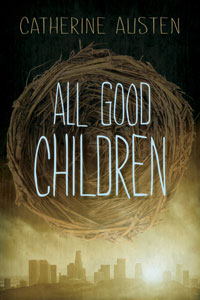
All Good Children

Austen, Catherine. All Good Children. Custer, Wash.: Orca Book Publishers, 2011. Print.
[Book cover credit: http://catherineausten.com/books_agc.html]

Booktalk:
We've gone too far treating children like they're precious when actually there are billions of them in the world and most of them are good for nothing.
p.97*
Yikes, right?

In a future not far from our own, Max is struggling to maintain his independence while everyone under the age of 18 is turning into some kind of zombie. The scary, do-what-you're-told kind, not the fun, brain-eating kind. They're being changed in the hope is that this program, called NESTing, will make sure that no child is "good for nothing." They will all be good doing what they're told.

Review:
All Good Children is a great book. The world that Austen has created really is a whole lot like ours could be in, oh, 50 years (or less). The majority of the population is desperately poor and living in cars they cannot afford to fuel. The (what we now call) middle class minority works in some capacity with the booming elder care industry. Everyone has an RIG that connects them constantly to entertainment, work, communication, whatever (ie, it's what iPad aspires to be). A chemical spill has created a whole region's worth of people born with physical deformities...that compete on a reality TV show. The cities are dangerous places, and everyone has moved to gated communities (actual communities rather than housing developments) for their own safety. That they've given up a whole host of civil liberties in exchange for that safety bothers almost none of them. They even give up the right to know what vaccinations are being administered in their children's schools and why their children suddenly have no discernible personalities. It's cool though, because they're just so darn well-behaved.

Max is not well-behaved. He never has been, and if he has anything to do with it, he never will be. He, along with his best friend Dallas, struggle to maintain their own thoughts and personalities while pretending to be perfectly "good children." Their struggle was awful, but their friendship was great.

The fact that Max's mom is Black and his father was white is not a constant issue, but it is an important one. In their own community, it is a non-issue (or it's supposed to be), but outside is another story. Without the visual aid of their father, Max's mom is always eyed with suspicion while traveling with Max and his sister Ally.

This is a really plot-driven book, which makes it hard to review; I don't want to give too much away.

Though it is published by Orca, it is not technically a hi-lo (high interest, low reading level). It's appropriate in both areas of measurement for the 12 and up set. It is, however, about a couple high school seniors and could be used as reading material for the same. I think it will be great for reluctant readers and dystopian lovers alike.


All Good Children comes out in in hardback in October!


Book source: ARC provided by the publisher through the LibraryThing Early Reviewers program.

*Quotes and page numbers are from an uncorrected proof and may not match the published copy.

Links to Amazon.com may be affiliate links for the Amazon Associates program. If you buy something through this link, I may receive a referral fee.

Wednesday, September 30, 2009

The Graveyard Book

Gaiman, Neil. Ills. Dave McKean. The Graveyard Book. New York: HarperCollins Publishers, 2008.
[Book cover credit: librarything.com/work/4479754]

Awards:
A Horn Book Fanfare Best Book (2008)
Cybils Award, Fantasy and Science Fiction - Elementary/Middle Grade (2008)
ALA Best Books for Young Adults (2009)
British Fantasy Award Nominee - August Derleth Fantasy Award (2009)
Hugo, Novel (2009)
Newberry Medal (2009)
World Fantasy Award Nominee, Novel (2009)
and more...

Booktalk:
You might think - and if you did, you would be right - that Mr. Owens should not have taken on so at seeing a ghost, given that Mr. and Mrs. Owens were themselves dead and had been for a few hundred years now, and given that the entirety of their social life, or very nearly, was spent with those who were also dead. But there was a difference between the folk of the graveyard and this: a raw, flickering, startling shape the grey color of television static, all panic and naked emotion which flooded the Owenses as if it was their own. Three figures, two large, one smaller, but only one of them was in focus, was more than an outline or a shimmer. And the figure said, My baby! He is trying to harm my baby!
p.15

And so Mr. and Mrs. Owens take it upon themselves to raise a living baby and protect him from the man Jack who murdered the rest of his family. Nobody Owens, as he is renamed, or Bod, as he comes to be known, grows up in the graveyard, learning things like how to Fade, Haunt, and Dreamwalk with ghosts and other non-living creatures for company.

But the man Jack is still looking for him. Bod should have died with the rest of his family, and the man Jack wants to make sure that he does.

Review:
I hadn't been putting off reading this book, per se, but it certainly was never at the top of my reading list, even though I've been wanting to read it since it came out. Then I read the Newberry acceptance speech Gaiman gave at the ALA conference. (It is available in the late summer issues of both Horn Book and Children and Libraries.) I don't know how, but Ihad forgotten just how fun Gaiman's writing is to read. He says in his speech that this book took him twenty years to write. It shows. I'm sure there are faults to be found in The Graveyard Book, as there are in any book, but I didn't find any.

For being set in a graveyard and opening with a triple murder, this book is a lighthearted story. It is told rather episodically, to span Bod's life from infancy to when he is 15 years old. As so much of his life is unchangeable, only the exciting bits need to be shared, such as his first living friend and a tutor who is also a Hound of God. Each chapter could almost be its own short story, with shared characters between them. Because of this, and because the language is just begging for it, The Graveyard Book would make for a wonderful read aloud, spread across weeks in a classroom, library, or bedtime setting.

This was a quick and enjoyable read. It's not a laugh-out-loud book, but it's funny in places. It's also really sad in places and really happy in others. I liked it a lot.


Book source: Philly Free Library

Monday, August 10, 2009

Coraline

Gaiman, Neil. Ills. Dave McKean. Coraline. New York: HarperCollins Publishers, 2002.
[Book cover credit: librarything.com/work/4183]

Awards:
Bram Stoker Award, Work for Young Readers (2002)
British Science Fiction Association Award, Short Fiction (2002)
Carnegie Medal Nominee (2002)
American Library Association Notable Children's Book (2003)
Hugo, Novella (2003)
Nebula, Novella (2003)
ALA Popular Paperbacks for Young Adults (2005)

Booktalk:
Coraline's family's new apartment has a door that leads to nowhere. Behind it is a brick wall. Naturally, Coraline must find out what is on the other side of that wall. When she does, she finds another mother, who cooks better food, another father, who is never too busy to play with her, and a bedroom very much like her own, except that the toys are much better. Sounds great, right? Well, everything does until you're told it's all you get. When Coraline realizes that the Other Mother wants to keep her for herself, trapped in this other apartment, Coraline must figure out a way to get out and get everything back to normal, which really wasn't all that bad now that she thinks about it.

Review:
Coraline, like Peter Pan and Alice in Wonderland before it, tells the story of a young girl who leaves her home for something more fantastical and exciting only to find out that what she had to begin with was pretty great. Of course, now that she's figured that out, she can't get back. Gaiman manages to take this trope and make it new and creepy and exciting. It's also missing that heavy dose of appreciate-what-you-have lesson that is present in many tellings of this type of story.

I read this in a day and loved every minute of it. I gave it to the girlfriend to read. She usually ignores my you-must-read-this-book advice where non-adult books are concerned. She read this and loved it too. If that's not a glowing recommendation, I don't know what is. :)

Book source: College library

Friday, July 31, 2009

Kids say the awsomest things

For a little background, the classrooms in the college library that I work in are being used all summer by a summer camp for smarties. These kids are supposed to be gifted young things who run from the art room to the science room to the computer room all day until someone has the sense to take them outside to run on the grass. For a while we had a camper incident of the day, the most exciting one was The Great Goldfish Explosion (crackers, not real fish). Recently, happily, we've moved on to camper cute quotes of the day.

Yesterday's quote came after the teenagers who chaperone the kids around campus lost a 5yr old. His best friend found him hiding behind a plant here in the library. Here is their conversation on the way out.
Friend: Why did you hide?
Hiding Kid: Because I just wanted to stay here.
Friend: Why?
Hiding Kid: It's so nice in here.
These kids are five.

Today's quote came early this morning. On their way out of the building a group of maybe 7-8yr olds were talking about their schedule for next week. We overheard:
"And on Monday we get computer class first! It's like a dweam come twue!"
Of course, the kid who can't say his r's yelled it out, making it that much cuter to all of us folks who only get to deal with stressed out grad students all summer.

What happens between when these kids stop going to camp (they have kids as old as 12 and the helpers start around 13 or 14) and when they enroll in college? Why can't we even entice them to come into the library with free food? The idea that kids magically stop needing programming when they hit 18 or when they become college students is clearly hurting us here. Have more ideas on the subject? Bring them to the new YALSA interest group for Serving New Adults. I know that I will be.