Showing posts with label romance. Show all posts

Wednesday, October 19, 2011

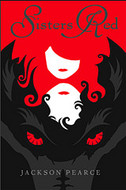
Sisters Red

Pearce, Jackson. Sisters Red. New York: Little, Brown and Company, 2010. Print.
[Book cover credit: librarything.com/work/8547268]

Booktalk:
"Versteck euch!" Oma March whispered hoarsely, pointing urgently toward her bedroom in the back of the cottage. Hide. Hide now.
...
"Schatzi, my treasures, I won't let him have you!" Oma March murmured under her breath, like a prayer. She dashed for the telephone and began dialing.
"Charlie? Charlie, one is here. Outside," Oma March whispered frantically to Pa Reynolds, the woodsman who lived down the road. "Oh god, Charlie, hurry," she pleaded.
p.4-5
But Pa Reynolds didn't make it in time, changing the lives of Oma March's granddaughters, Rose and Scarlett, forever.

Review:
Everyone was raving about Sisters Red when it came out last year, and I, ever the cynic, figured no book could live up to that much hype. So I skipped it. Even though it's a fairytale retelling of sorts. Even though it's a fairytale retelling of Little Red Riding Hood.

Sometimes I'm dumb.

Luckily, I'm willing to admit my mistakes, so when I overheard someone in the bookstore telling her friend how much she loved this book, I snuck up and grabbed a copy for myself. By "myself" I mean "my library,"* but Sisters Red is a book I would gladly spend my own cash monies on. I loved it, and my gushing while reading has already prompted a holds list, which is pretty unusual for a YA novel in my academic library. Here are just a few of the things I was gushing about:
  • Scarlett is so tough. She's deadly with a hatchet and harshly truthful and fiercely loyal and secretly proud of while being secretly self-hating because of her many battle scars. She feels overwhelmingly obligated to do the work that she does, and she's good at it. She's generally kick-ass.
  • Rose is so conflicted. She wants Scarlett to trust her to hunt alone, but she also wants Scarlett to need and protect her. She wants to remain half of a pair, but she also wants to break away into a different life. She's got wicked aim with throwing knives, and she holds Scarlett together when no one else can. She's generally kick-ass.
  • Silas is quite literally the boy next door. As such, he's managed to win the crushes of both Scarlett and Rose over the years. But he is first and foremost Scarlett's partner; they are a team and they act like one. He also manages to be first and foremost Rose's support. He pushes Scarlett to trust Rose on the hunt, and he pushes Rose to break away from hunting and live her own life. And he does all of this without being two-faced or playing one sister against the other. He totally gets that no matter how much Rose might swoon over him or how much Scarlett depends on him, he will never be able to compete with the relationship Scarlett and Rose have with each other. So he doesn't try.
  • The twist that Pearce puts on werewolf mythology is great. They're still totally evil people-eaters (unlike some other werewolves you may be familiar with), but they're not the werewolves of B-rated horror films (or Harry Potter) either. How she weaves the girl in the red riding hood into this mythology made me giddy. She's created a werewolf that is, a lot of the time, victim to his own senses and sensations. In showing how Scarlett and Rose manipulate these monsters, she completely immerses the readers in a rich fantasy: the one that Scarlett and Rose (with help from Silas) nightly create. 
  • None of this compares to the twist Pearce has put on the ending of her own story. I thought I had it figured out about halfway through the book, then I lost it, then I figured it out again, but by then things were so complicated that I didn't know how Scarlett, Rose, and Silas were going to pull it off.

Seriously guys, I loved this book. The opening hook worked like a charm, and by the end, I was reading with my heart in my throat. I was so invested in these characters. Pearce's second book, Sweetly, came out last month. I will not be skipping it.


Book source: bought it for and then checked it out from work!


* And, of course, i couldn't just get one book... They'll never let me out with the library credit card again.

Links to Amazon.com may be affiliate links for the Amazon Associates program. If you buy something through this link, I may receive a referral fee.

Wednesday, September 7, 2011

Texas Gothic

Clement-Moore, Rosemary. Texas Gothic. New York: Delacorte Press - Random House Children's Books, 2011. Print.
[Book cover credit: librarything.com/work/10612398]

Booktalk:
When Amy agreed to ranch-sit for her aunt, she envisioned a quiet, normal summer relaxing and feeding the goats. Unfortunately, her sister Phin, along with all of Phin's half-magic half-physics experiments, are also spending the summer at Aunt Hyacinth's ranch. And the goats climb trees. Amy has been balancing her normal self and her white magic family her whole life, so she's not going to let Phin and some misbehaved goats ruin her summer. The ghost that's taken a liking to her from the next ranch over, on the other hand...

Review:
There are two things that Clement-Moore does fantabulously: community and swoony guys. The ranch town in which Amy and Phin are spending their summer is great. It's not the setting, really, that's great; it's the people in it. They make this small town believable. There's the crazy grandad, the close-minded town folk, the local pothead, the nerdy college students, the local "royal" family, and the brooding son of those royals. We don't get to know all of these characters well; this is not a crowded book. And yet, these are not stock characters. Altogether, they are the town. They give the town a feel and a history. They make it a place. The town bar and the community picnics are just where they hang out.

And then there's the guy. Le sigh. Now, I'll be the first to admit that I have a weakness for rugged folk who wear cowboy hats unironically. But even if that's not your thing, this guy is sooo great. Ben McCulloch, literally the guy next door, is so swoony and angsty and responsible and gentlemanly. I fell for him, and hard, long before Amy figured out why Ben made her feel both frustrated and fluttery at the same time. Mark, one of those nerdy college students, isn't so bad either. His sweet and awkward flirting with Phin is so cute! The best part about both of them, though, is that they are both completely devoid of cheese. There is no heavy-handed romance talk or gazing into one another's eyes.

So the guys and the cast of characters are what made Texas Gothic great for me. Amy and Phin's relationship, the complicated ghost story, the small town rumors and legends, and the ranching drama were all added perks for me. These aspects of the story were just as strong as the ones I loved, and they might be what makes this a great book for you.


Book source: Philly Free Library

Links to Amazon.com may be affiliate links for the Amazon Associates program. If you buy something through this link, I may receive a referral fee.

Wednesday, July 27, 2011

Almost Perfect

Katcher, Brian. Almost Perfect. New York: Delacorte Press - Random House Children's Books, 2009. Print.
[Book cover credit: librarything.com/work/8205913]

Awards:
ALA Best Books for Young Adults (2010)
ALA Quick Picks for Young Adult Readers (2010)ALA Rainbow List (Fiction, 2010)
ALA Stonewall Book Award (Children's and Young Adult Literature, 2010)

Booktalk:
     She turned to me. "Hi," she said. "I'm Sage Hendricks."
     Sage had a deep but sexy, feminine voice, the kind you hear on ads for 900 numbers. I waited for her to say something else.
     "Dude," whispered Tim, jabbing me with a chocolaty finger. "Your line."
p.18
As soon as she walked through the classroom door, Logan became enamored with Sage. But love is seldom without complications, and Sage's hard-to-get act is hiding a doozy of one.

Review:
Almost Perfect, how do I love thee? Let me count the ways.
I love thine characters in their complexity and their completeness,
From their talk of motorboating to their genuine concern for each other
They make me think of actual teenagers rather than teen-aged "types."
I love Tammi's fierce love for her sister, masquerading as aloofness:
Most quiet need to protect and hope at the same time.
I love Logan's mother, who has done her best in trying circumstances.
I love Logan's cool and supportive older sister (who tries to help him get laid).
Logan, I love thee. Insecurities and bravery and insecurities again
In situations never expected, and with grace unmatched by peers.
I love every characters' flaws; none is the pinnacle of righteousness or political correctness.
Sage, the object of Logan's affection and mine, shines as brightly as her braces.
She lives in the belief that the world can be better and love worth the risk;
And, if God choose, she is right.*


Seriously guys, this is an amazing book, and Brian Katcher is an amazing author.** That might explain why I've been waiting for my turn to read it from the library since it was announced as the winner of the Stonewall in January. It was more than worth the wait. Everyone has talked about the Big Issue that Almost Perfect addresses, but I have yet to see someone talk about how the issues (more than one, even) are in perfect balance with the flirting and the humor and the sexiness and the teenage-guy-ness of the book as a whole.

I loved it. You probably will too.


Book source: Philly Free Library (but I'm gonna go buy my own asap)


*  To Elizabeth Barrett Browning, I extend my greatest thanks for the inspiration. And my apologies.


** And also a practical genius! The standard has been set, folks, any author's note containing lists of websites that offer support to queer or genderqueer or drug addicted or suicidal or [insert thing you don't want your parents to know about here] kids should also contain detailed instructions for how to clear your cache history.

Links to Amazon.com may be affiliate links for the Amazon Associates program. If you buy something through this link, I may receive a referral fee.

Tuesday, June 21, 2011

Dead Rules


Russell, Randy. Dead Rules. New York: HarperTeen - HarperCollins Publishers, 2011. Print.
[Book cover credit: librarything.com/work/10226008]

Booktalk:
It was the first time Jana had thought the words Dead School.
But that was it. She was dead. And she was in school. They should put the name over the door so you didn't have to guess when you first got here.
p.34
Worse than that, she's alone. Surrounded by other dead teens, sure, but she might as well be stranded alone in the desert without Michael. She's sure he feels the same way. And since she can't go back to him, he must already being trying to figure out a way to join her. And if he's not, well, she'll help him.

Review:
This book was pitched to me as a cross between Romeo and Juliet and Heathers. That was certainly enough for me, and I'm guessing it's going to be enough for a lot of you as well. If it's not, or if you're unfamiliar with the genius that is Heathers (or you're talking to a group of teens who've yet to see it), don't worry. Dead Rules is great, and familiarity with Heathers is certainly not necessary in order to understand this book. Some would say it is necessary for life in general, but I would never try to force my subversive loves on all of you (though the links above lead to some pretty great/convincing pics from the movie). ;)

Jana is absolutely heartbroken to be away from Michael in the afterlife. She is one of those girls who does not exist outside of her relationship. She even introduces herself as Jana, of Webster and Haynes (as in Jana Webster and Michael Haynes). I have to admit that I kind of hate those girls. In the beginning of this book, Jana was no exception. Luckily she pairs up with Mars Dreamcote (yes, it conveniently rhymes with dreamboat) pretty quickly. I don't know that I would have been able to stick it out through a whole book of her otherwise, and that would have been a shame. This book is more than just Jana and her longing for Michael. It's also about Jana's adjustment to the afterlife, Mars's lack of adjustment, Arva, Beatrice, Christie, Wyatt(!), the grays, and the virgins.

The social hierarchy of Dead School, like that of any high school, is complicated to outsiders, and I liked watching Jana figure out how to navigate and then ignore it. The sliders vs. risers was something that I wished was explained a little bit more, but it's clear that Jana (and we) find out everything that the students know about why most people end up in one of these two groups. Any more information would have made this a completely different book as it would have required more sleuthing and less Michael's-death planning. Getting all her information from other students definitely enhanced the story. As Jana gets to know her roommates, Mars's slider buddies, and other folks around campus, she also gets to hear their death stories, and I LOVED reading everyone's death stories. They very nicely ranged from the ridiculous to the very, very serious/tragic.

Overall, Dead Rules is a fun read! It's less romance-y than your average paranormal romance. In fact, it kind of pokes holes in the idea of blind devotion and teenage lurv that lasts for all eternity. That and the dark humor made it a great fit for me, and I think other readers who roll their eyes at flowery proclamations and super-serious feeelins will love it too (as will the average Heathers fan). Those looking for the story of a love that continues beyond the grave may not.


Dead Rules comes out today and is now available for purchase!


Book source: ARC provided by the publisher.

Links to Amazon.com may be affiliate links for the Amazon Associates program. If you buy something through this link, I may receive a referral fee.

Wednesday, May 25, 2011

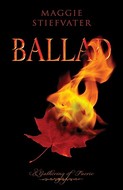
Ballad: A Gathering of Faerie

Stiefvater, Maggie. Ballad: A Gathering of Faerie. Woodbury, Minn.: Flux - Llewellyn Publications, 2009. Print. A Gathering of Faerie 2.
[Book cover credit: librarything.com/work/8109101]

This review contains no spoilers for Lament, and the book really doesn't either. And yet, this isn't quite a stand-alone book. There are a few things, especially in the stressful climax of the action, that will be a bit confusing if you don't at least have a vague idea of the first book.

Booktalk:
When people said "musician," they never seemed to mean "bagpiper." If I heard the phrase "folk musician" one more time, I was going to hit someone.
p.5
James and Dee, both fully recovered from their summer shenanigans (at least physically), have been recruited by a prestigious music school, miles away from the faeries they're hoping to leave behind. It should be a wonderfully enjoyable, life-changing experience, right? Except it's not. They're both still reeling from the love-proclamation-that-never-was, and neither of them plays the "right" kind of music for their prestigious school. And the faeries have followed them.

You'd think two people as experienced in the practical consequences of faerie lore as James and Dee would have known they'd be surrounded by faeries at a school named Thornking Ash.

Review:
I love James. In fact, I capital "L" Love him. He's funny and snarky and smart and oh-so-flawed. He's also hopelessly stuck in the friend-zone, and the story he tells from way over there is both hilarious and tragic. That's right. This book is all about James. Even the parts of the story that are told from other points of view are all about James. It's great. He deserves it.

Ballad contains some serious faerie shizz. There's a wack-job wielding an iron crowbar, mysterious singing accompanied by a guy with horns growing out of his head (possibly king of something ;) ), teachers who wear iron jewelry, and the return of Eleanor, Lament's faerie queen, but what this book is really about is how James finally figures out that girls like him. At the opening of this book, his heart is continuing to break over Dee. Still, he finally allows himself to revel in the attention of another woman (and though it gets steamy in a few places, it's totally an intellectual romance). He also finally gets to have some guy friends, even if his closest buds consist of Paul, his oboe playing roommate, and Sullivan, his English teacher/dorm parent. Even at Thornking Ash and without Dee (who contributes with text messages never sent between chapters), James figures out how to be happy.

And this is a Stiefvater book. As you can see, this woman knows how to put words on a page. Her characters are all fully-fleshed people, many of whom I would die to eat Chinese take-out with on a Saturday night. They're funny and smart and a little nerdy. This would be a great book for John Green fans who want to ease into fantasy, or vice-versa.

So far, there's no word of another book in this series, but I still want to throw this out there: Stiefvater, if you're listening, the world could use more James.


Book source: Philly Free Library
Book 1: Lament: The Faerie Queen's Deception

Links to Amazon.com may be affiliate links for the Amazon Associates program. If you buy something through this link, I may receive a referral fee.

Friday, January 28, 2011

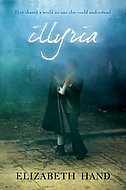
Illyria

Hand, Elizabeth. Illyria. New York: Viking, 2010. Print.
[Book cover credit: librarything.com/work/2569090]

Awards:
Shirley Jackson Award Finalist (Novella, 2007)
World Fantasy Award (Novella, 2008)

Booktalk:
No one had ever heard of DNA back then, not in my family anyway, and our grasp of genetics was practically nonexistent. But, because our fathers were identical twins, their children had all been told -- warned -- that we were closer than the other cousins.
"More like stepchildren," said Aunt Dita.
"Half-brothers and -sisters," my mother corrected her.
"Kissing cousins," said Aunt Roz. That would be the cue for everyone to cast a cold eye upon Rogan and me.
p. 8-9

Review:
Illyria feels like it's set in some make-believe world where eccentric aunts never age, miniature theatres come to life, every house has a ghost light, and where Maddy's childhood crush on her cousin Rogan can turn into a not-so-secret love affair. But it's not. Maddy and Rogan's story takes place in a cul-de-sac in a town outside New York City populated by the descendants of a once well-known actress. But that doesn't keep any of the above from being true. Hand just makes it all seem surreal.

In this not quite a fantasy world, the ick factor of Maddy and Rogan's relationship is missing. There is disapproval from the family and their classmates make fun of them, but their romance is just another (doomed) romance. And it is doomed, right from the beginning, and not just because they're cousins. There is something off about Rogan, something that sets him apart from everyone else, and it's what attracts Maddy to him. It haunts the entire story in the beautiful way that it haunts Maddy. It stays with you.

I know I'm not doing this book justice, but that's hard to do with my overwhelming book crush! Seriously, everything about this book is lyrical, magical, gorgeous. But just in case you're interested, here are a few more reviews from:

Liz @ A Chair, A Fireplace & A Tea Cozy
Jenny @ Forever Young Adult
Tasha @ Kids Lit (Menasha Public Library)


Book source: Philly Free Library

Links to Amazon.com may be affiliate links for the Amazon Associates program. If you buy something through this link, I may receive a referral fee.

Monday, October 25, 2010

Personal Demons

Desrochers, Lisa. Personal Demons. New York: Tor, 2010. Print.
[Book cover credit: librarything.com/work/9527854]

Booktalk (kind of):
I want to think of something clever and interesting to sum up the plot of the book and get you interested, and I almost never use the jacket copy or internet summaries, but what it says right on the cover is just too good to pass up:
If you had to choose between Heaven and Hell, which would it be?

...Are you sure about that?
Awesome, yes? But in order to give you a little more info about the set-up, I'll try again:

Frannie Cavanaugh is a pretty average girl: one of 5 sisters all (really) named Mary, kicked out of Catholic school, expert in Judo. Like I said, pretty average. Until Luc shows up, shortly followed by Gabe. Two new guys at school, one smolderingly hot and sexy, the other the real life embodiment of what Calvin Klein was trying to do with all those blond male models in tighty-whiteys. And both seemingly enamored of Frannie and determined to win her for his own. But this is no (un)friendly rivalry or game to get the girl. Luc and Gabe are battling each other to win Frannie to their side, and who she picks may determine the fate of the world.

Review:
Look at that cover and then look at my little blurb again. It seems like Personal Demons could be an overly dramatic teenage bodice-ripper involving "heavenly bodies" with "hellish consequences" (it's a euphemism if it's in quotes) among other things. It's not. True, there are some Very Big Things going on here, and the potential to be over the top about it is high, but Desrochers manages to make this story focus on Frannie and her inner turmoil about these two guys who suddenly want her, her unwillingness to let people in, and her discomfort around religion in general.

Told in alternating points of view, Frannie and Luc's, Personal Demons is not only really damn steamy, it's also a refreshing look at the start of a relationship. In YA lit, it seems that we're always treated to the girl side of the equation, and more often than not, that girl is insecure about where the relationship is going. We get that here, and Frannie certainly has a LOT to be worried and insecure about with Luc, but we also get the other side. The parts of the book from Luc's point of view were my favorite. Not only has he had centuries to perfect his wit, making him both funny and insightful,* but he's also just as insecure as Frannie. She's supposed to be his mark; he's been sent from the depths of Hell to tag her soul for eternity. He is knocked on his butt by his genuine attraction to and feelings for Frannie. I love seeing a guy in YA go all googly eyed (without turning stalker or otherwise creepy) over a girl...even if this guy is a demon.

There is so much else that Personal Demons has going for it. I don't want to make this unreadable long, so I'll try to just touch on a few other points of greatness here:
  • Frannie has awesome friends who threaten to beat up Luc if he messes with her. 
  • Frannie has hilarious sisters (all named Mary) who aren't so fleshed out that they crowd the story, but are all there and manage to be supportive anyway.
  • Frannie's Grandpa! He's great. Just so so great. He's supportive of Frannie in a way that the rest of her family is not. They all want what's best for her (which is wonderful); he trusts her to figure out what that is for herself.
  • There are multiple deep discussions about forgiving oneself as well as a serious look at whether or not there is anything that is unforgivable.
  • Frannie's discomfort with religion is explored in a sensitive way along with why bad things happen to good people.
  • By the end of the book, Frannie, Luc, and Gabe all learn a lot about love and sacrifice.
I really loved Personal Demons, and I wasn't sure I would just by looking at it. It fits in nicely with other paranormal romances (though it's way sexier than most), but it also looks at some more serious issues. The paranormal aspect brings all of Frannie's existing issues (religion, forgiveness, her inability to let her guard down) to the forefront, but the hot demon and sexy angel roaming the halls of her high school do not cause her story to exist.


Book source: Review copy provided by the publisher.


*Best line in a book EVER (with some context):
Because I love her.
That's got to be what this feeling is--the giddy rush I feel when I look at her, the way all my insides scream when I think about Belias taking her, the insatiable need I have to be with her. How is that possible? There's no crying in baseball and no love in Hell. It's just the rules.
p.193 (bold emphasis is mine; the italics are all Desrochers)

Saturday, October 2, 2010

Jane

Lindner, April. Jane: A Modern Romantic Retelling of Jane Eyre. New York: Poppy - Little, Brown and Company. 2010. Print.
[Book cover credit: librarything.com/work/8873909]

Booktalk:
After the death of her parents, Jane finds herself running out of options. With no money to pay for school and no home to go to when the dorms close, she applies for work at a nanny agency. Jane's never been overly social or interested in pop culture, facts that made her a bit of a loner at Sarah Lawrence, but they make her the perfect candidate for a nanny position in the home of world-famous rock star Nico Rathburn. After reading through internet archives of tabloid stories about Nico Rathburn's sordid life so far, she expects to have to babysit through a constant drunken party. Instead she finds life at Thornfield Park to be calm and her charge's life to be almost normal. And Nico Rathburn isn't the playboy she expect either.

Review:
In the review of a book like this, a modern romantic retelling of a classic, you might expect a bit of commentary about how the retelling relates or compares to the classic. There are plenty of reviews of Jane out there already that do that, so I'm not going to. Also, I've never read Jane Eyre, which would make the comparison a little difficult. More importantly, I've never had any desire to read the original, and yet Jane was one of the new books I most eagerly awaited this fall. Because, really, who hasn't had a daydream (or two) about a chance meeting with a rockstar/actor/hot guy in French class where you fall in love and live happily ever after in a mansion?

Well, Jane Moore apparently never had that daydream. She's very serious and very artistic at the same time. I bet her doodles never involved practicing her Mrs. Nico Rathburn signature (or any other future signature, for that matter) in middle school. That's why when she gets to Thornfield Park and finally meets Mr. Rathburn (who looks just like Russel Brand in my head), the guy all the guys want to be and all the girls want to date, she's completely blindsided by the feelings she develops for him. From the very beginning, Mr. Rathburn takes Jane seriously and values her opinion, not only because she's basically raising his daughter Maddy, but because he sees intelligence and value in her. The problem is that with their real big age difference (which I would have loved to see addressed or at least acknowledged at some point) and his role as Jane's employer, she's never sure if he's interested in her as Miss Jane, Maddy's nanny, or in Jane, all on her own.

What follows is a book's worth of "does he like like me?" introspection and touching moments that will generate enough butterflies in your belly to last a lifetime. It's practically a fairytale in its perfection...

And because the real plot of the story starts so far into the book, this might be considered a bit spoilery. Proceed at your own risk:
...until you realize that you're reaching the happy ending only about 2/3 of the way through. With happily ever after right within their grasp, the world comes crashing down around Jane, Maddy and Mr. Rathburn. If you're familiar with Jane Eyre, this mini-apocalypse probably won't be all that shocking, but I was completely thrown for a loop, as was Jane. And she runs from it. Jane, on her own and without a plan, gets to pull herself up by her bootstraps and figure out what she really wants in life for the first time since her parents' death. As much as I loved the lovey-dovey parts of the book that led up to this, Jane on her own was the best part. It finally gives her time to mourn the loss of her family, both her natal family and the family she had been building with Mr. Rathburn. She becomes more than the mousy youngest sister, the proper nanny, the "Plain Jane" that managed to snag Nico Rathburn's heart. I definitely liked her more as a character for her growth and found all that happens after much more believable. I get why all Jane's growth had to happen so far into the book, plot-wise, but I wish Jane had been a more realized person from the beginning. I don't think it's a problem with the characterization or the writing; I think it's just that Jane was kind of coasting on auto-pilot up to that point, or as auto-pilot as one can be when dropping out of college to be a nanny.
Done with the spoilers.

In short, this is the story of a great romance. It combines all those timeless, delicious feelings of a first love with the glamor of the rich and famous and the realities of how real life can intrude on both.


Jane comes out on October 11th! But it looks like it's already available for purchase on amazon.


Book source: ARC provided by the publisher

Saturday, September 25, 2010

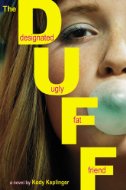
The Duff

Keplinger, Kody. The Duff (designated ugly fat friend). New York: Poppy - Little, Brown and Company, 2010.
[Book cover credit: librarything.com/work/9731272]

Booktalk:
Bianca is having a rough time of it. Her mom is out of town a lot. Her two best friends insist on dragging her to The Nest, a teen nightclub, every weekend. She still can't form coherent sentences in front of her long-time crush. And then Wesley, a world-class sleaseball sits down next to her at the "bar," and tries to make friends. It'll up his chances of nailing one of Bianca's hot besties, he says, being nice to their Duff, their designated ugly fat friend who they only keep around to make themselves look hotter. So Bianca does what any self-respecting girl would do: she throws her cherry coke in his face. And then she makes out with him?

Review:
I started this book ready to be disappointed. There's been so much hype, and not all of it good, that I didn't think The Duff could possibly live up to it. Then I opened it and found a pessimistic, foul-mouthed main character that I didn't think I'd grow to care about. I brought an extra book with me to read on my commute so that i could put this one down as soon as I'd read the obligatory 50 pages (this is my personal rule for books sent to me for review). Next thing I know, I'd almost missed my train stop because I was so sucked in.


Bianca's relationship with Wesley is clearly complicated, though she tries to play it off as the simplest thing ever: just sex. Wesley seems okay with this arrangement and helps Bianca keep up appearances at school and everywhere else for a while. They hate each other. He's a man-slut, womanizing, cocky little brat, representing everything that Bianca, a smart and confident young woman, despises. And he calls her "Duffy," constantly reminding her that he's way out of her league and that their relationship could never go public. For the most part, they maintain a snarky banter both in and out of the bedroom (it's very 10 Things I Hate About You). Until they don't. Bianca is having some very real problems at home that she's avoiding by spending all of her time with Wesley. She can ignore things when she's with him; her friends will want to help and make her talk about it. Wesley just asks her if she's okay and then listens; he doesn't push. Maybe this is because he doesn't actually care (likely in Bianca's opinion) or maybe, as she comes to figure out, it's because he has real problems that he doesn't want to talk about either.

Other reviewers have said that the relationships between Bianca and her friends is what "saved" this book for them. Their friendship is sweet, fierce and awesome. They build each other up with nary an insult. Bianca ditches her friends for Wesley and doesn't even tell them about him. I think this happens a lot (it certainly did when I was in college), and to see it portrayed here was great. Bianca's friends are both pissed and worried, and both those sentiments are clearly expressed. No one is one-dimensional. When Bianca finally spills all to her friends, they (mostly) forgive her. Casey decides to make the word duff theirs. Instead of having a fat day or a bad hair day or even a zit, they say it's their turn to be the Duff. Though the word catches Bianca off guard throughout the book, it loses it's power to make her feel ugly and fat, exactly what the word is supposed to imply.

Overall, I enjoyed this book. It's all about relationships, between Bianca and her friends, Bianca and her parents, Bianca and Wesley, but it's not weighed down by emotional drama. Sure, there are really emotionally draining parts of this book, especially when it comes to Bianca and her parents, but they are tempered by sarcasm, sex, and Bianca's own personality.


Book source: ARC provided by the publisher.


Now, about the SEX:
Feel free to skip this part. I wrote my thesis on Forever... by Judy Blume and its effect on the uses and appearances of sex in literature for girls, and I saw in an interview (that I can no longer find - if it was on your blog, let me know so I can link to it!) that Keplinger was inspired by the frank discussions of sex in Forever... when writing The Duff. I can't let that just go without comment and comparison.

Now, in Forever..., there is a whole chapter about going to Planned Parenthood for birth control. There is an author's note in every edition published since AIDS became known and prevalent about how birth control is no longer enough, protecting oneself against STIs is just as important as preventing pregnancy. This information, both in the PP chapter and the author's note, are pretty separate from the story. Yes, going to PP is a turning point for Katherine, showing that she's ready to have sex, but the wealth of information about exactly what happens in a birth control appointment has nothing to do with the story. It's there so that readers aren't afraid to make that appointment themselves; it's showing them how to do it in real life.* It's very didactic. It's very 80s. For a book published in the 70s, it was very ahead of its time.

We don't get that in The Duff. This book has boatloads of sex, but it's not the this-is-how-it's-done sex that appears in Blume. The sex in The Duff is not graphic. It doesn't happen "off-screen," but the reader is not treated to a play-by-play all that often. What is present, however, is the word condom every time Bianca and Wesley do it. It's much more subtle than Blume's way of telling readers to use precaution, but because of that, it's less likely to be skimmed. It's right there in the story. It's natural, almost taken for granted, that Wesley and Bianca will use a condom every time. Later on, Bianca mentions that she's been on birth control for years. It's no big deal. She went on birth control (with her mother's knowledge) when she started having sex. It's just what you do.

Unfortunately, I don't think either approach is all that realistic. It is for some teens, thank goodness, but not for all. Both books also show a teen pregnancy or pregnancy scare. Blume is, again, way more obvious about it. If you don't do as I've shown you, you'll have a baby instead of going to Smith! But Keplinger, too, aims to show consequences. When Bianca is talking to Vikki, the school slut, about her pregnancy scare she thinks, "Had all of this made her realize the consequences of her choices? Our choices" (256).** Even though Bianca is on birth control and is sleeping with a guy who buys condoms in bulk, she recognizes that she and Vikki could easily be in the same boat. It's a huge a-ha moment for her. Calling Vikki a slut doesn't make Bianca anymore of a virgin or less likely to get knocked up. Calling someone else a duff doesn't make her more beautiful. The lesson is different, but it's told in the same way.

Something that I did think is way too realistic in The Duff was the treatment of oral sex, something that isn't even broached in Forever.... The thing that bothered me is that when Wesley, who always always has a condom in his pocket, goes down on Bianca, he doesn't use any kind of protection. The idea that oral sex isn't real sex is prevalent among teens. It's dangerous. I was a little disappointed that Keplinger had been SO GREAT throughout the book with the condoms and the birth control (and all without breaking up the story!), but didn't even mention a dental dam here. But turning a condom into a dental dam would have created a "let's go to PP" chapter in an otherwise clever and not remotely heavy-handed book about safe sex. It's still a little upsetting though.

I don't know if Keplinger meant for The Duff to be about safe sex so much as it was about how running away from your problems doesn't solve them (with a lot of sex). Regardless, I applaud her efforts to portray responsible choices even in the midst of an "enemies-with-benefits" relationship where sex is had for all the wrong reasons.


*For a more extreme example of this tactic of providing information about something some might think is squicky or controversial for young readers, see the "I'm bleeding to death from between my legs" chapter in the Alanna: The First Adventure. Getting her period has nothing to do with the story, but everything to do with being a preteen girl, as Alanna is.
**Quotes and page numbers were taken from an uncorrected proof and my not match the published copy.

Friday, September 17, 2010

Low Red Moon

Devlin, Ivy. Low Red Moon. New York: Bloomsbury, 2010. Print.
[Book cover credit: bloomsburykids.com/books/catalog/low_red_moon_hc_105]

Booktalk:
Avery's childhood was a bit isolated, but never lonely. She lived in the woods with her mother and father. Her father wrote for the local paper, her mother made jams and taught Avery at home. Then someone, no something, took it all away and left Avery lying in her parents' blood with no memory of what happened to them. Now she's living with Renee, her estranged grandmother, in town and going to school to try to distract herself from all she's lost. That's where she meets Ben, beautiful Ben who moved to town just before her parents died and is the only person who is as comfortable in the woods as Avery is. Just when Avery thinks she might be able to move on, weird things start to happen: her father's friend tries to buy his land, Avery's hair turns blood red, and another land-owning family in the woods turns up dead. Avery knows she has to find out who killed her parents before anyone else dies, and she's terrified that Ben has something to do with it.

Review:
Low Red Moon is paranormal romance at its best, but it is also so much more. It is also a book about a girl who is dealing with the loss of her parents. Avery, who has little to no relationship with her grandmother even though they are so close geographically, just wants to go home, but when she finally makes it to her parents' house, it's not longer home without them there. It's also a murder mystery with some all-too-human players, such as her father's friend who wants to turn the woods into a strip mall. With all of this going on, you might think that the paranormal romance aspect of the plot might push everything over the top, but it is actually what makes everything gel together.

As in all your favorite paranormals, Avery and Ben have an almost immediate feelings for each other, a bond that goes (a bit) beyond attraction (though there are plenty steamy make-out scenes). But Avery is not the swooning type. She does not also immediately trust Ben or follow all of his for-your-safety commands (why do these paranormal guys all think they're love interest are so freaking helpless?). She reserves a bit of herself for, well, herself, even as she throws herself headlong into a pretty fast-moving relationship with Ben. It is during one of their massive make-out sessions that she discovers a patch of fur on his back. Not man-sweater fur, actual fur. The fact that Ben is more than human (werewolf, to the rest of us) terrifies her, even though Ben swears he would never ever hurt her. Ben, who she feels can see into her soul. Ben, who is a distractingly good kisser. Ben, who is a certifiable monster and moved to the woods near her parents' house just before they were murdered. Ben, who also doesn't remember the night they died. Avery makes the mental jumps that any rational human would make.

I don't want to say too much more. While reading, my head was split between thinking that of course Ben killed Avery's parents and thinking, as paranormal romances have been teaching me since Twilight, that tru lurv conquers all and that Ben couldn't have possibly hurt her parents. Even though Avery and Ben hadn't met yet when they died. And even though Ben has a really good reason for wanting Avery's dad to shut his pie-hole. I was torn between the romance and the facts as we know and see them, just as Avery is. Her struggle is real and by the time she opens up and asks for help and advice, it looks like it might be too late.

About the romance: I know there has been a lot of criticism around the blogosphere about the unexplained attraction that is mistaken for love in all of these paranormal romances. Well, that's probably what's going on here too. Instead of this being a chaste "love" story (not that there is anything wrong with chaste teenage romances!) all about how hot the other person is, Avery and Ben get it on. They're attracted to each other, so they make out, feel some crazy connection to each other when they kiss, and think they're in love. Let's be honest, there's nothing all that paranormal about that. It happens to young adults, in books and in real life, all the time. As much as I wanted them to have a more meaningful relationship, it is pretty realistically portrayed. With all that is going on in Avery and Ben's lives, they don't have a ton of time to go get coffee and get to know each other. Does that mean they should constantly make-out in alleys? No, but they do. We can only hope that if Ben is not a crazed mass-murderer that they'll go back after this is all over and find out each others favorite colors.

Also, that hair turning red thing that I dropped into the booktalk? It's important. It's just dropped into the beginning of the book and its weird and scary when it happens. It's just left hanging until everything comes together in the end. It's super-subtle foreshadowing that makes you want to re-read to see if you pick it up the meaning the second time around.


Low Red Moon came out earlier this week and is available for purchase. The published copy also has 60 more pages than the arc I reviewed, allowing me to let a few holes in the story pass as I hope they're patched up by now.


Book source: ARC picked up (and signed!) at ALA

Friday, August 27, 2010

Infinite Days

Maizel, Rebecca. Infinite Days. New York: St. Martin's Griffin, 2010. Print.
[Book cover credit: librarything.com/work/9793458]

Booktalk:
Lenah's life as a vampire was one full of misery, her own and the misery she inflicted on her thousands of human victims over the centuries. Then, after a century long nap, she wakes up as a human. The torment of the vampire existence is gone, replaced by the range of feelings and senses we humans take for granted. But Rhode, her maker and soul mate, site in front of her dying so that she can live again. A new kind of misery. But Lenah is now human and humans are resilient creatures with much shorter memories than vampires. If Lenah can make a life for herself in the boarding school in which Rhode has left her, maybe she can survive without him and in spite of all the other vampires she has left behind.

Review:
Woohoo! The vampire is scary again! This is not a horror book because Lenah is no longer a vampire, but in her flashbacks to her former un-life, she is eeevil. But Lenah, and her coven of sexy vampire men, still have a few tricks up their sleeves, such as the one that allows Lenah to be human again. I love that Maizel added to vampire lore and myth without completely ignoring traditional vampire tales. This allowed her to focus on what made Lenah and her coven different from traditional vampires without making that the focus of the story. Unfortunately, even though it wasn't the focus of the story, the vampire parts were my favorite parts.

Lenah as a human was not my favorite person. I wouldn't say Lenah as a vampire was my favorite either because she, you know, ate people for fun, but at least she was interesting. I get that having just watched the love of her un-life sacrifice himself for her, Lenah wouldn't be the peppiest person on the quad. I also get that having been unconscious for 100 years, Lenah finds a lot of things weird, offensive, alien, whatevs. I'm fine with all of that. And so is Tony, the cute Japanese-American scholarship student who befriends her. Even though odd things are always coming out of her mouth and she never seems to know what's going on even though she's obviously a smarty-pants, Tony takes Lenah under his wing, shows her around campus, teaches her how to drive (Rhode left Lenah a seriously amazing car, in addition to the steamer trunk full of cash in her PRIVATE APARTMENT on the top floor of her boarding school dorm), and inducts her into the woes of bathing suit shopping. He's the best best friend a girl could ask for, especially a girl in Lenah's situation.

When Tony falls in love with Lenah, she knows about it but doesn't acknowledge it. No problems there. Things like this happen. And it's awkward. Instead, broody Lenah who wears all black, works in the library, and whose biting wit is almost as evil as her former, well, bite, falls in love with The Jock. You know the one. He's the star of everything he touches, all the guys want to be him, all the girls want to do him, and he's dating the hottest girl in school. In his defense, Justin does not fall into the 80s movie stereotype of a jock; he really is a nice guy (except for the fact that he continues dating the hottest girl in the school while he pursues Lenah, right up until the moment when he knows he's won Lenah over and it's safe to dump the girlfriend, but that's a whole different rant). When Lenah and Justin finally get together, it's like everything clicks into place for Lenah. She's no longer a stranger in a strange land. No transition, no learning stuff, she just all of a sudden belongs in a New England boarding school in 2010. It's like magic (barf). But Justin's nowhere near as in tune to Lenah as Tony is, and she ditches Tony for him. She doesn't just choose Justin over Tony romantically, that I would have been fine with as it's almost never a good idea to date your friends. Instead, Lenah pulls an "If you can't immediately and 100% support my true lurv that I just discovered yesterday, even though we both know that you're secretly in love with me and this might be hard for you, then we can't be friends."

Tony, my favorite character in the whole book, the only one besides (dead) Rhode that I really liked, just fell out of the book. And I sort of lost my interest.

But the vampire lore was pretty cool, as were the flashbacks to Lenah's un-life (and don't worry, Maizel is not nearly as dorky as I am and does not refer to it that way). Rhode and Tony are both drool-worthy side characters and make the book worth reading, at least for me. And the ending is really intense. I have no idea how it is a set-up for the start of a series, though. The end seemed pretty definitive to me, but in a world where vampires can return to human form, I guess nothing is really all that permanent.


Book source: Review copy from the publisher through the LibraryThing Early Reviewers program

Friday, August 13, 2010

The Girl Next Door

Castrovilla, Selene. The Girl Next Door. Lodi, NJ: WestSide Books, 2010. Print.
[Book cover credit: librarything.com/work/9838360]

Booktalk:
Sam and Jesse have been best friends since they bumped strollers in the elevator of their building. They've grown up doing everything together, and though Sam has been in love with Jesse since that fateful day when they were two, Jesse sees Sam as the girl next door, not girlfriend material. All that changes when Jesse gets sick. He cuts everyone out of his life except Sam. Suddenly, without the distraction of the rest of the world, he sees her for what she's always been: perfect for him. But will Sam ever believe that he's really in love with her and this isn't just a romance of convenience? And will that even matter if Jesse never gets better?

Review:
When I was in junior high, I was really into books where someone dies. Kids with cancer, car accidents, loving but ancient grandparents; these were my books. I don't know why, but I loved sad books. Girl Next Door is the more grown-up version of those books. Death is more than a possible ending for this book; it is practically the setting and a main character as well. Jesse and his mother are, of course, consumed by Jesse's sickness, but so is their housekeeper Maria, Sam, and Sam's mother and little brother. Sam especially. She starts to fail out of school, she moves into Jesse's room, and she lets everything that is not Jesse fall to the wayside. She desperately wants Jesse to live, but she knows that it's very possible that she has years and years to catch up on things like high school while she may only have months (if she's lucky) to spend time with Jesse.

It is unbearably sad.

More sad than the situation itself is the way that Sam deals with it. She truly becomes a shell of herself, her sole purpose to make Jesse as happy and as comfortable as possible. The prime example of this, and one that causes more than a few problems for both Jess and Sam, is that she crawls into bed with him based on nothing more than her lifelong crush and Jesse's wish to not die a virgin. He doesn't fall in love with her until afterward. With that kind of a set-up, of course she doubts Jesse's feelings for her! She's available and willing to put out (and make sandwiches and clean up when he pukes them up later) all the time. Even though her doubts linger for a whole lot of the book, Sam never backs up, sets boundaries, or ASKS Jesse about his feelings for her. She just clings to him all the more. When her mother finally notices that Sam has gone to the bad place over Jesse and over Jesse's illness and makes Sam see a therapist, Sam won't go without Jesse.

Sam's so desperate throughout the whole book, not only to have Jesse live but to be Jesse's whole life the way he has become hers. To be honest, it made me uncomfortable. I wanted for someone, her mom, her therapist, Jesse, to make Sam see that she needed to be her own person in order to survive when Jesse may not. They all tried, but it never really sunk in. Even when things start to get a little bit better, Sam is still all about Jesse. Their relationship becomes more healthy than it is in the beginning, but Sam is never just Sam. All about the ending spoiler: I think if the book allowed us to see Sam after Jesse's death and see her grow from this experience a bit, it wouldn't be so bad. Even on his deathbed, Jesse is trying to explain to Sam that she needs to go on and she is quoting the "Evermore" lines from a poem he wrote to her. I know that the end is peaceful, but as it is written, I have no faith that Sam will be able to pull herself out of her grief and do all the things she promised Jesse that she would: finish high school, go to college, fall in love again.

Still, I don't know that teen readers will have the qualms about Sam that I do, and even with my worry for Sam and discomfort over the way she was portrayed, I was totally sucked into this story. I cried. And I would have eaten this book up when I was in junior high/early high school. It is a really good sad story.


Book source: Review copy from publisher

Friday, August 6, 2010

The Dead-Tossed Waves

Ryan, Carrie. The Dead-Tossed Waves. New York: Delacorte Press - Random House Children's Books, 2010. Print. The Forest of Hands and Teeth 2.
[Book cover credit: librarything.com/work/8363459]

Booktalk:
Gabry always follows the rules, does what she's supposed to. She's grown-up watching her mother kill the Mudo that wash onto the beach at every high tide; she knows that the rules are there to keep her safe and she knows the consequences for breaking them. Still, she lets herself be convinced to climb the barrier to hang out under the ruins of a roller coaster with a bunch of other kids. Cira, her best friend is going and so is Catcher, Cira's big brother and the object of Gabry's secret affection. Everything starts out perfection. She even gets some alone time with Catcher, which is why she's so far from the rest of the group and able to escape back to Vista when a Breaker shows up, biting and infecting Gabry's friends.

Review:
I wasn't that big of a fan of The Forest of Hands and Teeth, and when this book, its sequel, finally came out, I decided I wasn't going to bother. But there is was, staring at me from the library shelves, and I had to grab it. TFoHaT left me with lost of questions about the Sisterhood, life after the return, and the survival of Mary and crew. And I wanted answers, dammit! The Dead-Tossed Waves held the possibility of answers and a story about the new generation of folks post-return besides. On some level it delivered, but on another, not so much.

All of my leftover questions from TFoHaT were answered, kind of, all in about 5 pages towards the end, and those answered were satisfying. Buuut those answers did not justify the rest of the book for me. There was less monotony and repetition in this book than in the last; really and truly a lot happened. Buuut it still didn't do it for me. A lot of the book was Gabry's reactions to what was going on around her, especially what went on between her and Catcher and her and new guy Elias. And, well, I didn't like being in Gabry's head. There were SO MANY TIMES that I wanted to shake her because she would read a situation as completely opposite of how I read it and/or completely opposite of what was actually going on. It helped to build tensions and intrigue the first couple of times she thought one of the boys was disregarding her or brushing her off when in actuality they were trying to profess their undying love, but when it happened EVERY TIME THEY TALKED, it got a little old.

And I have lingering questions. Again. These questions might convince me to pick up The Dark and Hollow Places when it comes out next March, but little else will.


Book source: Philly Free Library

Monday, July 5, 2010

The Dark Divine

Despain, Bree. The Dark Divine. New York: Egmont USA, 2010. Print. Dark Divine 1.
[Book cover credit: librarything.com/work/8363496]

Booktalk:
This is the epitome of the girl with a big brother experience: your best friend has a crush on your brother, you have a crush on your brother's best friend, and your brother and his bestie have no idea that you or your bestie exist. At least not in that way. Grace's situation is slightly more complicated. Her best friend, April, has a crush on her brother, Jude. Jude, not having a mean bone in his body, knows April exists and makes sure she and Grace get to hang out with him and the other seniors at least some of the time. Other than that, Grace is left completely out of the equation. Then Daniel comes back. Daniel, Jude's ex-best friend. Daniel, the guy Grace has been in love with since she was a little kid. Daniel, the only guy Jude wants no where near his little sister. The only person Jude can't forgive. The only person Jude has ever called a monster.

Review:
I was skeptical about The Dark Divine at first glance. It is a story featuring Grace Divine and her siblings Jude, Charity and James, Pastor's kids all. It seemed like a bit of overkill. And it's a paranormal romance. And when it first came out it inspired nail polish giveaways all over the blogosphere. But it's not cheesy, and it's not overkill. For a book about PKs there is surprisingly little to no religious overtone. Don't get me wrong, religion, the physical location of the church, and Christian mythology are all very important to the story. I really want to tell you why, but the best part about reading this story, for me, was not knowing anything about it, really, in advance. Just trust that Despain does not throw a ton of stuff at you without context. Everything that needs to be explained is, without an obtrusive info dump in sight.

On the surface, Grace is trying to figure out the cause of, and therefore mend, the riff between Daniel and Jude. Whatever happened between them caused Daniel to disappear for years and caused the whole Divine family to pretend he never existed. When he suddenly returns, Grace is drawn to him, and not in the magical "We have a future destiny/past connection with each other" kind of way, but in the "We grew up together and I've had a crush on your since time immemorial and now you're back and broody and angsty and muscle-y" kind of way. I love this about their relationship. The scenes that we've all come to know and love (maybe) in paranormal romances are there. Daniel and Grace have plenty of tense conversations where he tries to convince her that he is too dangerous for her, but these scenes are tempered with flashbacks to their childhood together and the kind of flirty banter girls the world over share with their brothers' friends.

But for all their normalcy, Jude cannot stand Grace around Daniel, and Grace can't resist him. She promises Jude she won't have anything to do with him, and then invites him over for Thanksgiving dinner. The worst part is that if it wouldn't make them total corndogs, Grace's best friend wouldn't be April; her best friend would be Jude. They are so close and Grace knows that she's hurting him by talking to Daniel. Forget the fact that she's falling in love with him. And she doesn't want to hurt Jude. What Grace does not know is what this hurt is really doing to Jude and, in turn, to Daniel. This is where they real story is, and this is what I've probably already hinted at too much. The outcome will not be what you expect.


Book source: Philly Free Library

ETA: The sequel, The Lost Saint, will be released in December!

Friday, May 14, 2010

Amiri & Odette

Myers, Walter Dean. Amiri & Odette: A Love Story. Illustrations by Javaka Steptoe. New York: Scholastic Press, 2009. Print.
[Book cover credit: librarything.com/work/6906772]

Booktalk:
I asked myself if there were modern dangers to young people similar to magic spells of folklore. The answer, of course, was a resounding yes, and I began to craft a modern, urban retelling of the Swan Lake ballet.
from "How I Came to Write This Poem"
(unpaged)

Amiri is the basketball playing "prince" of the Swan Lake Projects, destined to fall in love with Odette, a woman "cursed" and owned by her dealer, Big Red.

Review:
I can't unknow the story of Swan Lake, so I am not a good judge of how clear that story in in Amiri & Odette to the non-balletomane. I can, however, say that there are a lot of little touches that hark back to the ballet in beautiful ways, such as Odile's (who is never actually named in the book) black mask at Amiri's party, but nifty connections to the ballet are not the strongest part of this telling. What Myers does fantastically is really make this a story that isn't about princes and magic; he makes it real. The curse is drug addiction and the evil wizard, a dealer. This makes the cause and effect of Amiri's profession of love for Odile a bit nonsensical (Odette's addiction and debt to Big Red will not magically go away if Amiri loves her and only her, nor will she be trapped in that life with no possible means of escape if Amiri doesn't love her), but it also leaves room for non-magical consequences. There is no but-the-spell-said moment that makes Amiri's mistake irreparable. Just because the deal is broken, doesn't mean that the curse is everlasting or that Odette is doomed. Myers' telling makes way for a change in the ending.

The artwork in Amiri & Odette is fabulous. It is dark and gritty and portends doom in a way that dozens of classical white tutus never could.* The artist's note says that the collages that make up the illustrations were painted on slabs on asphalt. They are large and hardcore; each a complete work of art on its own. The texture of the asphalt shows through and Chinese food menus, feathers, pieces of jewelry and other street flotsam are used throughout. The feathers surrounding Odette as she tells Amiri about her entrapment make her look like both an angel and a beast, much like the swan-woman Prince Siegfried is initially afraid of in the original story, even if all the audience sees is a ballerina in white. Or a girl watching a basketball game.


There have been countless stagings of Swan Lake, and all but the most traditional performances (the ones that dance four full acts) are showing some kind of adaptation for the modern audience. I can't embed the videos here, but I can give you links to a few versions of Swan Lake:
Classic Odette Variation by Svetlana Zakharova (2:43)
Classic Odile Variation by Svetlana Zakharova (2:40)
Matthew Bourne's staging of the pas de deux between Odette and Prince Siegfried (5:58)
Parody of the "Baby Swans" pas de quatre by Ballet Trockadero (1:37)


Book source: Philly Free Library

*Romantic white tutus (the long ones), on the other hand, suggest doom quite nicely. In the midst of this trend of YA paranormal romances, where is the modern day adaptation of Giselle?!?

Monday, May 3, 2010

Jellicoe Road

Marchetta, Melina. Jellicoe Road: A Novel. New York: HarperTeen - HarperCollins Publishers, 2008. Print.
[Book cover credit: librarything.com/work/1509866]

Awards:
ALA Best Books for Young Adults (2009)
Printz Award (2009)

Booktalk:
For the first time since they made me leader of the community, I realise why I told Hannah I was thinking of leaving. It's fear. Not of having to negotiate territory, fight a war, and make sure we come out of it with more land than when we started. I can do that blindfolded.
It's this that scares me.
My seniors have left the House.
I'm in charge of fifty kids who don't give a shit about territory wars. They just want to be looked after.
And I have no idea how.
p.61
In addition to being in charge of a house of year seven to eleven girls, Taylor is in charge of her school's efforts in a territory war against the Cadets and the Townies, a war that has been going on for years. Personal relationships with enemy factions are not allowed. But Taylor knows the leader of the Cadets; she ran away with him once. Her second-in-command, Raffy, grew up in town and should be, by all rights, a Townie. As she tries to figure out how to use these "complications" as advantages, life goes on, and Taylor's life gets more hectic than most. As her relationships with Jonah, Chaz (the leader of the Townie's), and Raffy become the most important things in Taylor's life, memories of what caused her to run away with Jonah in the first place threaten to push her over the edge, and the other Heads of House try to overthrow her to gain control of Jellicoe School. Because all is fair...


Review:
I loved this book. I cannot possibly write a rational and unbiased review of it, but I'll try. Kind of.

There are a lot of things going on in this book, and, for a while, you just kind of have to take it on faith that it will all make sense in the end. Taylor, our heroine, is named the leader of the students of Jellicoe School, against the wishes of just about every other Head of House in her year, for the purpose of territory wars with the Townies and the (visiting) Cadets. She has recurring dreams about a boy in a tree that sometimes leave her crying in her sleep. Her best friend Raffy has some kind of veiled past relationship with the leader of the Townies. Taylor herself has a past relationship, which she wishes were a bit more veiled, with the leader of the Cadets. Taylor's friend/mentor/resident-adult up and leaves with no warning, and we are treated to portions of her manuscript which feature the story of five kids from about 20 years ago. One is a Townie, one is a Cadet and the remaining three are students at Jellicoe school, one of whom likes to hang out in a tree. As you can probably see, everything is connected, as much as Taylor wants to keep everything nice and compartmentalized, and even though hardly any of it makes sense on its own, let alone all together. Marchetta drops you right into the lives of these kids, giving you only the information you need (and sometimes not even that, I thought) to keep going. Eventually, though, it all starts to fall together. There is no aha-moment of clarity (or at least there wasn't for me). I just realized, at some point, that not only did I understand the intricacies of what was going on, but I cared deeply about the people to whom this was all happening.

The strength of Jellicoe Road is the characters and their revelations, not those of the reader, and that is a hard thing to pull off. There is some mystery built into the story, which I solved before Taylor or the other characters did. Normally, I am the person who flips ahead just to see how long it takes the characters to figure out what I already have, and I'm always annoyed when it takes them eons. That was not the case here. Even though I was pretty sure I knew all about who those five kids were twenty years ago and all about Taylor and Raffy's former relationships with the boys, I still felt their pain, amazement, shock, and fear as they figured things out for themselves. I loved these characters. Taylor is so tough and yet so vulnerable at the same time, and Raffy is her perfect compliment, in the way that your best friend in any boarding school (or dorm or first roommate) situation should be. Their friendship reminded me SO MUCH of my freshman year of college, the wonderful women I lived with, and how we all thought we learned to be self-sufficient but because we did it together we really depended on each other for love and support. Their relationships with the guys were equally authentic. They were full of history, hurt feelings and attraction that in no way featured in their former relationships. And while I know nothing about what it is to be a high school guy and make friends with other high school guys, the relationship between Jonah and Chaz (Taylor and Raf's guys, respectively) also felt very real to me.

And the whole thing is just so beautifully written. That's what made me keep reading in the beginning when I didn't feel like I knew what was going on, and that's what made me cry (like whoa) towards the end when everything finally came together and got to be okay. I cannot recommend it enough.

I know I haven't written a review so much as some kind of testament to the everyone-should-read-it-because-it-was-SO-GOOD feeling, so here are some of the reviews that got me to pick up Jellicoe Road:

poshdeluxe's review at forever young adult
Persnickety Snark's list of reasons why she loves this book
and
a brief review (that still gushes) at bookshelves of doom


Book source: Philly Free Library

Friday, April 16, 2010

The Splendor Falls

Clement-Moore, Rosemary. The Splendor Falls. New York: Delacorte Press - Random House Children's Books, 2009. Print.
[Book cover credit: librarything.com/work/8463434]

Booktalk:
"It's a test," I said. "If I'm crazy, then the power of suggestion will make me see something when I open this door. If there's nothing there, then I am still in control of my senses."

Unless there really was such a thing as ghosts, in which case, my test proved nothing either way.

Ghosts, Sylvie? Really?

No, not really. But it would explain a lot.

"I could stand here all day at this rate." And sooner or later someone was going to come by and wonder why I was standing with my face to the door, talking to myself.

p.122-3


Sylvie might be depressed, she might have PTSD, she might be going crazy, or she might just be a rich spoiled brat with an active imagination. Whatever is the case, she can't be left alone. While her mother enjoys her honeymoon and their New York City apartment stands empty, Sylvie is left to recover from the serious leg break that ended her ballet career just as it was starting. She's been sent to stay with her late father's cousin, in Alabama, in a mansion that her father never mentioned. A mansion that may or may not be filled with ghosts.

Review:
Stacked on top of each other, The Splendor Falls and War and Peace (which is finally picking up now that I'm only skimming the War parts...) look about the same size. This kept me from reading The Splendor Falls for quite a little while, even though I knew I would probably love it. It's a paranormal romance about a ballerina in the Deep South! What's not to love? 500+ pages, I always told myself. Do not make the same mistake I did! The Splendor Falls is a wonderful and gripping story that you will fly right through. I read it in two days.

Sylvie is sent to Alabama to deal with the aftermath of a fall that has left her limping, unable to ever dance again. The way that she has to learn to physically, mentally and emotionally deal with this is masterfully woven into the ghost story that is the thrust of this book. For example, she tries to run from what she thinks is a ghost, but has to slowly go down a spiral staircase in reverse, slowing up her escape. The way that she relives the fall seemed painfully realistic to me, and I was glad that the author kept this reminder throughout the story. It's obviously not a common experience, but it kind of kept the whole story grounded in the real world. This had the dual effect of pulling me out of scary moments sometimes and making things that much scarier at others. Sylvie has actual problems that she is dealing with and she is mostly rational, but she still sees ghosts, hears screaming by the river, smells lavender where there is none, etc. Creepy.

Also, there is no shortage of swoon-worthy gentlemen in this story. I was worried for a bit that Sylvie would fall for her new step-brother. Luckily an older British guy, complete with an endearingly bumbling father, and a Southern teenager, who the whole town would love to see paired up with Sylvie because of some old superstition involving both their families, arrive on the scene. They nicely relegate the step-bro into friend territory. The romance part of this paranormal romance is a lot of getting hit on by one guy while lusting after the other, but both guys in this equation take on mythical significance when the real paranormal activity starts in.

That's right. There's a lot more going on here than ghosts.

I don't want to get too spoiler-y and tell you what's going on here (neither does Clement-Moore, for that matter. The more-than-ghosts stuff doesn't make an appearance until the last third of the book at the earliest), just believe me when I say that there is some real magical payout by the end. It is totally worth the wait.


Also, this is a stand-alone book, and I don't mean the start of a series or the suddenly popular trilogy that just happens to stand alone. There is just this one book. No cliffhanger. No waiting to find out what happens. You only need to commit to reading (500+ pages of) a single book to get the whole story. Bliss, I tell you. Bliss.

Book source: Philly Free Library

Friday, February 26, 2010

Lament: The Faerie Queen's Deception

Stiefvater, Maggie. Lament: The Faerie Queen's Deception. Woodbury, Minn.: Flux - Llewellyn Publications, 2008. Print. A Gathering of Faerie 1.
[Book cover credit: librarything.com/work/5955972]

Awards:
ALA Best Books for Young Adults (2010)
ALA Popular Paperbacks for Young Adults (Twists on the Tale, 2010)

Booktalk:
"It struck me that we'd come to a strange unspoken agreement. He pretended to be normal, and I pretended I believed him. I wanted to believe him. But I couldn't. What brand of abnormal, I wasn't sure yet. I just hoped it didn't involve axes, gags, and the trunk of a car."
p. 45
With that, Deirdre decides to go with Luke wherever he happens to take her, even though she knows, deep down, that there is something strange, maybe magical and definitely dangerous, about him.

Sounds familiar, right? Don't start drawing out the similarities too quickly. Dee has a head on her shoulders and isn't afraid to fight the darker forces that seem to be popping up all of a sudden. And though she's decided to let Luke drive her around and buy her ice cream, she won't fully trust him until she can figure out if he's here to keep her safe or to lead the bad faeries to her.

Review:
Lament veers from what looks like it might be the current formula for YA paranormal romance:
girl, painfully ordinary, meets boy, spectacularly wonderful, and finds out she's not so normal after all, in addition to landing a hottie.
Dee does not start out boring or blank or ordinary. She is a harp prodigy, not unexpected in a family of musical virtuosos, which makes her stand our from her peers even if it doesn't make her popular. She spends her weekends playing fancy dinner parties and weddings, her summers at music competitions -- competitions in which she places well. She has interests! and a personality! and talent coming out the whazzoo! She's so much better than Bella! Sorry, that last one slipped out. And I'm not even a Twilight-hater.

But on to the rest of the book.

Stiefvater manages to weave a lot of faerie-lore throughout this story, without it turning into a Lisa Frank extravaganza or seeming any less current or more princess-y. These are not nice faeries. While Dee is taken aback by a lot of what happens (being attacked by a monster-sized, panther-type creature while at a wedding reception without anyone else noticing could throw anyone off. also, not nice), she gets the hang of everything real quick. She clearly has some background knowledge of faeries and what they're capable of. It is this knowledge, let me rephrase: her own damn smarts, that save her more often than not, although Luke does manage to get a few dramatic rescues in as well.

Everything I know about faeries I learned from Lady Cottington or Marion Zimmer Bradley, so I did not know many of the little tips that Dee has picked up from a lifetime of playing/singing Irish folk songs on her harp. And yet, I never felt out of the loop. Stiefvater does a great job of immersing the reader in Dee's and the Faeries' world without getting too didactic or explanatory. And then she throws all of what I thought she was telling me on its head so that Dee and Luke can fall in lurv.

In short, give this to Twilight fans and Twilight haters. This is paranormal romance without the clueless, helpless love interest.

Also: She didn't make it into my review (Luke barely made it into my review, I was so happy about a stronger female lead), but I thank and applaud Stiefvater for making the hot, ditsy side character important and solid by the end. James (Dee's best friend, who also didn't make it into my review) is great, but I'm glad Dee got to have a girl-friend to gush about Luke with. And to help her save all the boys.


Book source: Philly Free Library which does not, horror upon horror, have Ballad: A Gathering of Faerie, the sequel, yet.

Sunday, November 1, 2009

Splendor

Godbersen, Anna. Splendor. New York: Alloy Entertainment-HarperCollins Publishers, 2009. Print. A Luxe Novel 4.


Once again, it is impossible to talk about this book without talking about the books that came before it. If you have yet to finish Envy, don't read my review of Splendor. Just look at the pretty picture on the cover (it's Lina this time).


Booktalk:
  • Carolina is actually an heiress now and uses her money to get a house within view of Leland's. Coincidence? Of course not.
  • Elizabeth is settling into her new life with Mr. Cairns away from the public eye. Women who are "in the family way" are better not seen.
  • Penelope is recovering. Polite people won't say that she's recovering from a miscarriage, but really impolite people don't mind letting it slip that she wasn't ever actually pregnant.
  • Henry and Teddy are off to war, but only one of them gets there.
  • And Diana. Diana is in "Paris." At least that's where the Gamesome Gallant would have you believe she is.

In the last installment in The Luxe series, things never go as you would expect. There is a death, a new-found love, an uncovered plot, a steamy affair, a wedding. Someone is thrown from her high horse as someone else decides to share in her bounty. And someone decides to run away and start life over somewhere else. Again. There are no neat little bows in this ending, except for those on Penelope's dresses, but did you really expect everyone to get to live happily ever after?

Review:
These books have never really been heavy on the historical details, and neither is this one. If you worried after Envy that Godbersen would let her pretties be set aside so the boys could go off to war (honestly, I'm still unclear as to which war they went off to), breathe a little easier. Henry lives the good life in the army just as does anywhere else he goes, and Teddy, who really does see combat, is back in the States by the time we see him. Both of the guys, and a few others, have important roles, starring you might say in the case of Henry, but this book is still about fancy rich girls in pretty dresses and their intrigues.

There were a lot of ends to tie up in order for Splendor to be the final book in the series. Some storylines had miles to go before they could make it to the last page. Godbersen took all the room she needed to tell Diana and Henry's stories, they are everyone's favorites after all, but that left little room for other storylines that also needed endings. Penelope and Carolina seemed to get a fair share of the page space, but their stories weren't as fleshed out as they had been in previous books. Elizabeth's story was downright anemic. She had one or two big scenes where important things happen, but the story was slim on the build-up and then managed to wrap up so very nicely a page later. After all she's been through, maybe Godbersen felt that Elizabeth deserved to be calm for most of Splendor and then have a happy ending dropped in her lap. Lord knows hers was the only traditionally happy ending provided.

I could have lived with all of the focus being on Diana and Henry (who couldn't) at the expense of Carolina and Penelope and even Elizabeth. I do wish that the stories overlapped more. Yes, Diana visits her pregnant sister. Yes, Penelope and Carolina attend a couple of the same parties. Of course Penelope's husband is still snubbing her in favor of Diana. Their stories aren't really connected by much else. There's a whole lot less gossip, plotting and backstabbing going on than in the other books. But what I really missed in this book were some of the minor characters that were so multidimensional and so alive in previous books. Aunt Edith only got one really good appearance, Buck is practically a prop, and the elder Mr. Schoonmaker hardly even gets to yell at anybody! He does get to change the course of EVERYTHING though, so he shouldn't be too upset. And Mrs. Holland? Who's she?

But even with all of this, I still loved Splendor. It wasn't until after I was done reading (a whole 4 hours after purchase) that I felt a bit let down in places. What Godbersen gives us is really good and really enthralling. I just wish she'd given us more. Le sigh. I'm so sad it's over!


About the ending (spoiler-free)
I wasn't going to talk about the ending, but after reading reviews on amazon, goodreads and librarything, I feel like I have to. I really liked the ending. This series does not end with the good people all happy and in love and the bad people publicly paying for their sins. How would you figure out who falls into which category anyway (except for Elizabeth and Penelope who embody good and evil so distinctively)? Disney did not write this, and I'm glad Anna Godbersen did not compromise her characters to make it seem like he did.


Book 1: The Luxe (on amazon)
Book 2: Rumors (on amazon)
Book 3: Envy (my review)


Book Source: I bought it.