Wednesday, April 20, 2011

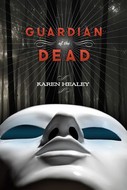
Guardian of the Dead

Healey, Karen. Guardian of the Dead. New York: Little, Brown and Company, 2010. Print.
[Book cover credit: librarything.com/work/8574661]

Awards:
ALA Best Fiction for Young Adults (2011)
William C. Morris YA Debut Finalist (2011)

Booktalk:
Ellie can't seem to get control of her life lately. She's let her best friend Kevin "convince" her to drink on school nights and even to let him sleep in her room. She's made a fool of herself in front of the guy of her dreams, Mark (did she somehow mistake her secret fantasy that he actually wanted to interact with her for real life?). She's even starting to get along with Iris, Kevin's other best friend. And, as if that wasn't bad enough, she has a nagging feeling that the Eyelasher killings that have been terrorizing the North Island have something to do with her. This feeling goes way beyond the connection that everyone who's lived on the North Island feels to the murders, and that feeling might have something to do with Mark. Unless that's just her fantasy life invading reality again.

Review:
There is a lot to love about Guardian of the Dead. Here's the shortlist:
  • a smart, kind of nerdy heroine
  • the freedom/restrictions of boarding school
  • use and explanation of Maori myth (by a white author who has the balls to point out in the text the colonial nature, possible inaccuracies, and just plain wrongness of Maori myth written down by white people)
  • high school use of a university library, because serious shizz calls for serious research
  • patupaiarehe (fairy-type creatures), one of whom is Titiana in Iris's production of A Midsummer Night's Dream -- because I'm not the only one who likes art to imitate life
  • casual treatment of varying sexualities*
  • a hottie who is half-Maori, half-...well, something else
and I could go on. But do you want to know what I loved the absolute most about this book? The ending. I won't go into detail (or talk about the "action" ending) because I don't want to ruin it for you (cause oh-my-gosh is it cool), but I can still tell you why I love this ending.

Things go crazy, Ellie falls in lurv which may become love in the future, and Ellie and love-interest have to save the world. It's life-changing, obviously, but Ellie doesn't let it derail her life completely. She doesn't possibly blow off her art school application or get married right out of high school or ditch her best friend in the face of tru lurv and harsh circumstances or even, and this is the big one, drop out of school in order to save the world which apparently cuts off the possibility of being a brilliant academic and instead becomes a mostly silent side-character.**

Instead, Ellie keeps going, gets excited about going to college and majoring in Classics, and tells love-interest that she'll visit him when she's on break. She simply takes all that she's learned from these life-changing events with her, because that's what smart girls do.

So, if you want to read an urban fantasy (a little light on the urban grit) or paranormal romance (a little light on the romance) that's headed by a smart girl, this is your book. It's also your book if you want to read the Maori Percy Jackson equivalent, a good boarding school romp, a murder mystery, a different kind of fairy book...


Book source: Philly Free Library


*How often do you see YA books with a teen character who is asexual? Not often. I'm not going to lie and say it's not a big deal at any point, but it is not THE big deal. And it is not a problem ever, except to the people crushing on the character. :)

**Was this anyone else's take-away message from Hermione's whole 1 or 2 lines in that horrible epilogue?!? I know Ginnie's important and everything, especially cause she's the mother of Harry's children, but why does she get all the speaking parts? Since when does Hermione let everyone around her do all the talking?

Links to Amazon.com may be affiliate links for the Amazon Associates program. If you buy something through this link, I may receive a referral fee.

Wednesday, April 13, 2011

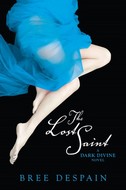
The Lost Saint

Depain, Bree. The Lost Saint. New York: Egmont USA, 2011. Print. A Dark Divine Novel 2.
[Book cover credit: librarything.com/work/9903924]

Not only will this not make much sense if you haven't read The Dark Divine, but it will spoil the crap out of the last chapter for you. You've been warned!

Booktalk:
     "Oh. My. Gosh." April shouted so loud I slammed on the breaks, thinking we were about to hit a dog or something. But April bounced in her seat with the craziest smile on her face, like she'd just thought of the best idea since nail polish. "...I have to ask: if you're gonna be a superhero, can I be your sidekick?"
p.111
Now that Grace is the one with superhuman abilities, Daniel is trying (mostly in vain) to get her to keep her powers and emotions in check so that the wolf doesn't take control. But calm and controlled is not what Grace wants. She wants to be out fighting the evils of the world, rescuing damsels in distress, thwarting demons and saving Jude. And if she has to embrace the power the wolf gives her in order to do that, she will. The fact that the hot new guy in town is willing to train her in ways that Daniel is not has nothing to do with it. Right?

Review:
I'm going to start out by saying that, while I loved the first book, I was not DYING to read The Lost Saint. I was interested, looking forward to it, and knew I would love it, but the first book did not leave me with that unquenchable need (as a result of a too-late-in-the-story twist or cliff-hanger) to pick up the next book in the series. I knew that nothing horrible would happen to Grace, Daniel, or even Jude before I met them again.

Well, I'm clawing my eyes out now waiting for the still untitled third book in the series. I tore through the last chapter and was half a paragraph into the acknowledgements before it hit me: I have to wait until December to find out what happens next. Oh, the agony!

Where The Dark Divine had mystery and the unknown (and one of my favorite romances in the paranormal genre) to move it forward, this has an overall feeling of doom and dread to push the story along (and a rift in my favorite romance). Despain does not fall into the paranormal trap of making either Grace (the girl) or Daniel (the love interest of the paranormal) helpless or unable to read the hints right in front of them, but there were still plenty of moments where I just knew that Grace was Going the Wrong Way, and just like while watching a horror movie, I could do nothing but yell at her through the pages and watch her go. Her little tiffs with Daniel that turned into petty I'm-not-speaking-to-you problems that turned into secrets kept were believable and painful. They also made her vulnerable, and that vulnerability made her trust people she shouldn't have. And that, of course, gets everyone in trouble.

The upside to all of this is the return of April. And, well, she's just awesome. From her superhero aspirations to her wink-wink-nudge-nudge secret keeping to her inability to not see the upside of everything Grace is going through, she made this book for me. This is what I absolutely love about Despain's writing and why I will keep reading anything she puts out. There is so much about these books and others like them that is serious and stressful (in a good way), but she so far she has managed to put in something to balance it, and it is not a serious and dramatic love story where no one smiles but instead gazes. In the first book, it was the happy flashbacks to Grace and Daniel's childhood together and the fluttery first love between them. In this book, it is April's excitability and the rekindling of Grace's friendship with her. These additions help to pace the story and help to create well-rounded characters (did I mention that April is designing Grace a superhero outfit as part of her art school application?). The world does not fall away in the face of the Despain's werewolves; they exist in it.

And I can't wait to see what they do next!!!


Book source: Philly Free Library


Links to Amazon.com may be affiliate links for the Amazon Associates program. If you buy something through this link, I may receive a referral fee.

Monday, April 11, 2011

Happy National Library Week!

Is your library doing anything exciting to celebrate?

My public library definitely is, and we're even hosting a few events here at work (which hopefully won't be thwarted by pre-Easter, end of the year assignments).

Even if your library isn't having or is unable to have any special NLW programming this week, there are other ways to celebrate such as by writing a twaiku or by sharing the YA love with complete strangers (I know that many of you do this a lot of the time anyway, but click through for the readergirlz annual Teen Book Drop info and bookplate).

However you choose to celebrate, this is a great week to do something bookish!

Links to Amazon.com may be affiliate links for the Amazon Associates program. If you buy something through this link, I may receive a referral fee.

Monday, April 4, 2011

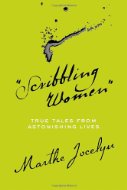
Scribbling Women - for Nonfiction Monday


This week's Nonfiction Monday round-up will be at L.L.Owens!


Jocelyn, Marthe. "Scribbling Women": True Tales from Astonishing Lives. Toronto: Tundra Books, 2011. Print.
[Book cover credit: librarything.com/work/10940696]

Booktalk:
In this slim volume, Jocelyn looks at the writing of 11 women throughout history and around the world. Some of them were famous in their own times and have names that are still recognizable today. Some of them meant for their writing to be read by thousands, some meant for it to be read by only a few. They differ in nationality, economic status, opportunity and experience. What they do have in common is the need and the will to write down the incredible stories of their lives.

Review:
Starting with Sei Shonagon in Heian Japan and working her way chronologically to Doris Pilkington Garimara in modern day Australia,* Jocelyn manages to look at the writing of a wide variety of women. She admits in her introduction that she was limited to work written in or translated into English, which explains the predominance of North American and British women in these pages. Still, this is not a book filled with the polite letters of Victorian ladies.

Of the eleven women in these pages, five are women of color and five (not the same five) spend a better part of their lives as decidedly lower class. Their stories really do cover a broad spectrum of the female experience; no two are alike. Whether you are looking for action or introspection, gumption or the strong will to make do, there is woman represented here for you. Following closely on the heals of the rather offensive to our modern sensibilities writing of a barely pre-Victorian wife of a wealthy captain (Mary Hayden Russell), we are treated to the writing of a slave who remained hidden in her mother's attic for years (Harriet Ann Jacobs). Daisy Ashford, the eight year old author of the still in print The Young Visiters, is followed by Ada Blackjack, the sole survivor of an expedition to the Arctic. A surgeon during the Vietnam War (Dang Thuy Tram), an undercover reporter (Nellie Bly) and one of the first female felons to be shipped to Australia (Margaret Catchpole) are also represented here.

My only problem with this book was that I wanted to know more about each of the women. In some cases, there is just not that much more that is known. In others, I'm going to have to go looking for information about these women or others like them on my own. There is a bibliography in the back of the book, but it's arranged in alphabetical order (like bibliographies should be) rather than organized by subject or chapter, and it's pretty long. I would have much preferred short biblios at the end of each chapter even if it would have broken up the narrative a bit. Also, though this book has the subject heading of "biography," the information contained in Scribbling Women is based almost entirely on the writing of the women themselves. I love this, but it will make this book a hard sell for report writers as some common details are often not included (birth and death dates, however, are present). Still, this is an interesting book about an interesting mix of women that nonfiction readers and budding young writers will enjoy.


Scribbling Women came out last week!


Book source: Review copy provided by the publisher through LibraryThing's Early Reviewer program.


*Upon whose book (about the life of her mother) the movie Rabbit Proof Fence is based. This movie is heart-breaking and horrible at the same time that it is inspiring. I highly recommend it!

Links to Amazon.com may be affiliate links for the Amazon Associates program. If you buy something through this link, I may receive a referral fee.

Tuesday, March 29, 2011

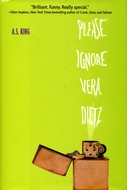
Please Ignore Vera Dietz

King, A.S. Please Ignore Vera Dietz. New York: Alfred A. Knopf, 2010. Print.
[Book cover credit: librarything.com/work/9822588]

Awards:
ALA Best Fiction for Young Adults (2011)
Edgar Award Nominee, Young Adult (2011)
Printz Honor (2011)

Booktalk:
Kid bullying you at school? Ignore him. Girl passing rumors? Ignore her. Eighth-grade teacher pinch your friend's ass? Ignore it. Sexist geometry teacher says girls shouldn't go to college because they will only ever pop out babies and get fat? Ignore him. Hear that a girl in your class is being abused by her stepfather and had to go to the clinic? Hear she's bringing her mother's pills to school and selling them to pay for it? Ignore. Ignore. Ignore. Mind your own business. Don't make waves. Fly under the radar.
p.43-4
And while you're busy taking that advice and ignoring everything else that's going wrong, Please Ignore Vera Dietz too.

Review:
Ever since her best friend Charlie died, Vera's had a hard time dealing with life. Wait, back up. Ever since Charlie ditched Vera for the detentionheads (and THEN died), Vera's had a hard time dealing with life. And her dad, the biggest proponent of the "just ignore it" philosophy, is slow to notice, or at least slow to show Vera that he's noticing. And somehow Vera is stuck living life as a full-time high school student/full-time pizza delivery technician.

Even describing the book is a little confusing and wrapped up in itself. But King pulls it off in a way that only she can, by allowing the pagoda on the hill (yes, a building), Vera's dad, and Vera's dead best friend to all weigh in, along with Vera herself, on Vera's life. Through their joint narration, we get a glimpse of the real Vera (and the real Charlie and the real Vera's Dad). They're all flawed. There are no knights (or supernatural beings of your choice) in shining armor here. They're all just trying to make it through. Even Charlie, who is doing so from beyond the grave.

Though this is part mystery (we know Charlie's dead, but we don't know how or why), part "issue" book (Vera drinks a lot, much to the concern of her recovering alcoholic dad), part dangerous relationship (1-Vera's crush is in his twenties. 2-the flashbacks contain a guy who wants to take grade school Vera and Charlie's pictures. 3-Vera is herself the product of a young high school romance gone wrong), it is mostly a darkly funny book about grief. Everyone, except maybe the pagoda, is grieving someone. It's the way that they each deal with their grief, Vera and Charlie over the loss of each other and their friendship, Vera and her dad over the abandonment by Vera's mom, that makes this such a compelling book. There is plenty of the weird, the funny, the snarkiness, and the romance to keep the book fun, but it is the way that Vera et. al. deal with the more serious aspects that made me care about them.

It sounds all over the place, and I wish I could write a more coherent/convincing review. You'll just have to trust me that Please Ignore Vera Dietz is one that you really should pick up. Either that or check out the multitude of positive reviews already out there. We can't all be wrong.


Book source: Philly Free Library (Though I've finally convinced my director that as an academic library that (1) religiously collects Newberry and Caldecott winners/honors and (2) is serving a school with a Master of Education program that has a high school English track, we should also collect Printz winners/honors, so we have a copy at work too!)

Links to Amazon.com may be affiliate links for the Amazon Associates program. If you buy something through this link, I may receive a referral fee.

Friday, March 18, 2011

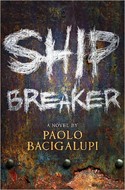
Ship Breaker

Bacigalupi, Paolo. Ship Breaker: A Novel. New York: Little, Brown and Company, 2010. Print.
[Book cover credit: librarything.com/work/9160869]

Awards:
Andre Norton Award Finalist (2010)
National Book Award Finalist, Young People's Literature (2010)
ALA Best Fiction for Young Adults (2011)
Printz Award (2011)

Booktalk:
While scavenging in an old ocean tanker, Nailer falls into a vat of oil, still black gold in his world years upon years ahead of ours. In order to survive, he has to watch all of that oil wash into the ocean. Still, he's lucky to be alive. He thinks his luck is going to give him a second chance when he and Pima find a clipper washed up on shore after a city wrecker of a storm. It's full of silver, gold, and other valuables in addition to regular old copper and steel scavenge. It's their own lucky strike. Until the dead swank in one of the clipper's cabins blinks.

Review:
The world in which Nailer lives and works is brutal. He and his friend Pima are on light crew which means they pick light scavenge from old ships, primarily pulling copper wire from small utility ducts. This is opposed to heavy crew, where Pima's mother works pulling steel and other valuable metals from the same ships. These are the only good options in life. The only others are to become professional fighters who moonlight as security (like Nailer's dad), sell of body parts and/or fluids, or become some version of a prostitute. Basically, even though Nailer is doing dangerous and backbreaking work that almost gets him killed, he was lucky even before he survived his dip in the oil. He's also 15. Nailer's background and, really, his entire society make his decision to help Nita (the swank) more amazing. And it's that decision, so contrary to the way he's been taught to survive, that create an adventure story in the middle of a dystopian world.

I think one of the most amazing things about Ship Breaker, for me at least, is they way Bacigalupi accomplishes his world-building. This is a seriously complex world full of swanks, ship breakers, beach rats, half-men, and all the cultural implications these groups carry with them. Bacigalupi manages to explain all of this without ever sitting the reader down and explaining all of it, yet I was amazingly un-lost throughout the story. The world he builds is still our world too. Nailer lives on the Gulf Coast and takes a train that carries him over the drowned city of New Orleans. We can recognize leftovers from our day and age. It's clear that some kind of environmental fall-out has occured (in addition to a severe lack of oil and a submerged New Orleans, traders can sail right over the Arctic Circle), but the details of how we got from here to there are never explained, leaving the reader to put 2 and 2 together. No heavy-handed environmental message required (or present).

Ship Breaker is, at times, a very bleak book portraying a society in which each person is practically required to step over someone else to survive. Getting ahead is a pipe dream. But, like many other dystopian novels, its points of light that make the story. This is the kind of book that can stress you out (in a good way) while reading, and it will be a hit with your dystopia fans. My library is also adding it to our Environmental Justice bibliography for next year's incoming freshmen.


There is talk of a sequel, The Drowned Cities, but it's not showing up yet on the publisher's website, only on GoodReads.


Book source: Philly Free Library


Links to Amazon.com may be affiliate links for the Amazon Associates program. If you buy something through this link, I may receive a referral fee.

Tuesday, March 15, 2011

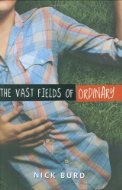
The Vast Fields of Ordinary

Burd, Nick. The Vast Fields of Ordinary. New York: Dial Books, 2009. Print.
[Book cover credit: librarything.com/work/7840771]

Awards:
ALA Rainbow List, Fiction (2010)
ALA Stonewall Award, Children's and Young Adult Literature (2010)
Lambda Literary Award Nominee, LGBT Children/Young Adult (2010)

Booktalk:
Dade has spent his senior year secretly coming out to inanimate objects and secretly sleeping with Pablo, who won't acknowledge their relationship in public on account of his girlfriend. So when Dade goes to a party at Jessica and Fessica's house in the hopes of seeing Pablo in public, he knows he's setting himself of for heartbreak. Instead of heartbreak, he gets Alex.

Review:
I checked out Vast Fields of Ordinary from the library when it won the (first ever) Stonewall Award for Children's and Young Adult Literature. I got about halfway through when I realized that this is a book I just had to own, so I returned it to the library and bought my own copy. Which promptly got lost in the TBR shuffle. Still, I'm not sorry I purchased this book even though it meant postponing the "real" reading of it for a year. It's just about everything I've been looking for in a contemporary YA fiction novel about a queer teen and I couldn't bear to not have a copy to mark-up, loan out, and make a home for on my bookcase.

This book is not all about the gayness, and I love it for that.*

The summer after senior year and before college is a summer of huge changes for a lot of people. For Dade, it means the end of an unequal and often emotionally abusive relationship. It's also the summer of finally having a best friend (Lucy!), drunken parties, extreme haircuts, and a hot new boyfriend who ::gasp:: holds his hand in public. He also becomes obsessed with a local girl who has gone missing and watches his parents' marriage continue to crumble. In short, this is an almost typical teen romance novel with a few Important Issues thrown in. But Dade's sexuality is not one of them.

Dade's crush and following romance with Alex is so sweet. It's not perfect, Alex is a drug dealer after all, but they make it work. The fact that Dade has someone to gush about this new relationship with in Lucy doesn't hurt either. He starts to fall in lurv in a way he never could with Pablo. He introduces Alex to his parents, fails to see the disasterous consequences of having the name "Dade" and becoming involved with someone who's last name is "Kincaid," and generally plans out the rest of their happy lives together. And those plans may or may not work out.

Just like any other YA romance. :)

Book source: I bought it at the always wonderful Giovanni's Room and then, as I mentioned earlier, got it signed!


*Looking through the LGBTQ books I've reviewed here, there are only one or two where the main character is queer and where one of the main conflicts of the story is not the character's sexuality. They're still great books, but there needs to be books where some of that has already been done and the character is just out living life. This book includes Dade coming out, but that's not nearly as important as his healthy relationship with Alex.

Links to Amazon.com may be affiliate links for the Amazon Associates program. If you buy something through this link, I may receive a referral fee.

Tuesday, March 8, 2011

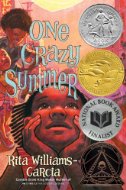
One Crazy Summer - for Tween Tuesday

Tween Tuesday was started over at Green Bean Teen Queen as away to highlight awesome books for the 9-12 yr olds or Tweens. This week's book is:


Williams-Garcia, Rita. One Crazy Summer. New York: Amistad - HarperCollins Publishers, 2010. Print.
[Book cover credit: librarything.com/work/9160752]

Awards:
National Book Award Finalist, Young People's Literature (2010)
Coretta Scott King Award, Author (2011)
Newberry Honor (2011)
Scott O'Dell Award for Historical Fiction (2011)

Booktalk:
     Mother is a statement of fact.
...
     Mommy gets up to give you a glass of water in the middle of the night. Mom invites your friends inside when it's raining. Mama burns your ears with the hot comb to make your hair look pretty for class picture day. Ma is sore and worn out from wringing your wet clothes and hanging them to dry; Ma need peace and quiet at the end of the day.
     We don't have one of those. We have a statement of fact.
p.14

It is not without a little trepidation that Delphine boards a plane with her little sisters to visit their mother in Oakland, California. When they get there, they're presented with a single room to share and told to walk themselves to get their own Chinese take-out for dinner. The end of their 28 day stay could not come soon enough.

Review:
This is a book that I want to tell you all about in quotes, because even in soundbites, it's so so good.

     My sisters and I had stayed up practically all night California dreaming about what seemed like the other side of the world. We saw ourselves riding wild waves on surfboards, picking oranges and apples off fruit trees, filling out autograph books with signatures from movie stars we'd see in soda shops. Even better, we saw ourselves going to Disneyland.
p.3
But they don't go to Disneyland just like they don't find a Mom or a Mommy in Oakland. They go to Black Panther Summer Camp. Delphine, Vonetta and Fern learn about the movement, about the Panthers themselves (who they've only seen in news stories), and about each other. Delphine, the only of the three who remembers her to begin with, also gets to learn about the mother that abandoned them.

But, as Liz B. points out, this isn't necessarily a book about the Black Panthers or the 60s or even finding a mother. This is mostly a sister book. There's Fern, the baby, who has carried around a (white) baby doll for as long as anyone can remember and is always ready to throw out a "surely" in support of her sisters. Vonetta constantly seeks attention like the middle child she is, and she's desperate to make friends with the most fashionable girls at camp, even at the expense of her sisters. Then there's Delphine. She promised her Pa she would take care of her older sisters, like she always has, and it's her job to keep them out of trouble (and keep them from killing each other). She's saved up money to pay the fines on the books she checked out from the library to read to her sisters each night before bed. She plans activities for the three of them to do in order to make the most of their trip to California (I looked forward to their field trip to San Francisco almost as much as Delphine did). She tries to stand in between her sisters and her mother; she remembers how crazy her mother can get. She's the leader.
     She gave another "Hmp" and a headshake. "We're trying to break yokes. You're trying to make one for yourself. If you knew what I know, seen what I've seen, you wouldn't be so quick to pull the plow."
     I sort of knew what she meant, but someone had to look out for Vonetta and Fern while we were here.
     I stacked the plates in the sink and ran the hot water.
     "It wouldn't kill you to be selfish, Delphine," she said, and moved me out of the way to wash her hands. Then she went back to praying over her puzzle pieces.
p.110
It's Delphine, Vonetta and Fern, their relationship and interactions, that drive the story. They help each other get through what looks like a horrible situation until it becomes kind of fun. Together they're the Gaither sisters. They finish each others sentences, each knows just how to get under the other two's skin, and though they take sides two against one all the time, they all always stand up for each other in the end.

Though the story is, clearly, centered around Delphine and her sisters, the "supporting cast" is fleshed out and important. There are tons of people at the People's Center while the girls are at camp, but their teacher Sister Mukumbu, who Delphine recognizes as a "real teacher" right away, lends the tiny bit of normalcy that Delphine needs to settle into the camp and Oakland. There's also a boy, Hirohito. Though it's no where near a major storyline, I loved the awkward crushing that went on all around him. And, of course, there is the girls' mother. As the story progresses, she becomes more of a real person than the dismissive, nervous woman who picked them up (late) from the airport. We also find out just how much Delphine remembers about her and how much she misses having a mother (even if she won't admit it). The relationship between Delphine and Cecile (their mother) is built on more understanding than either of them want to admit, and watching it unfold was one of the most moving parts of this story.

Overall, One Crazy Summer was a wonderful book and totally deserving of it's numerous awards! It has it all: history, humor, emotion, drama, and annoying but lovable little sisters!


Book source: Philly Free Library


Links to Amazon.com may be affiliate links for the Amazon Associates program. If you buy something through this link, I may receive a referral fee.

Sunday, March 6, 2011

Book Envy and the TBR hierarchy

Instruments of Darkness: A NovelI was at the library the other day to pick up some holds (more 2011 award winners!), and I got distracted by shiny things in Recent Fiction. The ones I was most attracted to? Under the Poppy and Instruments of Darkness. I was so tempted to check them out.

Thanks for sharing, you're thinking, or maybe even, why are you telling us about adult books you're pining for on your YA lit blog. Because, well, I already own both of these books.

But I don't get to read them yet.

Under the Poppy: a novelThere is a definite hierarchy in my TBR pile. ARCs are usually first, in order of publication date (Instruments of Darkness falls into this category), but YA ARCs have priority. After that is library books, in order of due date and factoring in the likelihood of being able to renew (example, Please Ignore Vera Dietz will get read before Guardian of the Dead even though the latter is due first because I know I won't be able to renew Vera - placing fake holds with the girlfriend's library card (and then removing them, I promise!) helps work out these distinctions). YA books, again, get priority over adult. Middle grade books are usually even higher up on the list, since I read less of them but I love Tween Tuesday.

Bright Young ThingsAfter all of these books with time lines attached, come the poor books that I've actually bought and paid for. The titles that I've snagged on sale or with coupons. Books I've picked up from library book sales. And even the wonderful books whose pub dates I've put in my calendar because I just HAD to HAVE them the day they came out (I'm looking at you Bright Young Things, Leviathan, Beautiful Creatures...).  

No wonder I tend to fail at the "read my own books" types of challenges. My books all sit collecting dust further down in my TBR pile while the books at the top rotate through based on the mail and my own (lack of) self-control at the library.

LeviathanOf course I want to check out books I own from the library. Then I'd be allowed to read them! Which is, of course, a load of crap. Why should the books that I shell out money for never be read? Why do I still spend hundreds of dollars a year on books that I don't allow myself to read? Because I've set myself up with a list of personal blogger obligations.

My blogger responsibilities have to do with both the kind of books I review (my adult TBR pile suffers even more than my YA TBR pile, if that's possible), and what or who is in them. I've started to let challenges dictate rather than guide my reading habits. I'm also distracted by the new and the shiny. Many of the books I own are so last year...or even older. But I still want to read them.

Beautiful CreaturesAll this to say that I'm going to try to pull from my own shelves and piles rather than placing holds at the library on or even rushing out to buy the hot new thing. I'm also going to give myself permission to read a bit more adult literature, even if it means I won't always have something to review here (it also means I'll probably be reviewing more crossover titles). Hopefully I'll be able to shed some light on a few titles that you've forgotten about or missed in the last few years. 


How about you? I know I'm a bit OCD about it, but I hope I'm not alone in creating a set of "rules" for the order in which I read books. Also, any books you're still dying to read languishing in your TBR pile?

Links to Amazon.com may be affiliate links for the Amazon Associates program. If you buy something through this link, I may receive a referral fee.

Tuesday, March 1, 2011

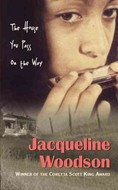
The House You Pass on the Way

Woodson, Jacqueline. The House You Pass on the Way. New York: Speak - Penguin Group (USA) Inc., 1997. Print.
[Book cover credit: librarything.com/work/248239]

Awards:
ALA Popular Paperbacks for Young Adults, GLBTQ (2006)
Lambda Literary Award, Children's and Young Adult (1997)

Booktalk:
Staggerlee has never had many friends. Her classmates think she's stuck-up, her ex-best friend ditched her when she found out about Staggerlee's famous grandparents, even her older brother, Charlie Horse, has left home and Staggerlee to go to college. Now, at least for the summer, she has Trout. Will she, too, leave Staggerlee behind? Staggerlee, who always stays in The House You Pass on the Way to somewhere else.

Review:
I'm always amazed by how quickly I get sucked in to Jacqueline Woodson's books. The House You Pass on the Way is barley over 100 pages, and yet it is full of growth, a well-rounded cast of characters, and so  much emotion. It even covers enough time to be both a little bluesy and a little hopeful at the same time. It's the perfect book for a rainy afternoon.

Staggerlee is kind of a loner, and, for the most part, she likes it that way. It gives her space to think and to play her music. In a town that is mostly Black, her mother is white. The statue in the center of town is of her grandparents, and it marks Staggerlee and the rest of her family as "special," something her classmates see as "better than." Also, we find out early on, Staggerlee was in love (in a sixth grade kind of way) with her ex-best friend Hazel. She has no words to describe the feeling she had for Hazel, but she knows she should keep them a secret. She feels different and out of place in her small town.
She looked so different from everyone. Her clothes, the thick-soled hiking boots, her hair. And she felt different too--off-step somehow, on the outside. What did it sound like, Staggerlee wondered, having someone call your name across a crowded school yard? How did it feel to turn to the sound of your name, to see some smiling face or waving hand and know it was for you and you alone?
p.43
And this is where Staggerlee's cousin Trout comes in. They understand each other in more ways than they could have predicted at the beginning of their summer together. They spend that crazy, transformative summer between middle school and high school together, and they each gain from the other the strength to figure out who they really may be.

Though the circumstances may not be universal, Staggerlee's feeling of being on the outside is something just about everyone has experienced at one time or another, and her friendship with Trout, the way it helps Staggerlee to define herself and the vulnerability that creates, is beautifully rendered in the text. Even though The House You Pass on the Way can be read as an overall sad book, the melancholy is never overwhelming. And the writing, oh the writing, is so lyrical, emotional, and just plain gorgeous.


I can't remember who suggested this book on the yalsa-bk listserv. I also can't remember if it what suggested to someone looking for books about African American teens in non-urban settings or someone looking for LGBTQ titles. The House You Pass on the Way would fit nicely on either list (yay!).


Book source: Philly Free Library


Links to Amazon.com may be affiliate links for the Amazon Associates program. If you buy something through this link, I may receive a referral fee.