Friday, July 16, 2010

Nothing Pink

Hardy, Mark. Nothing Pink. Asheville, N.C.: Front Street - Boyds Mills Press, Inc., 2008. Print.
[Book cover credit: librarything.com/work/5968322]

Awards:
ALA Rainbow List, Young Adult Fiction (2009)

Booktalk:
Vincent has been praying, for as long as he can remember, to have the burden of homosexuality lifted from him. Every time his father leads an altar call, Vincent goes to the front of the congregation to be prayed over and have hands laid on him. It hasn't worked yet, but Vincent is not giving up. He knows God hasn't abandoned him; he can feel His presence. Vincent just needs to be patient and avoid temptation. Then Vincent meets Robert, at his father's new church of all places, and everything changes. As Vincent gives up praying for deliverance and spends more and more time with Robert and the two become more and more involved, Vincent still feels God in his life. Maybe all of these years he's been praying for the wrong thing.

Review: (kind of spoilery, but the ending is mostly what you hope it will be anyway)
Nothing Pink is a pretty straight forward coming out story. That said, it's a very well done coming out story. Vincent does a lot of struggling within himself, with the help of his strict Baptist upbringing, about his sexuality. He does everything he can to try to change himself including making out with girls, avoiding TV shows featuring guys in tight pants, and a whole lot of praying. But this is not the focus of the book. This all happens before the book starts, though it is alluded to throughout the beginning. The book actually starts on the day things start to get better, the day Vincent meets Robert. Even though Vincent still has doubts about the morality of his relationship with Robert and has to hide the extent of their relationship from his parents, this is mostly a happy book about Vincent's first love and eventual acceptance of himself.

A lot of Vincent's happiness with himself hinges on religion, or rather, God. His relationship with God factors largely into Vincent's life and the story. Vincent is moved by his father's sermons, hymns, and prayer. He acutely feels God's presence in his life. He is a devout and upstanding Christian, except for his sexuality. That's why he's so confused and hurt by God's lack of response to his prayers to be straight. As he becomes more comfortable with Robert and his relationship with him, he becomes more convinced that God is okay with it too. It's great. His parents, however, do not agree. When they figure out what's going on, they give him a talking-to that centers around this oft heard sentiment:
"We love you, Vincent...But God hates the sin of homosexuality, so we must hate it too, son."
p.99
To their credit, they never say that God hates Vincent, and they stress that they love him unconditionally, though Vincent doubts that their version of "unconditional" should count when they hate something that is so much a part of him. I did get the feeling that the mom, at least, would come around at some point after the end of the book.

During the talk with his parents and later when he is at church camp, Vincent does a lot of defending himself. In his own head. I love that he didn't have to stand up and be out and and proud right away or a spokesperson/defender of all people queer in his Baptist community. Sometimes that's all you can do, and it's great that Hardy provides this positive role model of someone who can only hold it together for himself but is still not weak. Outwardly, Vincent simply stops asking God to make him straight. Internally, he does a lot of building himself up, and that involves a lot of "God-talk." The religious over tones and general message of God loves the gays becomes a bit redundant and heavy-handed toward the end. This is definitely not a book for readers uncomfortable with Christianity. I appreciated the message, but it did kind of take over the book in a couple of places and pull me out of Vincent's story. But given how heavy-handed much of the anti-gay, religious literature can be, I had to forgive this repeated positive religious message.

Also, and this surprised me a bit, the book is set in the 70s. It's not overly obvious and so led to some confusing moments for me, such as when Vincent lists the TV shows he avoids and its clear that I should have recognized the titles. Other than that, only the feathered hair and continual Barry Manilow references tipped me off (and the title verso, which is where I got the actual decade of the setting from). And I do mean continual, with the Barry Manilow. You'll be singing Copa Cabana for days after reading this one.


Book source: Philly Free Library

Monday, July 12, 2010

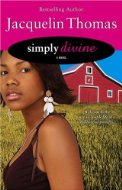
Simply Divine

Thomas, Jacquelin. Simply Divine: A Novel. New York: Pocket Books - Simon & Schuster, Inc., 2006. Print.
[Book cover credit: librarything.com/work/1828734]

Booktalk:
Divine is living the good life. Her mother is up for more than a few Grammy Awards; Jerome (her dad) is a little bit of a has-been, but people still recognize him from all of his action movies; and Divine herself is 15, popular, beautiful, and famous by association. Her biggest concerns are what to wear to events and whether she'll be allowed to attend the after parties. But living with that kind of fame and privilege has its drawbacks, such as everyone at school knowing, almost before Divine hears about it herself, that her father has been arrested for murder. As Divine's mother deals with this and a whole host of her own issues as well, she sends Divine away. Her mom says it's what's best for Divine, but how could moving, even temporarily, to a teeny town in Georgia to live with a preacher uncle and his family that she's never met be what's best? No malls, no friends, no Mom. Divine knows she's being punished, but for what? Her parents are the ones who were caught doing wrong.

Review:
Divine starts out as such a spoiled brat! All of the finery and ease that (her mother's) money has bought is simply owed to her. She can't imagine life without a personal assistant, bodyguard, and chef, mostly because she's never had to but also because she deserves to have people do for her. Not that she's actually done anything to earn the money that pays those people or done anything to justify the fame she enjoys. Her mom has. It made me hate her a little in the beginning. She's just so entitled and that bugs me. Luckily, for me at least, once Divine gets to Georgia her cousin Alyssa has absolutely no problem calling Divine out for her snobbery, general bitchiness, and trading in on her mother's name. And good for her! Alyssa, that is. She does her best to make Divine comfortable, the whole family does, but Divine is determined to be miserable in Georgia and drag everyone else down with her. Eventually, though, she starts to settle into life with her aunt, uncle, and cousins and generally becomes a much more likable person and character. And, really, she wasn't sooo bad in the beginning that I couldn't get into the book, and it was pretty obvious (in the way teenagers can be, not in a bad writing way) that a lot of her snobbery was to cover up insecurities about herself. But she still drove me a little bit nuts before she started chilling out.

One of the many things Divine has to get used to at her aunt and uncle's house is going to church. Though her daddy was also a preacher, Divine's mom does not have anything to do with the church now. Divine never has; that's just not the way she was raised. Her Uncle Reed's family attends the church he preaches in every Sunday. At first, waking up early on Sunday and sitting through a sermon causes problems for Divine; the girl is really not a morning person. As she starts to listen more often to what Uncle Reed is preaching, her problems change to focus on the act of forgiveness. How can she possibly forgive her father for what he's done to her and her mother? And why should she have to? Divine's internal struggle with forgiveness and her feelings about her father in general continue throughout the book. Her resentment about going to church does not, and she eventually becomes a Christian.

Religion is never forced on her by her family, nor is it really central to most of the book. However it is often present, particularly in the way that Uncle Reed and Aunt Phoebe raise and treat their children, including Divine. Especially with regards to Divine and Alyssa and boys. Both girls have boyfriends, but they are little more than names on a page. Given how little time they're allowed to spend with their boyfriends, this is not surprising. I expect that they, and the girls' relationships with them, will play a bigger role in the next book in the series, Divine Confidential, as the girls finally become old enough to be allowed to actually date.

But I have no doubt that the second book will be just as clean as this one. Even though it is a book with an extra-marital affair, drugs, sneaking around to meet up with boys, and even a murder, it definitely qualifies as a "clean read." I don't even remember any swearing. Yet it still manages to feel a bit edgy, probably because Divine's parents are kind of screw ups. With the help of her uncle, aunt, cousins, and God, Divine manages to move beyond her parents mistakes to star in a series that promises to be uplifting and cute while still tackling serious issues.


Book source: Philly Free Library
Thanks to MissAttitude at Reading in Color for the recommendation!


Simply Divine is only the first book in The Divine Series. The rest, so far, are as follows:
Book 2: Divine Confidential
Book 3: Divine Secrets
Book 4: Divine Match-Up
and the companion book: It's a Curl Thing, a Divine & Friends book

Thursday, July 8, 2010

Once Was Lost

Zarr, Sara. Once Was Lost. New York: Little, Brown, and Company, 2009. Print.
[Book cover credit: librarything.com/work/8305112]

Awards:
ALA Best Books for Young Adults (2010)

Booktalk:
  • Jody Shaw: Missing, presumed kidnapped. Focus of a community-wide search
  • Mom: Also missing, but in a different way. In rehab. Focus of no search but her own. And maybe mine.
  • Nick, Jody's big brother: Sweet, worried, disturbingly attractive, and suspect in his sister's kidnapping.
  • Dad, AKA Pastor Charlie: Comforting the Shaws. Comforting the community. Forgetting about Mom. Practically ignoring me.
  • Erin, youth group leader: Helping head up the search for Jody. Really wants to "be my friend" and spend time with Dad.
  • Vanessa, my BFF: Getting a little fed up with my mood and my secrets.
  • Me, Sam: Lost--not missing--in my family, in my town, in my faith. No one's looking for me, not even God.
Review:
Poor Sam. She needed a hug throughout almost this entire book, and not the one-armed youth leader kind. She sufferes from knowing a lot of people but being close to very few. She's also dealing with the absence of her mother, and her mother's long-time alcohol abuse, all alone. Her dad doesn't want to talk about the situation, or at least he doesn't want to talk about it with Sam, and Sam can't talk to anyone else about it either, not even her best friend Vanessa, without hurting her father's reputation. They just keep telling people her mom is "sick" and not letting anyone in the house. Luckily for Pastor Charlie's image, no one wants to come over anyway since it's August and their air conditioner is broken. When Jody is kidnapped, Sam is clearly upset (she's mad at life, not heartless), but it does give her something besides her mother and crumbling family to focus all of her energy/super-power-strength-worrying-skills on.

It's when the youth group is all gathered praying for Jody's safe return that Sam realizes that she doesn't know anymore if anyone's listening. How could a just and loving God let Jody be kidnapped? How could He let Sam flounder through her life feeling so abandoned and alone? Sam struggles through this by herself as well. A daughter who may have lost her faith could be more damaging to Pastor Charlie's reputation than a wife in rehab. But Sam's doubt isn't a rejection of God. She desperately wants to feel the closeness and comfort that her youth group friends feel, especially when she has such a lack of both in her day-to-day life. She just can't muster it, and so she feels isolated and wrong. Though Sam's situation would undoubtably be helped by talking to her church friends or youth leader, the fact that she doesn't feel she can go to them is ultimately realistic. Even if she had sought guidance, this is something so personal that she has to deal with it alone.

And she does, with the search for Jody, a budding relationship with Nick, fights with Vanessa, and unreturned voicemails left for her mother all buzzing in the background.

Though it is a heavy read, I highly recommend Once Was Lost, especially for regular youth group attendees.


Book source: Philly Free Library

Monday, July 5, 2010

The Dark Divine

Despain, Bree. The Dark Divine. New York: Egmont USA, 2010. Print. Dark Divine 1.
[Book cover credit: librarything.com/work/8363496]

Booktalk:
This is the epitome of the girl with a big brother experience: your best friend has a crush on your brother, you have a crush on your brother's best friend, and your brother and his bestie have no idea that you or your bestie exist. At least not in that way. Grace's situation is slightly more complicated. Her best friend, April, has a crush on her brother, Jude. Jude, not having a mean bone in his body, knows April exists and makes sure she and Grace get to hang out with him and the other seniors at least some of the time. Other than that, Grace is left completely out of the equation. Then Daniel comes back. Daniel, Jude's ex-best friend. Daniel, the guy Grace has been in love with since she was a little kid. Daniel, the only guy Jude wants no where near his little sister. The only person Jude can't forgive. The only person Jude has ever called a monster.

Review:
I was skeptical about The Dark Divine at first glance. It is a story featuring Grace Divine and her siblings Jude, Charity and James, Pastor's kids all. It seemed like a bit of overkill. And it's a paranormal romance. And when it first came out it inspired nail polish giveaways all over the blogosphere. But it's not cheesy, and it's not overkill. For a book about PKs there is surprisingly little to no religious overtone. Don't get me wrong, religion, the physical location of the church, and Christian mythology are all very important to the story. I really want to tell you why, but the best part about reading this story, for me, was not knowing anything about it, really, in advance. Just trust that Despain does not throw a ton of stuff at you without context. Everything that needs to be explained is, without an obtrusive info dump in sight.

On the surface, Grace is trying to figure out the cause of, and therefore mend, the riff between Daniel and Jude. Whatever happened between them caused Daniel to disappear for years and caused the whole Divine family to pretend he never existed. When he suddenly returns, Grace is drawn to him, and not in the magical "We have a future destiny/past connection with each other" kind of way, but in the "We grew up together and I've had a crush on your since time immemorial and now you're back and broody and angsty and muscle-y" kind of way. I love this about their relationship. The scenes that we've all come to know and love (maybe) in paranormal romances are there. Daniel and Grace have plenty of tense conversations where he tries to convince her that he is too dangerous for her, but these scenes are tempered with flashbacks to their childhood together and the kind of flirty banter girls the world over share with their brothers' friends.

But for all their normalcy, Jude cannot stand Grace around Daniel, and Grace can't resist him. She promises Jude she won't have anything to do with him, and then invites him over for Thanksgiving dinner. The worst part is that if it wouldn't make them total corndogs, Grace's best friend wouldn't be April; her best friend would be Jude. They are so close and Grace knows that she's hurting him by talking to Daniel. Forget the fact that she's falling in love with him. And she doesn't want to hurt Jude. What Grace does not know is what this hurt is really doing to Jude and, in turn, to Daniel. This is where they real story is, and this is what I've probably already hinted at too much. The outcome will not be what you expect.


Book source: Philly Free Library

ETA: The sequel, The Lost Saint, will be released in December!

Thursday, July 1, 2010

Saving Maddie

Johnson, Varian. Saving Maddie. New York: Delacorte Press - Random House Children's Books, 2010. Print.
[Book cover credit: librarything.com/work/9092942]

Booktalk:
Joshua sits in the choir while his dad preaches behind the pulpit. Just another Sunday until all the other guys start whispering and looking at the congregation instead of Pastor Wynn. They're looking at a woman in a really low-cut dress, too revealing for church. They don't point her out to Joshua; he's the preacher's son and wouldn't be interested. But he is, of course, and when he finally looks, he sees her. Maddie. She was his best friend a million years ago, when they were both kids and her father was the Assistant Pastor. Before her father took a lead pastor position out of town making their lives jump to different tracks. Because while Joshua is "too good" to do anything fun with the guys because he's a preacher's kid, Maddie, also a PK, isn't.

Review:
My mom always said that there are two kinds of PKs: those who follow the rules, act as a good example, and reflect well on their father [or mother], and those who rebel and do everything in their power to distance themselves from the ministry and the church. It was always made clear to me that my mother was the first kind of PK when she was young. The PK who helped me dye my hair black my freshman year of high school, on the other hand... That is neither here nor there, but I bring it up because Saving Maddie is all about the relationship between two PKs, Joshua and Maddie, who embody my mom's types perfectly.

Joshua Wynn has grown up being an example for other kids: The Wynn Boy. He doesn't seem to mind too much, except that he had to give up on his school's basketball team to lead the youth group and that everyone his age thinks he's some kind of prude. But even these things don't dampen his spirits, and he works very hard to keep his reputation. He has to; he's "Joshua Wynn, the preacher's son. ... a shining example of what [is] good and righteous and wholesome in the world" (28). More like some kind of super-hero than a real person, don't you think? It's not until Maddie comes back into his life that Joshua starts to object to the perceptions that other people have of him and the pressure that he is under, from his parents and the community, to do and be good. And no, he never liked that he gets left out of things because he's such a goodie-two-shoes, that he's the guy other kids hide their beer from at parties, but until Maddie comes along, it's as though he didn't know he could be any different. She opens up a world for him where he is not an extension of his father and his father's work.

Now, I've never been a PK, but I was raised by one, and I was definitely a goodie-two-shoes in high school who had more friends at youth group than at school. I think that Johnson has absolutely nailed that experience, or at least mirrored mine. The feelings and internal conflicts that Joshua goes through felt so authentic. His struggle to reconcile what he wants to do with what he's supposed to do with what everyone else is doing was ongoing. The lectures from his parents ("I'm not mad, I'm disappointed." -- the worst!) and the advice from his friends to just go for it (the BIG it, no less), were so familiar. And then there's Maddie, who seems so much more grown-up, experienced, and figured out than Joshua. Of course he falls for her! There is definitely attraction involved, but Joshua also gets one of those I-want-to-be-you crushes on her.

Saving Maddie is told from Joshua's perspective, so we don't get to see the inner workings of Maddie's head. Through her talks with Joshua, however, she becomes a fully realized and complex character. Something that makes up a large part of Maddie, and everyone else's problem with her, is that she is no longer religious. BUT she still has her faith. This disconnect between faith and religion is something that a lot of teens struggle with, not just PKs. Without going into great detail or getting bogged down in theology, Johnson makes Maddie an example of what it can mean to believe in God without participating in a specific religious tradition. She still considers herself spiritual and a Christian, but she doesn't go to church. Joshua sees her spirituality acted out in her life, rather than her Sunday attendance. It's a less obvious way of teaching-by-example than the kind of life he has been living, and while he may not change to be non-religious like Maddie, he definitely learns from her. Seeing how she acts out her faith in what she does rather than what she doesn't do gives him more choices for how he can show his. And he finally does that by sticking up for Maddie.

Because when Mom and Dad and everyone else saw Madeline, all they saw was the girl with the bad attitude and sexy body who didn't care about her faith or her family or even herself. The girl who threatened to sway me from the path of the righteous.

But when I saw Madeline, I saw a girl who prayed before every meal. A girl whose eyes shone with sadness every time her father was mentioned. A girl who desperately needed someone to tell her she was good.
p.145
While there is clearly more to Maddie than her lack of religion rather than her lack of faith, this is what stuck with me while reading. I think it will resonate with many other readers as well.


I could go on and on about Saving Maddie; there are at least half a dozen more quotes left in my notes. Johnson has done something wonderful here. He's managed to capture the PK experience, and the growing-up-at-church experience, so well! And he's managed to do it in a way that, I think, will be attractive and relevant to readers who've grown up without these experiences as well.


Book source: Philly Free Library

Wednesday, June 30, 2010

Noah's Castle

Townsend, John Rowe. Noah's Castle. 1975. Seattle, Wash.: October Mist Publishing, 2010. Print.
[Book cover credit: Provided by publisher]

Awards:
A Horn Book Fanfare Best Book (1977)

Booktalk:
When a financial crisis makes it impossible for England to import food, the country begins to fall apart. When Barry's father starts hoarding food in the basement rather than helping those in need, those on fixed incomes such as the elderly and the infirm, the Mortimers begin to fall apart as well.

Review:
It took me a long time to get into this book. Barry's father is just so horrible, even before he starts hoarding, that I didn't think I could handle a book full of him. For example:
"You always used to be at work all day until we moved here," Mother pointed out.
"That was before the present crisis," said Father. "Now I have the shopping to do."
"It was you who insisted on doing it," Mother said. ... "I sometimes wonder what I'm for. Just cooking and cleaning, I suppose. I might as well be a servant."
"A servant would need wages," Father said -- unaware, I was sure, of any cruelty in the remark.
p.43
Except that he is aware. He spends the entire book making belittling comments about Barry's mother and older sister Nessie, mostly about their inferior, womanly minds. And, for the most part, they just took it. Nessie gets all riled up about it, but only in front of Barry. No one stands up to Father. It wasn't until Barry started to doubt his father that I started to get into Noah's Castle. Then Nessie started actively defying her father and it really started to get good.

Of course at the same time, problems much bigger than a horrifically controlling and sexist head of household are looming all around the Mortimers. As food goes beyond "scarce" right to "rare," people around them start to starve. Barry, Nessie and their mother have to deal with the guilt of knowing that they have plenty when so many other people are suffering and dying of want. Father, on the other hand, feels no guilt. Those people are ill-prepared and none of the Mortimers are allowed to share with them, not matter how hungry, elderly, young, or sick they are. This conflict is the core of the novel. As much as you want to help the needy around you, how do you give away all of your food, not knowing when you may get more, knowing that it means your sickly little sister may go hungry? It's an impossible question with no rights answer, and none is given in the book. But the rights and wrongs of everyone's actions are explored.

Of course, the wrongness of the sexism isn't explored to its fullest, but maybe that would be a bit too much to ask of a book originally published in 1975. Luckily, Nessie struggles against her father's beliefs and bullying and seems like she'll escape the Mortimer house unscathed.


Book source: Review copy provided by the publisher.

Tuesday, June 29, 2010

while watching new moon...

when bella runs into laurent in the meadow.


the girlfriend: so, are vampires like penguins in that they mate for life and then when their mate dies they get another mate? or are they like soul mates, like romeo and juliet?

me: um...what?

the girlfriend: you know, how penguins are monogamous and stuff, but when their mate dies they get a new one? or are they like romeo and juliet?

me: like romeo and juliet, i guess.

the girlfriend: so in this mythology they're like soul mates, but in normal, not-stephenie-meyer mythology vampires are slut-fests, right?

me: right.

the girlfriend: i'm so confused. i don't need this woman adding more myth to the myth-pot.


amen, right? and she hasn't even read the books.

ALA Wrap-Up

...it's so good to be home where I can sit down!

I managed to get a last minute Exhibits Only pass and a spot on a bus down to DC with TCLC, a consortia to which my library belongs. So with no preparation at all, I flitted down to ALA for a couple of days!

The girlfriend convinced me to get a car (thank you PhillyCarShare, you make my life possible!) and drive down on Sunday, as the TCLC bus was only good for Monday. I'm so glad she did! I'm also eternally grateful that she came with me and acted as my PA, passing out my card to publishers, taking pictures, carrying stuff, and, most importantly, reading me the list of author signings on the drive down so we could have a plan of attack.

This allowed us to show up at the Random House Pavilion (seriously, "booth" does no begin to describe their set-up) in plenty of time to go swimfan on Libba Bray. Luckily she's into the crazy and played along:

Look at me. I'm totally in her personal space. Libba, if you somehow magically happen to read this, I'm sorry. BUT I LOVE YOU!

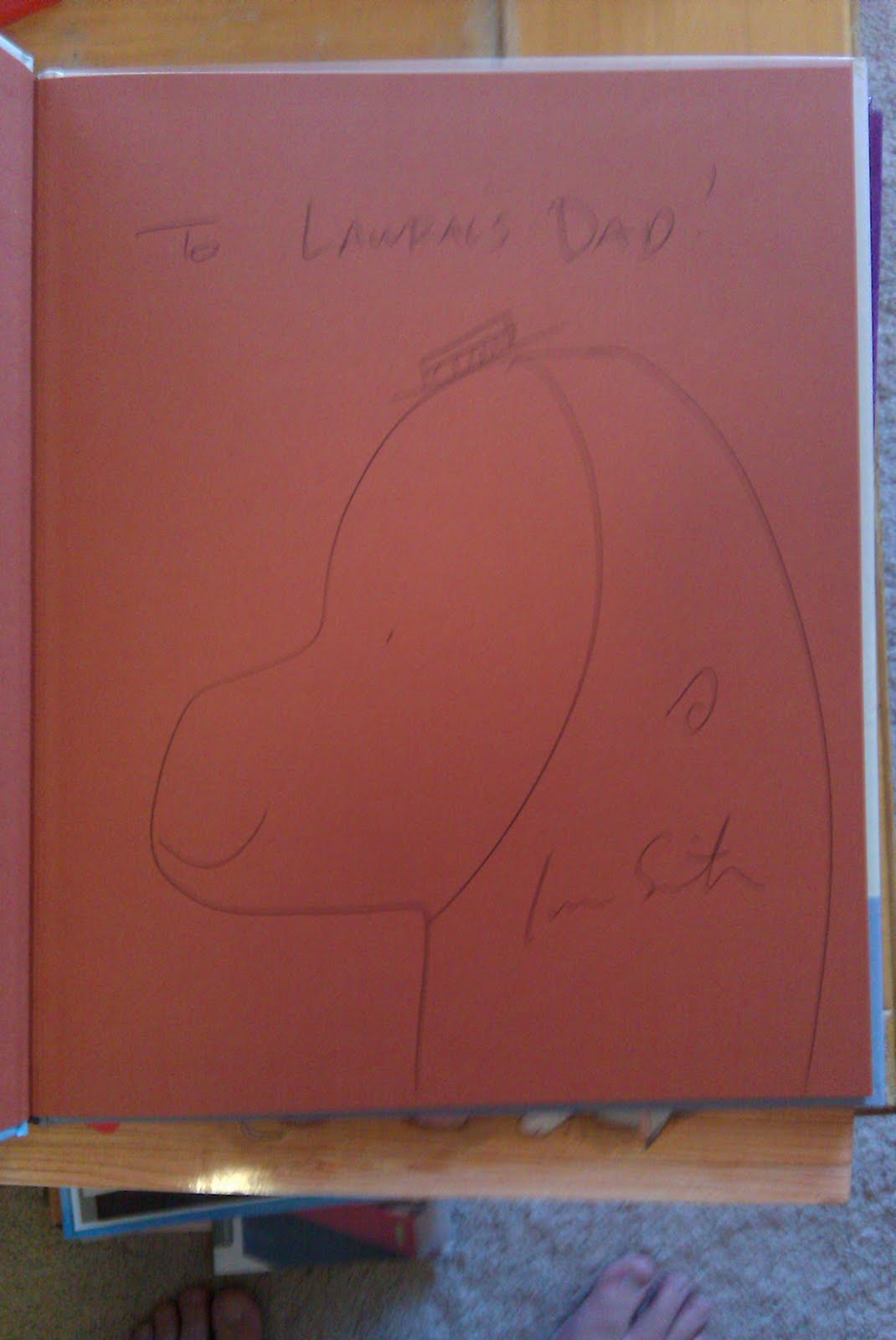
The rest of Sunday went by in a blur or schmoozing and carrying around heavy things, though I do remember needing to explain to Lane Smith why I needed to him to make a book out to "Lawral's Dad."


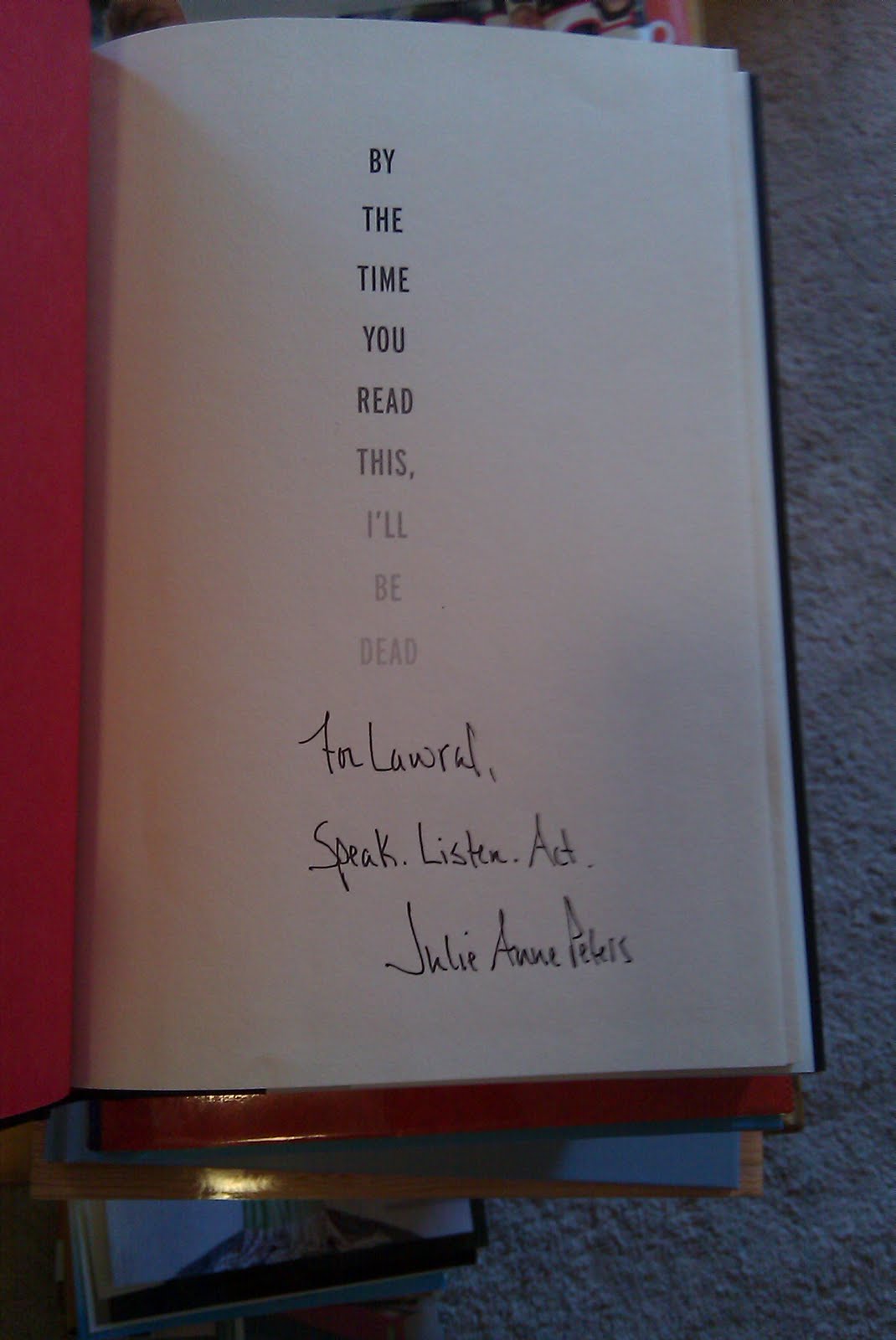
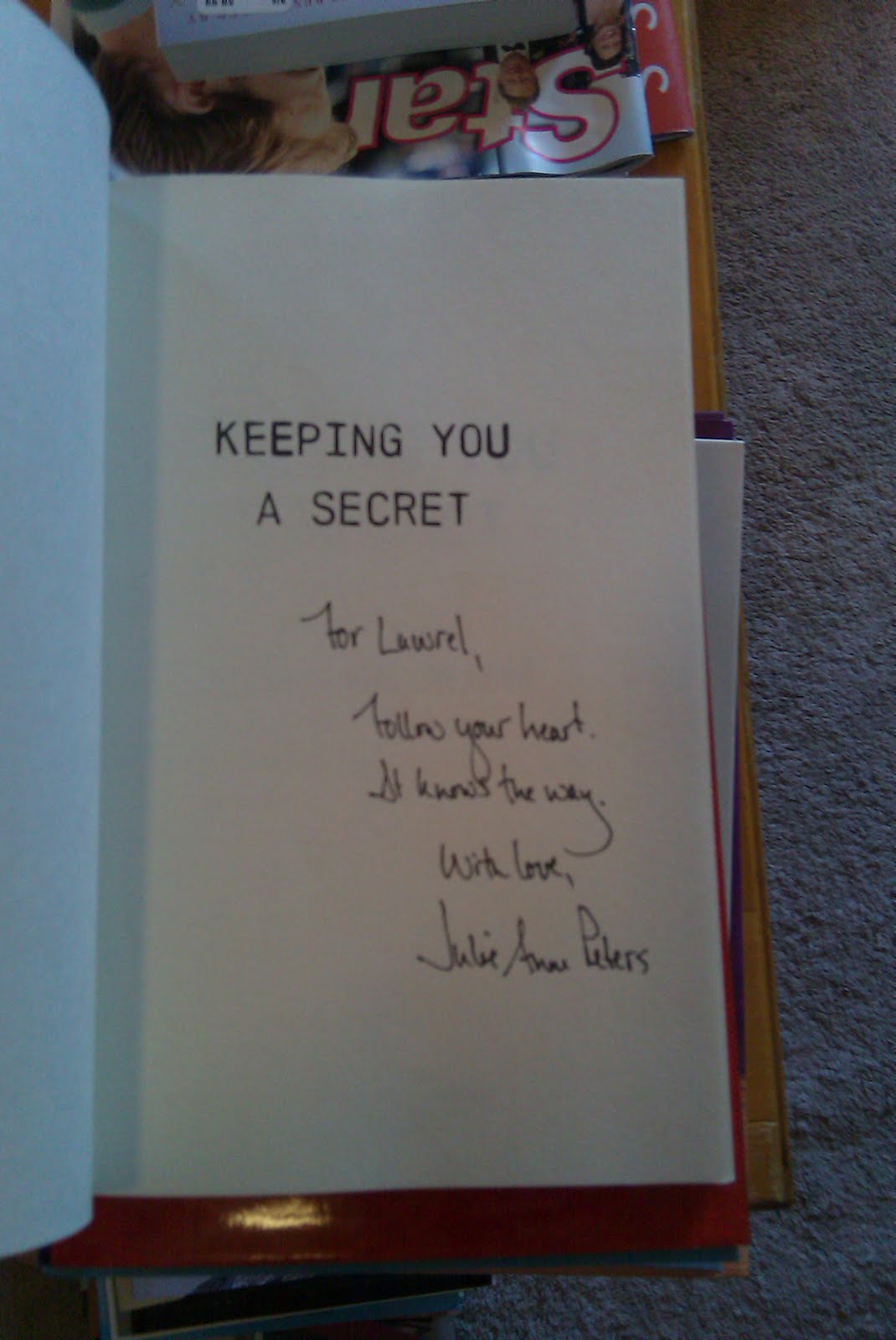
Monday I was a bit nicer on my wallet and, having read the author list in advance, brought books from home for people to sign. This is key, people. Because of my lack of preparation the first day, there are now multiple copies of Going Bovine and A Great and Terrible Beauty in my house.

Julie Anne Peters was awesome and sweet. She even laughed off my stalker joke when I showed up at two of her signings in one day.


And Nick Burd was also a doll. We chatted about queer bookstores and he "stole" the Giovanni's Room bookmark that fell out of my book.

All in all, I had a great conference! Hopefully next year I'll actually get to go for the whole weekend and/or to some sessions. :)

Thursday, June 24, 2010

Beautiful Malice

James, Rebecca. Beautiful Malice: A Novel. New York: Bantam Books - Random House, 2010. Print.
[Book cover credit: librarything.com/work/9367605]

Booktalk:
After the violent death of her little sister Rachel, popular Katie Boydell reinvents herself as quiet, keeps-to-herself Katherine Patterson. Moving in with her aunt and changing high school for her senior year complete the transformation.

Until Alice.

Alice is one of those girls who acts as her own center of gravity, always in the center of everything and dragging you in. Katherine can't resist her, and Alice pulls Katherine into Life again. It looks like everything could be alright in a post-Rachel world. But then Alice starts to devolve. And she's determined to take Katherine down with her.

Review:
I don't know that it's meant to be read this way, but Beautiful Malice was a great mystery. The entire story is told in flashbacks. Katherine, an adult with a young daughter, is looking back on her senior year of high school when she met and knew Alice. Eventually her teenage self is remembering and telling Alice about the events leading up to Rachel's death. In both scenarios, the reader should, on some level, know how the story ends: Katherine grows up and has a child; Rachel dies. And yet, I never felt impatient waiting for that end to come. In fact, there were plenty of points in the senior year storyline when I was sure that things could not possibly end the way adult Katherine seemed to imply that they would. Moreover, when the endings finally did come they were plenty twisted, making them surprising even if they really do amount to Katherine growing up and having a child and Rachel dying.

The bulk of the story is set during Katherine's senior year of high school, specifically when she is befriended by Alice. Katherine is Katherine, rather than Katie, because she is trying to move on in her life past Rachel's death, but it is still a big part of her. It takes a really long time for Katherine to open up to anyone, including the reader, about what happened to Rachel, and yet I wasn't annoyed by not knowing. From almost the beginning, I knew Katherine was dealing with some serious survivor guilt, but as her recollections of Rachel slowly unfolded, it became clear that her guilt went beyond just the guilt of still being alive. Katherine feels truly responsible for Rachel's death, and because her story of what really happened the night Rachel died is so drawn out, it looks like she just might be. She's dealing with all of this while she slowly gets sucked into Alice's world.

Alice, by the way, is the mayor of crazytown. She's fun-crazy in the beginning, always managing to have alcohol and a party to go to (and an awesome dress to wear to it, and one for you to borrow besides). She lives in an apartment of her own, paid for by her birth mother who feels guilty that Alice was adopted by hicks. She seems so grown-up and exotic to Katherine, who used to be a more suburban version of her. Alice drags Katherine back into the social scene she should have always inhabited, introduces her to new people and experiences, gains her complete trust and (for a while) adoration, and then goes crazy-crazy. When Katherine stops worshiping the ground Alice walks on and gets her own friends, Alice becomes possessive and stalker-y. It's pretty scary, and the lengths she goes to (and why) left me speechless.

I think Beautiful Malice will be devoured by readers looking for more thriller in their mysteries, but be warned that though Alice and Katherine are teenagers for most of the story, they have very few "typical" teen experiences. They're never in school, they hang out in bars, and they date grown men. I'm not saying that this book is inappropriate, because really, there's nothing graphic or too "adult" going on, but it's certainly not set in high school, even if the main characters are technically high schoolers.


Beautiful Malice will be available for purchase next month!


Book source: Review copy from the publisher through the LibraryThing Early Reviewers program.

Tuesday, June 22, 2010

Stolen - for Tween Tuesday

Tween Tuesday was started over at Green Bean Teen Queen as away to highlight awesome books for the 9-12 yr olds or Tweens. Any book highlighted on Tween Tuesday also counts for the In the Middle Reading Challenge! This week's book is:


Velde, Vivian Vande. Stolen. Marshall Cavendish, 2008. Print.
[Book cover credit: librarything.com/work/5839124]

Awards:
South Carolina Junior Book Award Nominee (2010-2011)

Booktalk:
The simplest way to begin is to start at the ending: The girl's name was Isabelle.

This is the simplest way because in the beginning she had no name -- she was a girl with no name running through a forest she didn't know, for a reason she couldn't remember. She didn't know if she was running away from something or to something or for the simple joy of running
p.10
When Isabelle is chased into a tree by a pack of dogs, she realizes she probably is running from something; she just has no idea what that something is. She's brought into the village and told that she's probably running from the old witch in the woods. A baby was just stolen by the witch, so maybe, just maybe, the witch released the girl she stole six years ago. Her name was Isabelle.
 
Review:
Let me start off by saying that this book is never as spooky as the cover would suggest. There may be an old witch, and there is certainly rampant speculation about said witch and what she might do out there all alone in the forest, but this book isn't about her. It's about Isabelle. Also, there is someone a lot more scary than a witch, but that person is scary in a much different way than what the cover advertises. This person inspires a slow build of scary rather than a jump out and grab you scary. I say this because I certainly wouldn't have picked this book up when I was in late elementary/early middle school (I was kind of a wimp), but I probably would have really loved the story inside.
 
The girl who might be Isabelle gets thrown into a lot of drama, right from the get-go. She's bitten by a hunting dog that is looking for a witch. When she begins to recover from that, she has to tell the family that took her in that she remembers nothing about her own life. Just when she starts to come to terms with that, the folks who might be her family come to claim her. The newly stolen baby was their daughter as well. Their joy at having Isabelle back is tempered by worry about the baby. There is so much pain in this family; Isabelle wants to be their missing daughter, if only to allow them to avoid the pain of losing a daughter all over again. Then Isabelle meets Honey, possibly her older sister, and she can tell that whether Isabelle is the "real" Isabelle or not, Honey wants her family to have nothing to do with her.

Isabelle has some memory; she knows how to spin wool and she knows she was never a princess, for example. She can still navigate the world she's found herself in, even if she has no idea what her place is in it. Maybe because, at least in her head, she has no history with the people around her, she sees things about them that the rest of the village may not. She feels sorry for the mother and father (hers?) who have love two daughters to the witch, but she can see, where others do not, that this desperation to have Isabelle back isn't just the grasping hope of grieving parents. She can see that the rich aunt after whom Isabelle was named is lonely and desperate to have her namesake back. She sees that Honey isn't just suspicious of her, never believing her to be the true Isabelle, but that she doesn't believe that the "real" Isabelle is capable of coming back at all. And she sees that Avis, the woman who initially took her in, doesn't trust the lot of them. These insights don't always seem to help Isabelle figure things out as quickly as she should, but they are more interesting than simple, wide-eyed wonder at that is new around her.

There's a lot of intrigue in this little village that Isabelle must decipher if she's going to figure out who she really is. When it does finally come back to her, it all comes back in a rush (I mean for her. The writing isn't rushed). The ending is unbelievably clever. I had to rush back and reread the prologue to make sure it all fits together, because it is certainly not what I was expecting. It's awesome; I highly recommend it.


Book source: Philly Free Library